
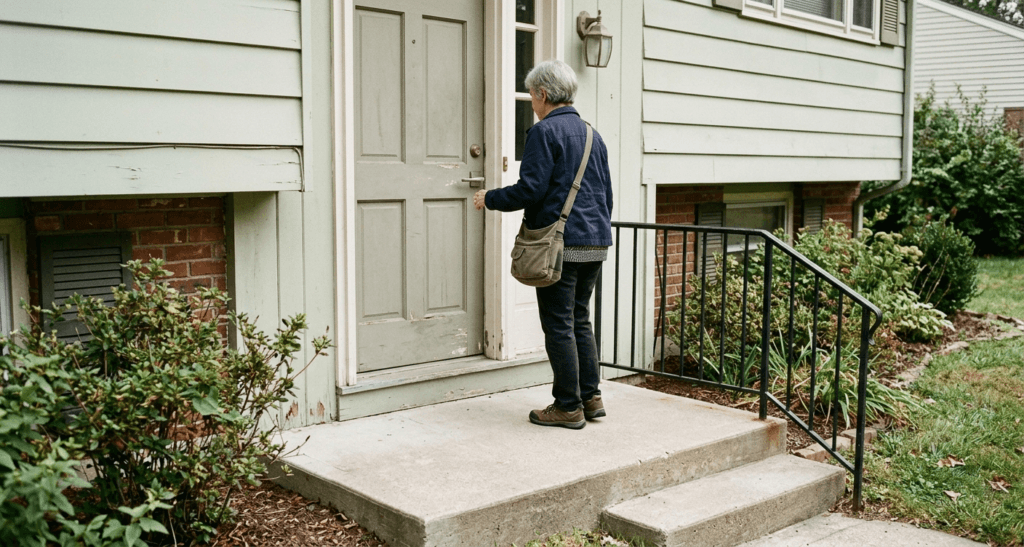
Older woman approaching a front door with a lever handle, low threshold, clear landing, and handrail

Front Door Safety for Older Adults: Locks, Handles, Thresholds, and Visibility

  A front door should protect the home without demandingdifficult gripping, rushed balance, awkward backward steps, orunnecessary dependence on another person. The safest solution is usuallythe one that improves the entire unlock–open–cross–closesequence. Executive Summary Front door safety depends on how easily an older adult can approach, unlock, open, cross, and monitor the entrance. Lever handles,

Front Door Safety for Older Adults: Locks, Handles, Thresholds, and Visibility Read More »
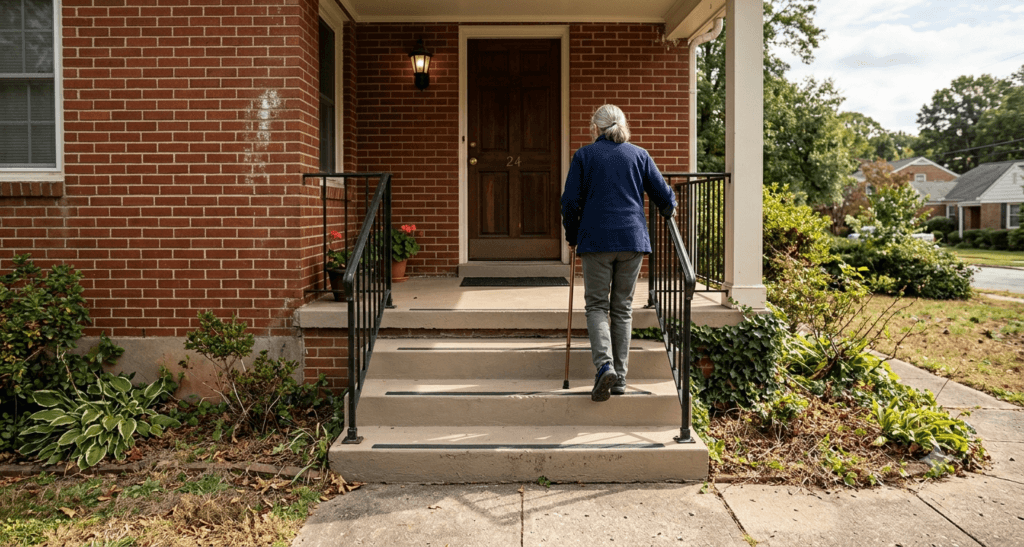
Older woman using a handrail and cane while climbing safe, well-lit front entrance steps

How to Make a Home Entrance Safer for Older Adults

  A home entrance can look perfectly ordinary when no one is using it. The difficulty becomes visible in motion: walking over an uneven path, climbing a step, finding a key, pulling a heavy door, and crossing a threshold—sometimes while carrying groceries or managing a cane or walker. Making the entrance safer therefore means improving

How to Make a Home Entrance Safer for Older Adults Read More »

Can a Stairlift Be Installed on Narrow Stairs?

Stairlifts & Aging in Place Can a Stairlift Be Installed on Narrow Stairs? A narrow staircase does not automatically rule out a stairlift. The real question is whether the rail, chair, rider, landings, and remaining walking route can work together in the space available. ✓Reviewed by the AgingAuthority Editorial Team Executive Summary Some narrow staircases

Can a Stairlift Be Installed on Narrow Stairs? Read More »

Can You Still Use Your Stairs Safely? Aging Self-Assessment!

AgingAuthority Stair Safety Guide Can You Still Use Your Stairs Safely? An Aging-in-Place Self-Assessment Stairs often remain part of daily life long after they begin to feel slightly harder, slower, or less predictable. This guide helps older adults and families look at stair safety realistically before a serious fall forces the conversation. Executive Summary Stair

Can You Still Use Your Stairs Safely? Aging Self-Assessment! Read More »

Stair Handrail Height & Grip Guide for Aging in Place

AgingAuthority Practical Guide Executive Summary A stair handrail can look solid yet still be hard for an older adult to use. Height, grip shape, rail continuity, wall clearance, and mounting strength all affect how confidently someone can steady themselves. The best handrail is not merely present or code-aware; it is reachable, graspable, predictable, and comfortable

Stair Handrail Height & Grip Guide for Aging in Place Read More »

Carpet vs. Wooden Stairs: Senior Fall Risk and Floor Safety

Stair Safety Carpet vs. Wooden Stairs: Senior Fall Risk and Floor Safety A practical aging-in-place comparison of carpeted and wooden stair surfaces through traction, visibility, maintenance, footwear, mobility changes, and real-world fall risk. Updated for AgingAuthority readersCluster articleEducational home safety guidance Carpeted and wooden stairs each offer different advantages and limitations for older adults. Surface

Carpet vs. Wooden Stairs: Senior Fall Risk and Floor Safety Read More »

Staircase Lighting for Seniors: Preventing Nighttime Falls

Stair Safety • Aging in Place Staircase Lighting for Seniors: Preventing Nighttime Falls Good stair lighting can improve visibility, reduce uncertainty, and support safer nighttime stair use. Executive Summary Many stair-related safety concerns are associated with visibility rather than the stairs themselves. A staircase that feels comfortable during the day may become challenging at night

Staircase Lighting for Seniors: Preventing Nighttime Falls Read More »

Stairlift vs First-Floor Living: What Makes More Sense?

Stairlift Planning • Aging in Place Stairlift vs First-Floor Living: Which Option Makes More Sense? Executive Summary When stairs become difficult, families often face a choice between installing a stairlift or moving daily living activities to the first floor. Neither solution is universally better. The right decision depends on mobility, home layout, long-term needs, safety

Stairlift vs First-Floor Living: What Makes More Sense? Read More »

Straight vs Curved Stairlifts: Costs, Design Differences

Stairlift Planning • Aging in Place Straight vs Curved Stairlifts: Costs, Design Differences Executive Summary The biggest difference between straight and curved stairlifts is not the chair itself but the staircase it must travel on. Straight stairlifts use standardized rails and typically cost less, while curved stairlifts require custom-designed rail systems built around turns, landings,

Straight vs Curved Stairlifts: Costs, Design Differences Read More »

Bathroom Safety Cost Calculator & Modification Guide

Bathroom Safety Modification Cost Calculator Answer a few quick questions to estimate how much bathroom safety upgrades may cost for aging in place. Get Your Bathroom Safety Cost Estimate This calculator is designed to be quick and simple. Answer a few short questions and get a planning range for common bathroom safety upgrades, from basic

Bathroom Safety Cost Calculator & Modification Guide Read More »