
For a complete overview of safer stairs, explore our Complete Stair Safety Guide for Aging in Place .
Straight vs Curved Stairlifts: Costs, Design Differences
Executive Summary
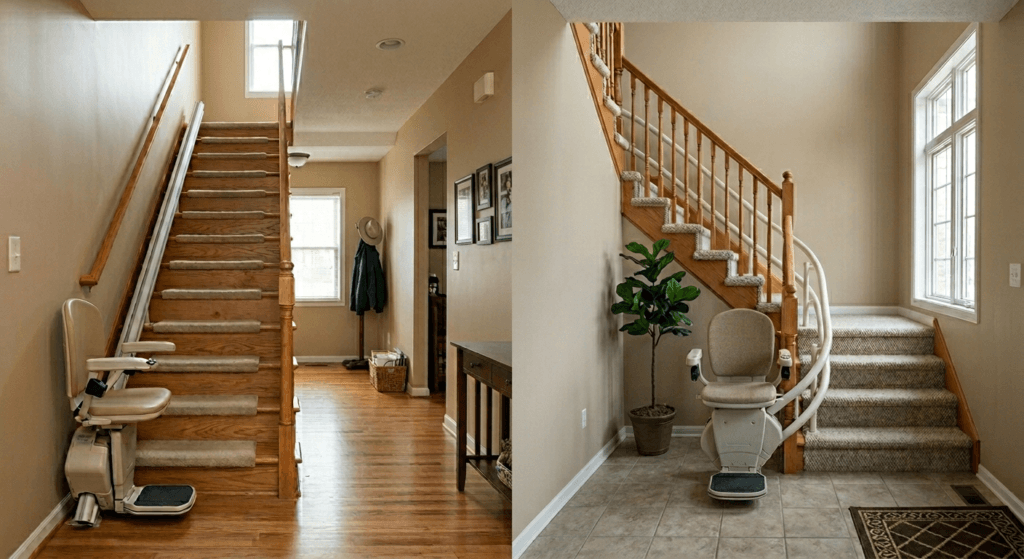
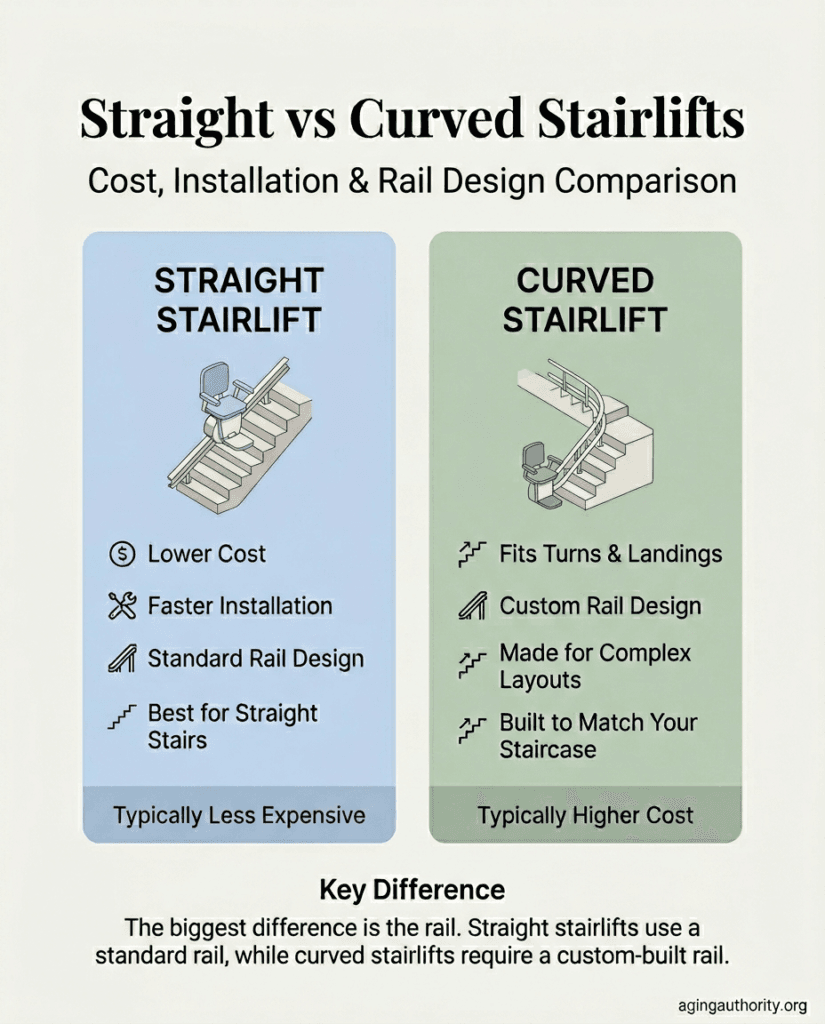
The biggest difference between straight and curved stairlifts is not the chair itself but the staircase it must travel on. Straight stairlifts use standardized rails and typically cost less, while curved stairlifts require custom-designed rail systems built around turns, landings, and complex layouts. Understanding how staircase design affects pricing, installation, customization, and future planning can help families make more informed aging-in-place decisions.
Introduction
When families begin researching stairlifts, they often focus on mobility needs first. That is understandable. A parent may be struggling with stairs, recovering from an injury, or trying to remain independent at home.
Yet one of the most important factors is something many people do not initially consider: the staircase itself.
In practice, the staircase often determines the project more than the user’s condition. Two older adults with nearly identical mobility challenges may receive dramatically different stairlift recommendations—and dramatically different quotes—simply because their homes have different staircase layouts.
The distinction between straight and curved stairlifts affects:
- Cost
- Manufacturing requirements
- Installation timelines
- Future flexibility
- Resale possibilities
- Long-term aging-in-place planning
Understanding these differences can help homeowners avoid surprises and evaluate proposals more effectively.
Check Your Stair Safety Score in Under a Minute
Organize stair handrail, lighting, and step priorities before comparing written proposals.
What Is a Straight Stairlift?
A straight stairlift is designed for a staircase that runs continuously in one direction without turns, bends, curves, or intermediate landings.
The rail follows a simple linear path from the bottom of the stairs to the top.
Because the rail design is standardized, manufacturers can produce many components in advance. During installation, the rail is typically adjusted to the required length and mounted directly to the staircase rather than the wall.
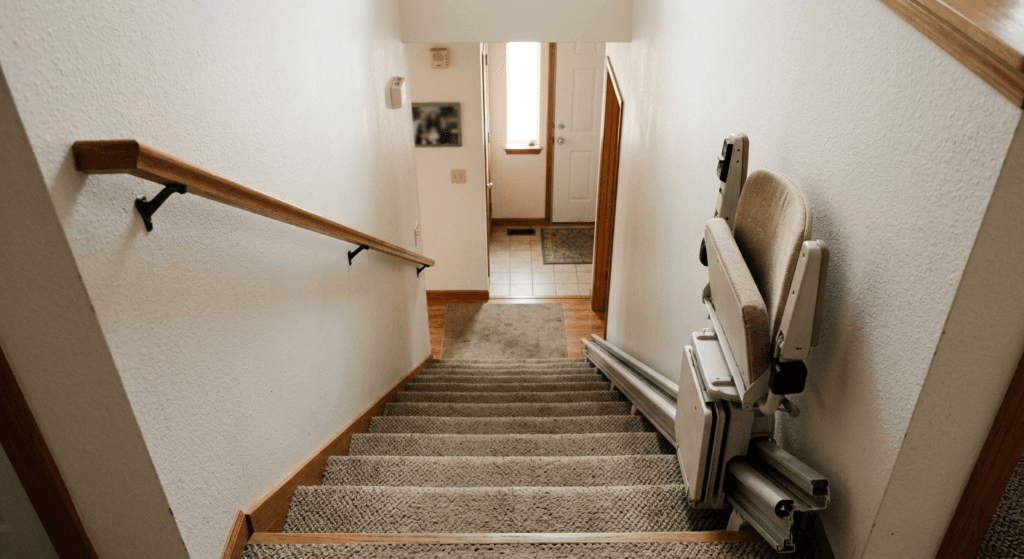
Common examples include:
- Traditional staircase from first floor to second floor
- Basement stairs with no turns
- Garage access stairs with a single straight run
Many homes built during the last several decades contain at least one staircase that can accommodate a straight stairlift.
The simplicity of the design usually results in:
- Lower manufacturing costs
- Faster installation
- Shorter lead times
- Greater availability of refurbished units
For households with a compatible staircase, a straight stairlift is often the least expensive way to improve access between floors.
What Is a Curved Stairlift?
A curved stairlift is designed for staircases that change direction.
The rail follows the exact shape of the stairs and may travel around:
- Corners
- Landings
- Multiple turns
- Split-level transitions
- Spiral or semi-spiral configurations
Unlike straight systems, curved rails are usually custom manufactured for a specific home.
This is where many homeowners encounter unexpected costs.
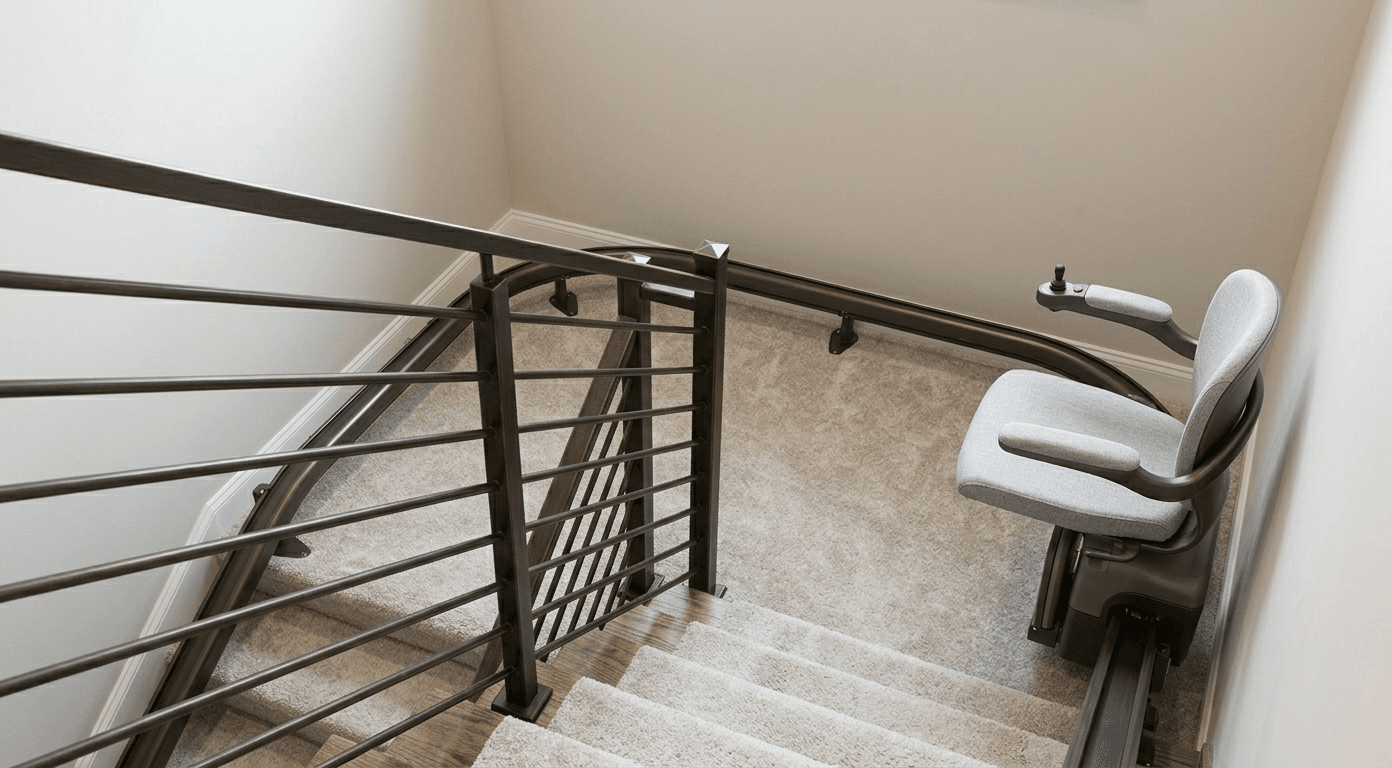
A staircase may appear relatively simple at first glance, yet small differences in geometry can significantly affect rail design. The location of a doorway, the width of a landing, or the angle of a turn can alter the engineering requirements.
As a result, two homes with seemingly similar staircases may receive very different curved stairlift proposals.
The rail effectively becomes a custom piece of equipment built specifically for that staircase.
Planning note: Many homeowners assume a staircase is “straight” because most of the stairs run in a single direction. In practice, even a small intermediate landing or directional change can move a project into the curved stairlift category. This misunderstanding is one reason families are often surprised when initial online pricing estimates differ from professional quotes.
Straight vs Curved Stairlifts: What Are the Biggest Differences?
The most obvious difference is the shape of the rail.
However, the practical differences extend much further.
Design Flexibility
A straight stairlift follows a predictable route.
A curved stairlift must navigate a customized path that mirrors the staircase configuration.
This affects everything from engineering to installation planning.
Manufacturing Process
Straight stairlift rails are generally standardized.
Curved rails are often measured, designed, and fabricated specifically for one staircase.
Installation Timeline
Straight stairlifts can frequently be installed relatively quickly once equipment is available.
Curved stairlifts may require additional time because rail manufacturing typically occurs after measurements are completed.
Future Flexibility
A straight stairlift can sometimes be removed and installed elsewhere if the new staircase is compatible.
Curved systems are usually far less transferable because the rail was designed for a specific staircase geometry.
Budget Impact
The difference in total project cost can be substantial.
While pricing varies by region, manufacturer, staircase length, and features, curved stairlifts often cost several thousand dollars more than straight models because of custom rail production and additional engineering requirements.
Why the Staircase Matters More Than the User
Families often expect mobility limitations to determine stairlift pricing. In reality, the staircase itself is frequently the largest pricing variable. A relatively active older adult with a complex staircase may require a more expensive system than someone with greater mobility limitations living in a home with a simple straight staircase.
This is why online price ranges should be treated as planning estimates rather than final project quotes. The chair, seat style, and user features matter, but the rail path often determines whether the project remains simple or becomes custom.
Why Curved Stairlifts Usually Cost More
Many people assume the higher price comes primarily from longer installation times.
That is only part of the story.
The largest cost driver is usually customization.
Custom Rail Manufacturing
Straight rails are largely standardized.
Curved rails must be designed to fit a specific staircase.
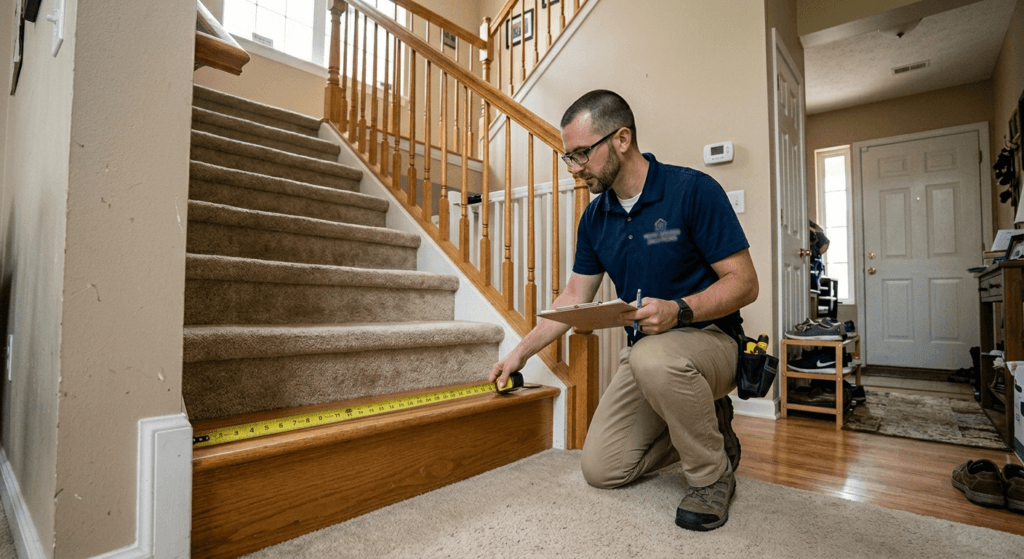
Measurements are often collected using advanced digital surveying methods before the rail enters production. The resulting rail may include multiple segments, directional changes, and specialized mounting requirements.
Increased Engineering Requirements
Every turn introduces additional complexity.
The rail must allow the chair to travel smoothly while maintaining proper clearances around walls, handrails, doorways, and landings.
Even small design differences can affect manufacturing costs.
Limited Reuse Potential
A straight stairlift rail may have value after removal because it can potentially fit another straight staircase.
Curved rails are often unique to one home.
That reduces refurbishment and resale opportunities, which contributes to higher overall pricing.
Additional Features
Complex staircases may require:
- Powered folding rails
- Special parking positions
- Custom start and stop locations
- Advanced seating configurations
Each feature can add to the overall project budget.
Estimate Your Stairlift Cost Before Requesting Quotes
Use the Stairlift Cost Calculator to see how staircase type, rail design, powered features, and installation choices may affect your estimated project range.
Installation and Customization Considerations
The installation process is not identical for every home.
Families are sometimes surprised to learn that the staircase itself may create limitations that only become apparent during a site assessment.
Landings Can Change Everything
A landing may seem like a simple flat area between stair sections.
In reality, landing size often influences whether a curved system is needed.
Some households ask whether two straight stairlifts could replace one curved stairlift.
In certain situations this may be possible, but it depends on the user’s balance, transfer ability, and available landing space. For some individuals, transferring between two chairs could introduce additional challenges.
Narrow Staircases
Clearance requirements vary.
Installers must evaluate:
- Stair width
- Door locations
- Handrail positions
- Walking space for other household members
A solution that works well in one home may not work in another despite similar-looking staircases.
Multi-Level Homes
Split-level homes often require additional planning.
The route may involve multiple turns, intermediate landings, or unusual transitions that influence rail design and overall cost.
Straight vs Curved Stairlift Comparison
| Feature | Straight Stairlift | Curved Stairlift |
|---|---|---|
| Staircase Type | Single straight run | Turns, bends, landings, complex layouts |
| Rail Design | Standardized | Custom-built |
| Manufacturing Complexity | Lower | Higher |
| Installation Timeline | Usually shorter | Often longer due to custom fabrication |
| Typical Cost Range | Generally lower | Generally higher |
| Resale Potential | Often better | Usually limited |
| Reuse in Another Home | Sometimes possible | Often difficult |
| Engineering Requirements | Relatively simple | More complex |
| Lead Time | Often shorter | Often longer |
| Customization Level | Moderate | High |
Sources indicate straight stairlifts commonly fall within lower pricing ranges, while curved systems frequently begin around the upper end of the market because of custom rail manufacturing requirements. Exact pricing varies significantly by home and project scope.
Urgency and Lead Time Comparison
Timing can matter when a stairlift is being considered after a fall, surgery, hospital discharge, or sudden decline in stair confidence. Straight stairlifts are often easier to source quickly because the rail system is more standardized. Curved stairlifts may require a longer planning window because the rail usually has to be measured, designed, manufactured, and then installed.
| Situation | Straight Stairlift | Curved Stairlift |
|---|---|---|
| Urgent mobility need | Often easier to obtain quickly | May require additional manufacturing time |
| After hospital discharge | Frequently available sooner if the staircase is compatible | Planning may take longer because of custom rail production |
| Short-term recovery | Rental or refurbished options may be more available | Less suitable for temporary use because the rail is usually custom |
| Long-term aging-in-place plan | Lower complexity when the staircase is simple | Useful when the home layout requires continuous access through turns or landings |
Long-Term Planning Considerations
A stairlift decision is rarely just about today’s mobility challenges.
Many families are making an aging-in-place decision that could affect the next five, ten, or even fifteen years.
Future Mobility Changes
Current mobility needs may not remain static.
Features that seem unnecessary today may become valuable later, including:
- Powered swivel seats
- Easier transfer positions
- Additional safety controls
Thinking ahead may reduce the need for future modifications.
Potential Home Sale
Homeowners sometimes overlook the impact of future relocation plans.
A straight stairlift may retain more practical value because it can potentially be reused or resold more easily.
A curved rail custom-built for one staircase may have little value outside that specific environment.
Alternative Aging-in-Place Strategies
In some situations, families may compare stairlift costs against other options such as:
- Main-floor living arrangements
- Bedroom relocation
- Home modifications
- Accessibility renovations
The appropriate approach depends on household goals, finances, health considerations, and property layout.
Organizations such as AARP and aging-in-place advocates frequently note that many older adults prefer remaining in their homes as they age, making accessibility planning an important part of long-term housing decisions.
Check Your Stair Safety Score in Under a Minute
Evaluate handrails, lighting, and step safety to reduce fall risk on stairs.
When to Consider Professional Evaluation
A professional evaluation may be appropriate when:
- The staircase includes multiple turns or landings
- More than one household member has mobility concerns
- Transfer ability is uncertain
- The home has unusual architectural features
- Multiple accessibility solutions are being considered
Professionals who may provide useful input include:
- Occupational therapists
- Accessibility specialists
- Home safety assessors
- Aging-in-place consultants
- Home modification contractors
- Stairlift installation specialists
An evaluation can help clarify whether a stairlift is appropriate and identify factors that may affect installation feasibility or long-term usability.
Frequently Asked Questions
Is a curved stairlift always more expensive?
In most situations, curved stairlifts cost more because the rail is custom manufactured for a specific staircase. However, actual pricing depends on staircase complexity, rail length, features, and local installation costs.
Can a straight stairlift be installed on stairs with a turn?
Generally, a straight stairlift is intended for a straight staircase. Staircases with turns or significant landings often require a curved rail system or another specialized solution.
Why do curved stairlift quotes vary so much?
Small differences in staircase geometry can create large differences in engineering requirements. The number of turns, landing configuration, rail length, and custom features can all affect pricing.
Are curved stairlifts custom-built?
In many cases, yes. The rail is often designed and manufactured to match the exact dimensions and layout of a specific staircase.
Which type is easier to move or resell?
Straight stairlifts are generally easier to remove, refurbish, and potentially reuse because their rail systems are more standardized. Curved systems are usually customized to one staircase.
Can two straight stairlifts replace one curved stairlift?
Sometimes, but it depends on the landing, available space, and the user’s ability to transfer safely between chairs. For some households, two straight stairlifts may reduce cost. For others, the transfer itself can create a practical or safety concern.
Which stairlift type is better for urgent needs?
A straight stairlift is often easier to arrange quickly if the staircase is compatible because the rail is more standardized. Curved stairlifts often require custom measurement and manufacturing, which can extend the timeline.
Conclusion
The decision between a straight and curved stairlift is ultimately driven by the staircase rather than the chair itself.
Straight stairlifts typically offer lower costs, faster installation, and greater flexibility because they use standardized rail systems. Curved stairlifts provide access on more complex staircases but usually require custom engineering, custom manufacturing, and larger budgets.
For many families, the most important realization is that two homes with similar mobility needs can require entirely different solutions. Understanding staircase design, customization requirements, and long-term planning considerations can help set realistic expectations and support more informed aging-in-place decisions.
Check Your Stair Safety Score in Under a Minute
Evaluate handrails, lighting, and step safety to reduce fall risk on stairs.
Reviewed by AgingAuthority Editorial Team. AgingAuthority publishes practical, safety-focused aging-in-place guidance for families planning safer homes. Learn more about our editorial standards on the AgingAuthority Editorial Team page.
Sources
The following sources were used to support general aging-in-place, home safety, and accessibility planning context in this article.
Disclaimer
This content is for general educational purposes only and does not replace a professional home safety assessment, medical advice, or licensed contractor evaluation.