
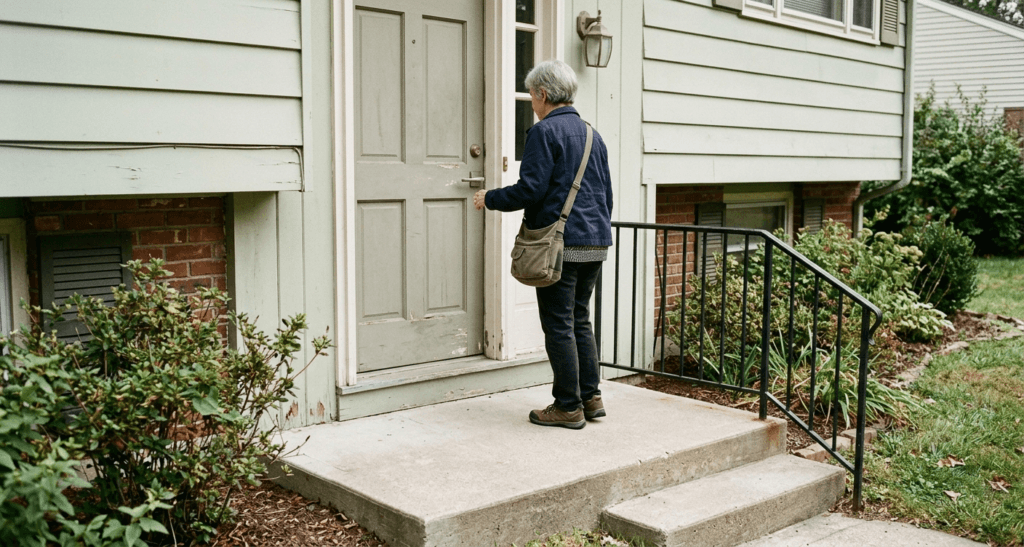
For a complete overview of safer home entrances, explore our Complete Entryway Safety Guide for Aging in Place .
A front door should protect the home without demanding
difficult gripping, rushed balance, awkward backward steps, or
unnecessary dependence on another person. The safest solution is usually
the one that improves the entire unlock–open–cross–close
sequence.
Front door safety depends on how easily an older adult can approach, unlock, open, cross, and monitor the entrance. Lever handles, simple locks, low stable thresholds, bright lighting, and clear visibility can reduce strain and uncertainty. The safest improvements address the whole entry sequence while preserving security, independence, comfort, and confidence in everyday use for older adults and their families.
✓ Reviewed by AgingAuthority Editorial Team
Jump directly to the part of the front-door sequence you want to review.
Repair what is unstable
Reduce daily effort
Protect dependable access
Why
Front Door Safety Deserves Separate Attention
The front door is often the most complicated part of the entrance
because several actions happen almost at once. The resident may need to
reach, grip, twist, pull, step, and watch the threshold while
controlling a mobility aid. Bags, rain, wind, pets, and a waiting
visitor add pressure.
The door also combines two goals that can appear to compete:
accessibility and security. A device that is easy to operate must still
secure the home. A reinforced door must remain manageable. An automatic
lock must not create repeated lockouts. The broader Complete
Entryway Safety Guide for Aging in Place explains how the entrance
works as a whole; this article focuses specifically on the door and the
few feet required to operate it.
Observe the
Complete Door-Opening Sequence
Observe ordinary use rather than testing one component in isolation.
Watch the resident arrive from outside, unlock the door, open it, cross
the threshold, close it, and lock it again. Then consider the reverse
sequence when leaving home.
Look for compensations: holding the frame for balance, leaning into
the door, placing bags on the ground, taking several attempts with the
key, stepping backward toward an exterior step, lifting a walker, or
waiting for someone else to help. These behaviors do not diagnose a
medical condition. They reveal a mismatch among grip, reach, balance,
vision, reaction time, the mobility aid, and the door itself.
Observation should reflect real life. Consider a normal package, the
resident’s usual cane or walker, a pet near the door, and the effect of
rain or wind. Never ask someone to repeat a movement that already felt
unsafe or caused a near-fall. For concerns beyond the door—including the
approach, landing, steps, and drainage—see How
to Make a Home Entrance Safer for Older Adults.
Front Door Locks and
Key Operation
A small key can be difficult to identify, align, pinch, and turn,
especially when the keyway is shadowed or the lock is stiff. Multiple
similar keys and several locks add steps and increase the time spent
standing at the door.
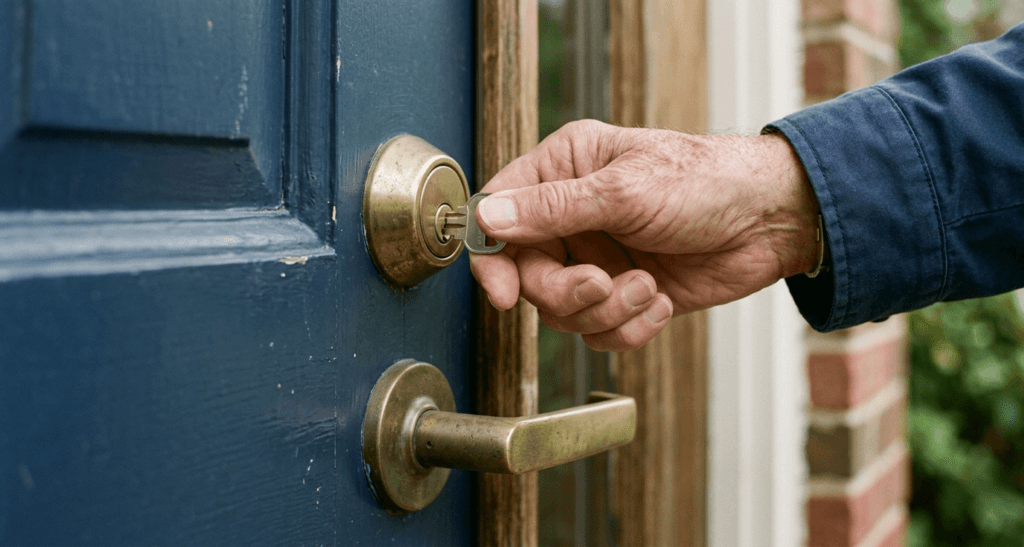
Start with condition. A deadbolt that suddenly requires force may
reflect a misaligned door, loose hinge, temperature-related swelling, or
worn hardware. Repairing and aligning the existing assembly may help
more than adding electronics. Lubrication should match the lock
manufacturer’s guidance; unsuitable products can attract debris or
impair operation.
Larger key grips or clearly differentiated key identifiers may reduce
fine-finger demands. A bright but non-glare fixture can make the keyway
easier to find. Lock placement also matters: the resident should not
have to stretch, bend, or abandon a stable hand position to reach
it.
Security remains essential. Avoid hiding a spare key under a mat,
planter, or other obvious location. If backup access is necessary, use a
deliberately managed method appropriate to the household rather than
making the main lock easier to defeat.
Plan Your Home Entrance Project
Organize door, threshold, lighting, and exterior access priorities before comparing written proposals.
Lever Handles vs. Round
Door Knobs
Lever handles often require less tight grasping and wrist rotation
than round knobs. That can be useful for a resident with limited hand
strength or dexterity. It does not make every lever universally safer. A
projecting lever may catch loose clothing or bags, and poorly installed
exterior hardware can introduce durability or security problems.
The U.S. Access Board uses hardware that can be operated with one
hand without tight grasping, pinching, or twisting as an accessibility
design principle. These standards are useful planning references, but
they do not automatically govern every private single-family home. The
actual choice should reflect the resident, door assembly, local
requirements, and security needs.
| Hardware type | Possible advantage | Possible limitation | Best planning question |
|---|---|---|---|
| Round knob | Familiar and compact | Requires grasp and wrist rotation | Can the resident turn it while maintaining balance? |
| Lever handle | Often easier with limited grip | May snag clothing; quality and security vary | Is the lever easy to operate without unintended movement? |
| Handle set with thumb latch | Large pull surface and familiar exterior appearance | Thumb pressure and simultaneous pulling may be difficult | Can the latch and door be controlled in one smooth action? |
| Keypad | Removes small-key manipulation | Small buttons, glare, codes, and batteries can create barriers | Can the resident see, remember, and reliably enter the code? |
| Smart lock | May support remote control and temporary access | App dependence, batteries, updates, and lockouts | What works when the phone, network, or battery fails? |
Door Weight,
Opening Force, and Closing Speed
A door that feels “too heavy” may not need replacement. Worn hinges,
frame misalignment, swollen material, tight weather stripping, a strong
closer, or floor contact can create resistance. Wind exposure can also
make an otherwise manageable door unpredictable.
Pay attention to changes. If the door suddenly scrapes, sticks, or
requires a shoulder push, inspect the assembly rather than compensating
with a larger handle. A heavy solid door may be appropriate for security
or weather protection, but its movement still needs to be manageable for
the resident.
Closing speed is equally important. A closer that begins pulling
before a person and walker are clear can cause rushing, contact, or loss
of control. The goal is not necessarily a door that moves freely;
uncontrolled movement can also be hazardous. The door should open
predictably, remain controllable, and allow enough time for the actual
user to cross.
Storm
Doors, Screen Doors, and Two-Door Sequences
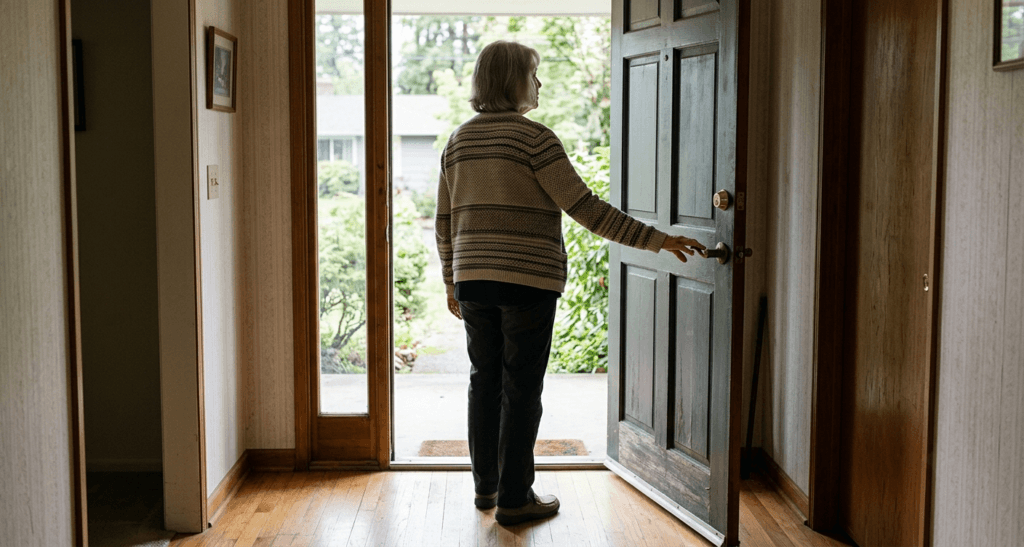
A second door can improve ventilation and weather protection, but it
also creates a more complex sequence. The resident may have to hold the
storm door while unlocking the main door, step backward within a small
landing, or maneuver a walker through competing door swings. A strong
closer may pull the storm door toward the resident’s hand, shoulder, or
mobility aid.
Before removing it, identify why the household uses it. Local
weather, insects, ventilation, package protection, and security
preferences may matter. Possible responses include adjusting the closer,
repairing hinges and latches, changing swing conflicts, improving
hold-open behavior where appropriate, or redesigning the landing. The
right response depends on space and site conditions.
The real test is whether the resident can manage both doors without
balancing on the frame, stepping toward an edge, or leaving a mobility
aid behind.
Threshold Safety for
Older Adults
A modest threshold can interrupt a shuffling step, catch a toe,
deflect a cane tip, or stop the small front caster of a wheelchair.
Walker users may lift the device and lose some of the support they rely
on at the exact moment they are crossing the doorway.
Inspect for loose sections, abrupt edges, damage, poor contrast, and
rocking portable products. A beveled transition or small threshold ramp
may reduce the abrupt change, but the solution must preserve door
clearance, weather sealing, and drainage. A poorly selected ramp can
block the door, direct water inward, shift under load, or create a new
edge on the landing.
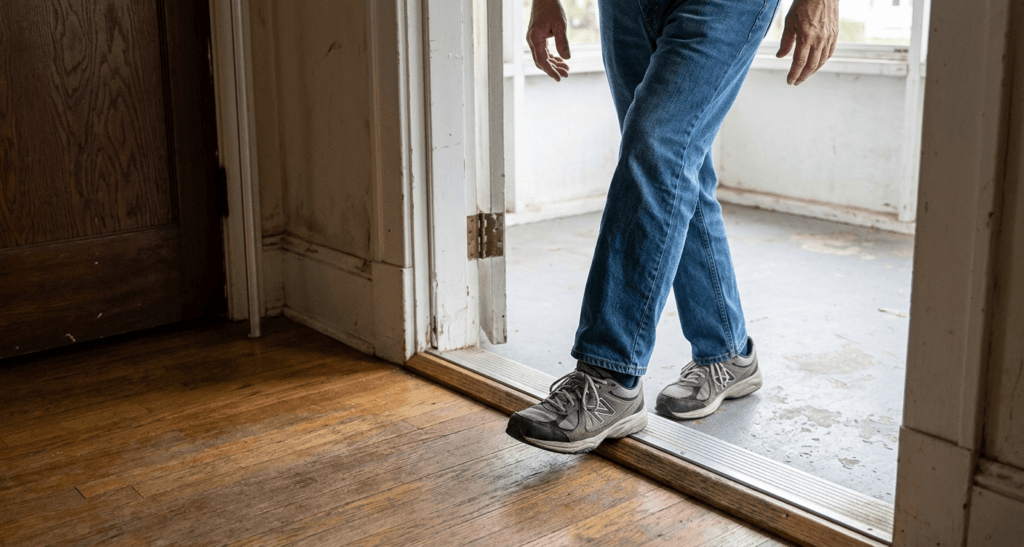
Do not apply one universal threshold height to every house.
Accessibility standards can provide useful design concepts, while
residential codes, existing construction, local climate, and individual
usability may differ. Larger structural changes belong within a
coordinated home-modification
plan for aging in place.
Estimate a Ramp-Related Modification
If the threshold problem is part of a genuine wheelchair or sloped-access need—not merely a loose strip that requires repair—the calculator can provide an early planning estimate. It cannot confirm drainage, landing size, door clearance, structural suitability, or code compliance, so treat the result as a budgeting starting point.
Visibility at
the Lock, Handle, and Threshold
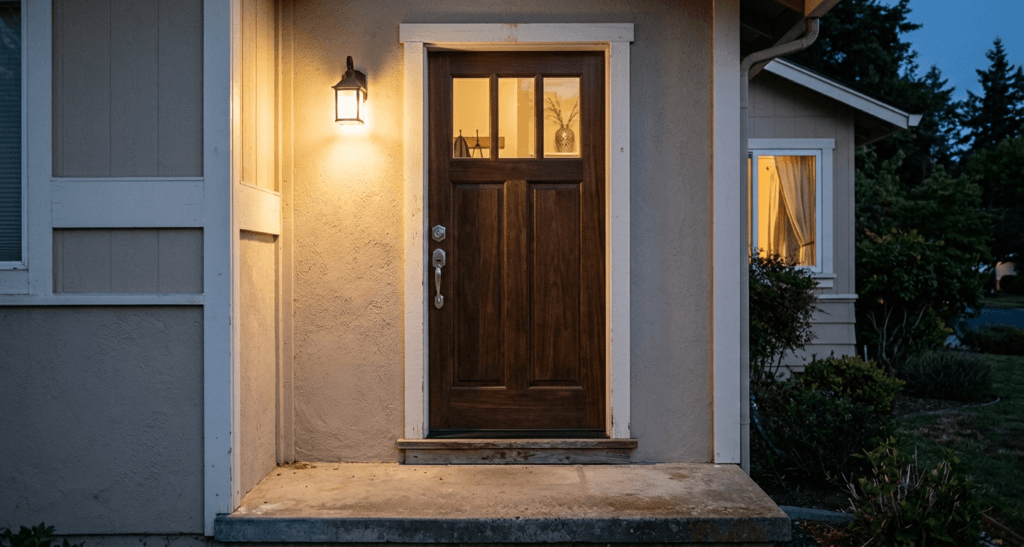
Effective front-door lighting reveals the keyway or keypad, handle,
threshold, immediate landing, visitor’s face, and any package near the
door. “Brighter” is not automatically better. A bare, badly aimed bulb
may create glare, wash out facial detail, and deepen the shadows around
the threshold.
Look at the doorway after dark from both directions. Is the lock
visible without the resident blocking the light? Does a reflective
handle create glare? Does the threshold contrast with the surrounding
floor? Can the interior switch be reached before opening the door?
Motion activation can help, provided the detection zone includes the
normal approach and the light remains on long enough to complete the
full sequence. A fixture that switches off while the resident is still
managing the lock is poorly matched to the task. During outages, a
maintained flashlight or appropriately selected backup light should be
easy to locate from inside.
Seeing and
Identifying Visitors Safely
The resident should be able to identify a visitor without feeling pressured to open the door. Traditional peepholes work only when their
height and viewing angle suit the user. An adjustable or lower viewer
may help in some homes. Glazed panels and sidelights can improve
visibility but may require curtains or other privacy planning.
Door cameras and video doorbells can provide a wider view, recorded
events, or two-way communication. Their value depends on how the
resident receives the information. A phone-only system may be ineffective if the phone is usually in another room or its interface is
difficult to navigate. Some systems support an indoor display or chime,
which may be more practical.
Consider hearing and vision needs, false alerts, notification volume,
night image quality, internet outages, subscriptions, software support,
and household privacy. Technology should reduce uncertainty, not create a new obligation to manage frequent alerts.
Smart
Locks and Keypads: Helpful or Complicated?
Smart locks and keypads may eliminate small-key handling, provide
temporary caregiver codes, record entries, support remote locking, or
automatically secure the door. Those features can support independence
when the resident understands and trusts the system.
The same device may create new failure points: depleted batteries,
unreadable touchscreens, forgotten codes, app updates, lost phones,
Wi-Fi or hub failures, and accidental lockouts. Auto-locking can be
reassuring but frustrating if the resident briefly steps outside without
a phone or key. Shared codes can also spread beyond the intended
person.
Before installation, let the actual resident test the controls in
daylight and darkness. Establish a physical or otherwise dependable
backup method where appropriate, battery-monitoring responsibility, a
replacement schedule, clear written instructions, and a trusted-person
plan. Confirm which functions remain available without power, internet,
or a connected phone. A smart lock is suitable only if the backup plan
is as carefully considered as the convenient features.
Security Without Creating an Accessibility Barrier
Extra security is not always better if it becomes impossible to use
consistently. Multiple locks may lead a resident to leave one
disengaged. A security chain mounted out of reach provides little
practical value. Reinforcement that increases opening force can
undermine everyday access. Automatic locking may protect the home while
also increasing lockouts.
The aim is secure, understandable operation with as few unnecessary
actions as practical. A qualified locksmith can often improve alignment,
simplify a confusing lock arrangement, and recommend appropriate
exterior-grade hardware without weakening the door.
Visitor identification should happen before opening, using a viewer,
window, intercom, or camera that the resident can actually use. Backup
keys and codes require controlled management. Accessibility should
remove physical friction, not remove deliberate security layers.
Emergency
Access and Power-Outage Planning
Every household needs to know what happens if the resident falls,
cannot reach the door, cannot hear someone outside, or becomes unable to
operate the lock. The plan should also cover smart-lock battery failure,
a power outage, lost internet service, and an urgent caregiver
visit.
Options may include a trusted contact with securely managed access, a
properly controlled lockbox where appropriate, a backup key, scheduled
battery replacement, and participation in a local emergency-access or
responder program if available. The appropriate method depends on the
person, property, local services, and security risk.
Write down who is responsible for batteries, codes, and spare access.
Test the agreed method without creating a public clue about where access
is stored. Emergency planning supports aging in place
because independence is stronger when predictable failures already have
a response.
How to
Inspect a Front Door for Older-Adult Use
Inspect the doorway from outside and inside, in daylight and after
dark. Use the resident’s normal mobility aid and observe a routine item
such as a handbag or small package only if doing so feels safe.
Find the control
Identify the correct key, keypad, or control from the normal arrival position.
Keep stable support
Unlock without leaning heavily or abandoning the usual mobility aid.
Control the door
Operate the latch and move the door without sudden or unpredictable resistance.
Handle the second door
Observe any storm or screen door and the space required to control it.
Clear the threshold
Cross without catching a foot, cane, walker, or wheelchair component.
Finish from inside
Close and secure the door after the resident and mobility aid are fully clear.
Check loose hardware, sticking locks, hinge movement, closer speed,
threshold stability, lighting, viewer position, storm-door conflicts,
maneuvering space, and backup access. Repeat the observation when
leaving, because push and pull demands differ. Stop if the resident
hesitates, becomes unstable, or reports discomfort; inspection should
reveal problems, not reproduce a near-fall.
How to
Prioritize Front Door Improvements
Cost and priority are not the same. A loose handle may be inexpensive
but urgent. A sophisticated smart lock may cost more while addressing a
lower-priority inconvenience.
| Observed condition | Likely priority category | Practical next step |
|---|---|---|
| Loose handle or lock | Immediate repair | Stop relying on unstable hardware; arrange repair |
| Door suddenly sticks or scrapes | Immediate assessment | Check alignment, hinges, swelling, and frame condition |
| Door closes before crossing is complete | Near-term usability improvement | Evaluate closer adjustment and door movement |
| Lock and threshold disappear in shadow | Near-term usability improvement | Correct fixture placement, glare, and timing |
| High, loose, or damaged threshold | Repair or structural modification | Assess stability, clearance, drainage, and transition design |
| Difficult two-door sequence | Usability or structural review | Observe swing, closer force, and maneuvering space |
| New walker or wheelchair use | Professional evaluation | Reassess the full route and door maneuvering needs |
| Repeated lockouts | System review | Simplify operation and establish dependable backup access |
| Smart lock without backup | Immediate planning gap | Create and test a battery/network-independent access plan |
Address unstable hardware and unpredictable door movement first. Then
improve daily usability and visibility. Technology upgrades come later
unless they directly resolve a verified barrier. Structural work may
require more planning but should not be postponed when the current
geometry prevents safe access.
When
Professional Evaluation May Be Appropriate
Different problems call for different expertise:
- A qualified locksmith can assess lock function,
alignment, hardware, keying, and secure backup options. - A door or window contractor can evaluate the slab,
frame, hinges, weather sealing, and storm-door assembly. - A general contractor may be appropriate when the
threshold, landing, framing, drainage, or surrounding structure must
change. - An occupational therapist can observe how the
resident’s abilities and mobility aid interact with the task. - An aging-in-place specialist can coordinate the
door with longer-term accessibility goals. - An electrician or lighting professional can address
wiring, controls, fixture placement, and backup lighting. - A security-system professional can evaluate
cameras, intercoms, access control, and privacy settings.
Not every household needs every professional. Start with the observed
failure: hardware, movement, visibility, resident interaction,
structure, or technology.
Front Door Safety
Checklist
- The lock turns reliably without excessive force.
- The resident can identify and operate the key, code, or control.
- The handle is secure and manageable with the resident’s usual grip.
- The door opens without scraping, sudden resistance, or uncontrolled movement.
- Closing speed allows the resident and mobility aid to clear the doorway.
- A storm or screen door does not force unstable backward movement.
- There is enough space for the resident’s normal mobility aid.
- The threshold is stable, visible, and manageable.
- Any ramp or beveled transition preserves clearance, drainage, and weather sealing.
- Lighting reveals the lock, handle, visitor’s face, landing, and threshold without glare.
- The resident can identify a visitor before opening the door.
- Emergency access is secure, documented, and assigned to a trusted person.
- Electronic locks have monitored batteries and a tested backup method.
- Hardware, hinges, closers, lighting, and batteries are checked periodically.
Frequently Asked
Questions
Clear answers to the questions families most often face when balancing easier access, daily safety, and home security.
01Are lever door handles better for older adults?
Often, but not always. A lever usually requires less tight grasping and wrist rotation than a round knob. The resident should still test the complete lockset, and exterior hardware must be secure, well installed, and unlikely to snag clothing or bags.
02What is the easiest front door lock for an older adult to use?
The easiest lock is one the resident can see, understand, reach, and operate reliably without excessive force. That may be a well-maintained keyed lock with a larger key grip, a keypad, or a smart lock with dependable backup access. There is no universal best type.
03Are smart locks safe for older adults?
They can be useful when the controls are readable, the resident is comfortable with them, and the household manages batteries, codes, privacy, and backup entry. They are a poor fit when app dependence or forgotten codes create more difficulty than the key they replace.
04How can a high front door threshold be made safer?
Possible responses include repair, a beveled transition, an appropriate threshold product, or a more substantial modification. Selection depends on door clearance, drainage, weather sealing, landing space, mobility equipment, and local requirements. A contractor or accessibility professional may be appropriate.
05What can make a front door difficult to open?
Common causes include misalignment, worn hinges, swelling, frame movement, tight weather stripping, a strong closer, floor contact, door weight, and wind. A sudden change should prompt inspection rather than simply adding a larger handle.
06Is a video doorbell useful without a smartphone?
Possibly. Some systems support an indoor display, chime, or intercom-style interaction. Confirm exactly how the resident will see and hear visitors, and what remains functional during internet or power outages.
07How can caregivers get emergency access without leaving the home insecure?
Families may use securely managed spare access, a controlled lockbox where appropriate, temporary codes, or a local responder-access program. The method should limit who receives access, include a backup, and never rely on an obvious hidden key.
Sources
- U.S.
Access Board — Guide to Entrances, Doors, and Gates - U.S.
Access Board — Guide to Floor and Ground Surfaces - U.S.
Department of Justice — 2010 ADA Standards for Accessible
Design - U.S.
Access Board — Accessible Means of Egress - National
Institute on Aging — Aging in Place: Growing Older at Home
This article provides general educational information and does
not replace individualized medical, occupational therapy, security,
construction, or code advice. Conditions and local requirements vary,
and professional evaluation may be appropriate.