
For a complete overview of safer stairs, explore our Complete Stair Safety Guide for Aging in Place .
Carpet vs. Wooden Stairs: Senior Fall Risk and Floor Safety
A practical aging-in-place comparison of carpeted and wooden stair surfaces through traction, visibility, maintenance, footwear, mobility changes, and real-world fall risk.
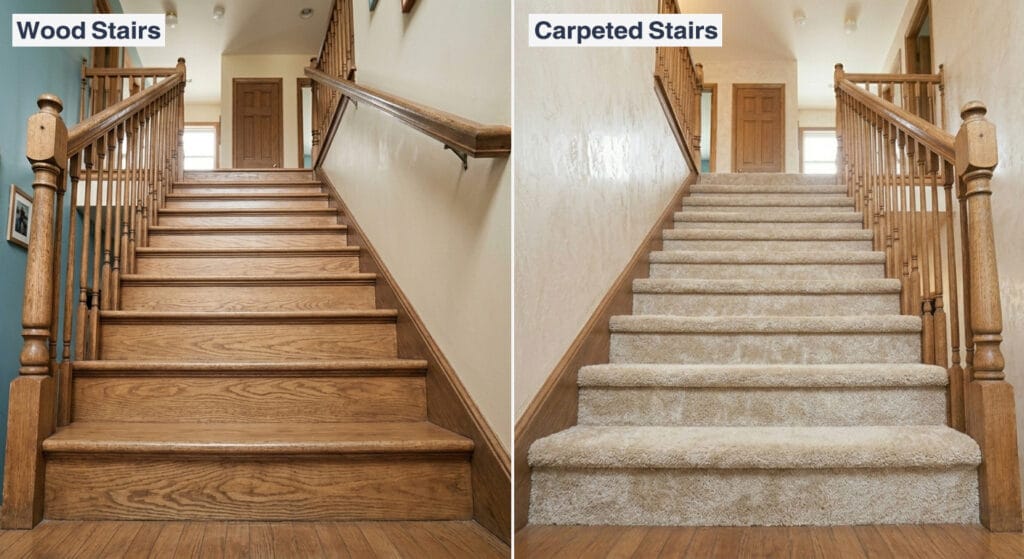
Executive Summary
Carpeted and wooden stairs can both be safe or unsafe for older adults depending on condition, lighting, maintenance, footwear, and mobility needs. Carpet may improve traction but can loosen or hide stair edges. Wood can be slippery if polished or dusty, yet safer when low-gloss, clean, visible, and paired with strong handrails.
Are carpeted stairs safer than hardwood? Securely installed, low-pile carpet may offer better grip than slick hardwood, but loose carpet or hidden step edges can create trip hazards. Hardwood is not automatically unsafe: its finish, cleanliness, lighting, and handrails matter too. The safer choice depends on the condition of the stairs and the person using them.
Introduction
Many families assume that replacing wooden stairs with carpet automatically makes a staircase safer for an older adult. Others believe hardwood is easier to maintain and therefore the better long-term choice.
The truth is more nuanced.
Stair-related falls rarely result from a single factor. Aging affects balance, strength, reaction time, vision, depth perception, and confidence. At the same time, stair surfaces gradually change through wear, cleaning practices, household traffic, moisture exposure, and maintenance habits.
A staircase that felt safe ten years ago may present very different challenges today, even if nothing appears visibly broken. That is why flooring should be evaluated as part of a broader home safety system, not as a standalone fix.
For families who are just beginning to evaluate stair safety, it may help to first understand why stairs become more dangerous with age before falls occur. Flooring decisions make more sense when viewed through the lens of changing strength, vision, balance, and daily habits.
Check Your Stair Safety Before Changing the Flooring
Plan stair handrails, lighting, step visibility, and surface priorities before comparing written proposals.
Are Carpeted or Wooden Stairs Safer for Seniors?
The safer option depends on the condition of the staircase, the type of carpet or wood finish, lighting quality, handrail stability, footwear habits, and the physical abilities of the person using the stairs.
Many aging-in-place professionals view flooring as only one component of overall stair safety. A well-lit wooden staircase with sturdy handrails may be safer than a poorly maintained carpeted staircase with loose edges and inadequate lighting. Likewise, a properly installed carpet can provide more grip than a highly polished hardwood surface.
The better question is not simply “Is carpet safer than wood?” A more useful question is: “How does this specific staircase interact with this specific person’s mobility, vision, footwear, and daily routine?”
That distinction often changes the answer entirely. It also prevents families from spending money on cosmetic surface changes while overlooking more important safety issues such as weak handrails, poor lighting, steep stair geometry, or unsafe nighttime routines.
How Stair Surface Affects Traction and Stability
Traction is one of the most important factors influencing stair safety. When climbing or descending stairs, each foot placement requires enough friction between the shoe and stair surface to prevent slipping.
Carpeted Stairs
Carpet generally provides greater surface friction than smooth hardwood. Potential benefits include better grip for many types of footwear, reduced likelihood of foot sliding, increased confidence during stair use, and improved stability during slower movement.
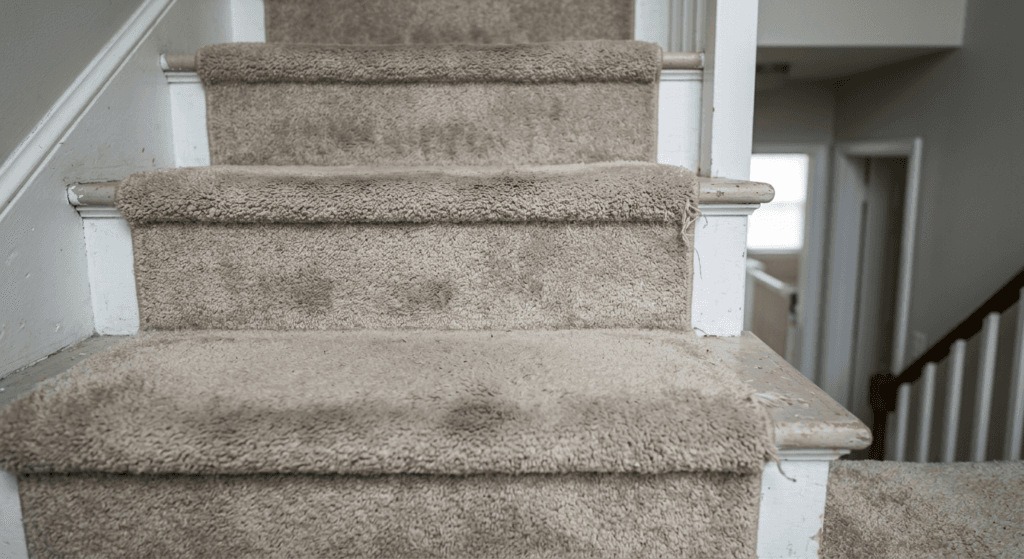
However, carpet traction is not permanent. As carpet fibers become compressed through years of use, grip characteristics can change. Older carpeting may become flattened, develop loose sections, create uneven surfaces, or hide stair-edge definition.
The result can be reduced stability despite the appearance of having a “soft” surface.
Wooden Stairs
Wooden stairs vary significantly. Factors affecting traction include surface finish, gloss level, wax use, cleaning products, moisture exposure, and the amount of wear near the tread edge.
A highly polished hardwood staircase may feel noticeably different from a textured wood staircase with a low-sheen finish. This is one reason broad statements about hardwood safety can be misleading. Two wooden staircases may perform very differently despite looking similar.
Why Carpet Is Not Automatically the Safer Option
One of the most common misconceptions in home safety is that carpet automatically equals protection. Carpet can improve traction, but it can also introduce hazards.
Loose Carpet Edges
As carpeting ages, edges can lift, curl, fray, or separate from stair treads. These changes may create trip hazards that are especially problematic for individuals with reduced foot clearance.
Stair Runners
Stair runners are attractive and common in many homes. However, runners can create safety concerns when installation loosens over time, edges begin lifting, the width leaves exposed slippery stair sections, or the pattern makes step edges harder to interpret.
Worn Carpet
A staircase can become less safe without obvious damage. Many homeowners expect danger to look dramatic. Instead, risk often develops gradually through fiber compression, uneven wear patterns, reduced traction, and subtle movement underfoot.
Because these changes occur slowly, residents often adapt without realizing safety margins are shrinking. A family may only recognize the problem after a near-fall, a stumble, or a repeated feeling of hesitation on the stairs.
Carpet Does Not Prevent Falls
Carpet may alter fall dynamics and may provide somewhat softer impact characteristics than exposed wood. However, it does not eliminate fall risk. In many situations, preventing the fall is far more important than slightly reducing impact severity after a fall occurs.
Why Some Wooden Staircases Perform Better Than Others
The term “wooden stairs” covers a surprisingly broad range of conditions.
Surface Finish Matters
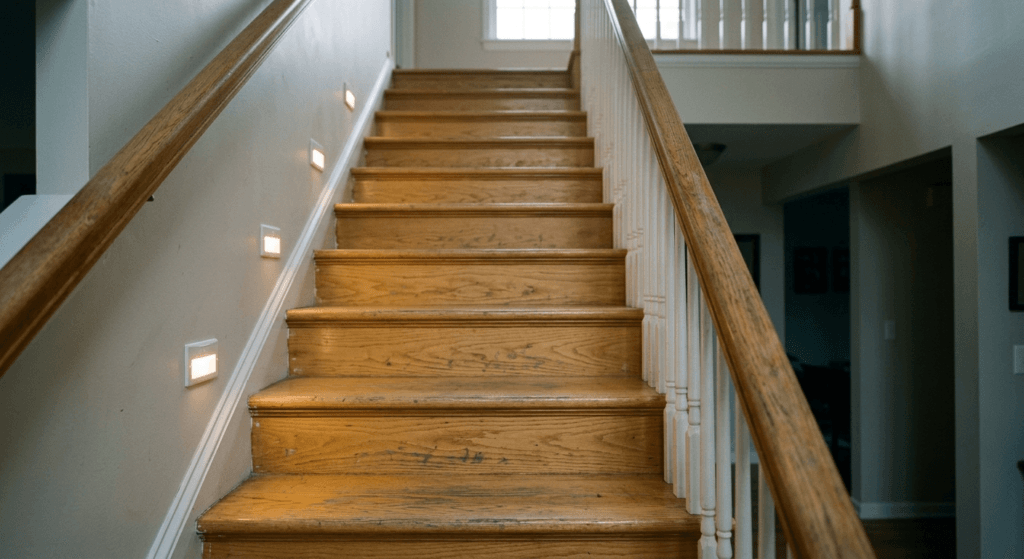
Wood surfaces can range from high-gloss finishes to satin, matte, or textured finishes. In general, highly reflective surfaces may create more slip and glare concerns than lower-gloss finishes, particularly when dust, moisture, or socks are involved.
Maintenance Practices Matter
Wood stair safety often depends on maintenance choices. Excessive waxing, residue-producing cleaners, infrequent cleaning, dust accumulation, and pet hair buildup can all change the way a wooden stair surface behaves underfoot.
A staircase may technically be in good condition while still becoming slippery due to maintenance habits.
Wear Patterns Matter
Over time, wood develops wear patterns. Certain areas, especially near the stair nosing, may become smoother than the rest of the tread. This can subtly reduce traction without creating obvious visual warnings.
Families often miss these changes because the staircase still appears structurally sound.
Why Going Downstairs Often Creates Greater Risk Than Climbing
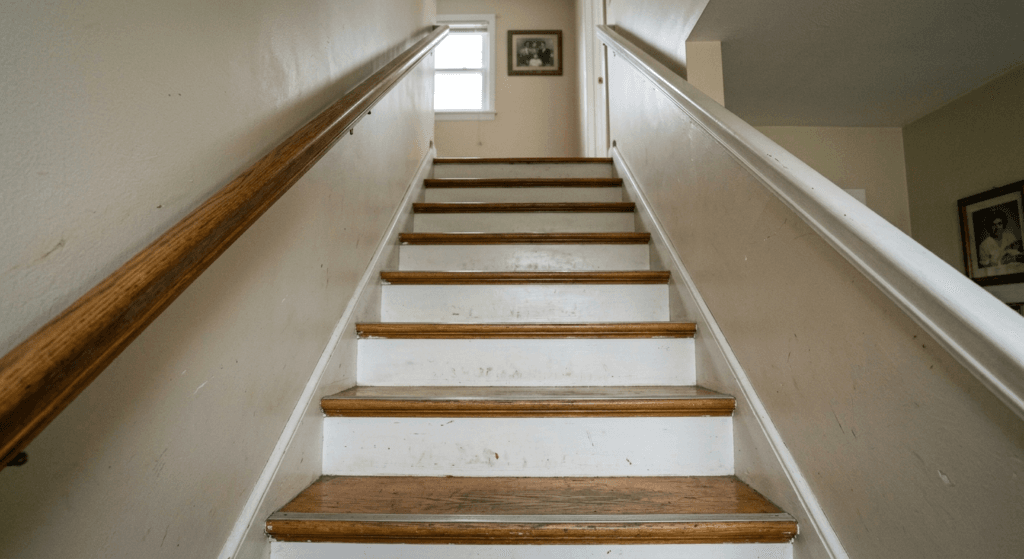
Descending stairs is often more demanding than climbing them because the body must control forward and downward movement at the same time. The person has to judge the stair edge accurately, place the foot securely, and manage momentum while the center of gravity moves forward.
This is where surface material becomes especially important. A slippery wooden tread may allow the front foot to slide during descent. A worn carpet edge may catch the toe or make the stair edge less distinct. A patterned runner may visually blur where one step ends and the next begins.
For older adults with reduced depth perception, slower reaction time, knee weakness, or fear of falling, descent can feel less forgiving than ascent. A staircase that feels acceptable going up may feel unsafe coming down, particularly at night or when carrying laundry, a phone, or household items.
Important safety point: If an older adult regularly pauses at the top of the stairs, grips the rail tightly, turns sideways, or avoids going down unless someone is nearby, the issue may not be “confidence” alone. It may be a sign that the stair system no longer matches their current mobility and vision needs.
Carpet Thickness, Pile Height, and Stair Safety
Not all carpet behaves the same way on stairs. A low-pile carpet that is tightly installed may provide traction without substantially changing foot placement. A thick, plush, or heavily padded carpet can feel softer, but it may also reduce the ability to sense the exact stair edge underfoot.
For stair safety, the most concerning carpet conditions often include:
- Thick pile that makes the tread edge feel less precise
- Soft padding that changes how the foot lands
- Loose installation that shifts slightly under pressure
- Busy patterns that make step edges harder to distinguish
- Dark, uniform colors that reduce visual separation between steps
This does not mean all stair carpet should be removed. It means carpet choice and installation quality matter. For an aging-in-place home, stair carpet should support secure footing, clear edge recognition, and easy maintenance rather than simply looking comfortable.
Canes, Walkers, and Stair Surface Decisions
Stair surface decisions become more complicated when an older adult uses a cane, walker, or other mobility aid. These tools interact differently with carpet and wood.
A cane tip may grip differently on polished wood than on carpet. A walker is generally not used in a normal way on standard stairs, and families should not assume that a walker-friendly hallway means the staircase is also safe. Some older adults also change their stair strategy by using one rail, two hands, a cane, or a step-to pattern.
These details matter because flooring changes alone may not solve the underlying access problem. If stairs now require a cane, heavy rail dependence, or another person nearby, families may need to think beyond surface material and consider a broader plan for stairlift versus first-floor living, especially if the home is intended to support aging in place for many years.
Comparing Flooring Changes With Bigger Stair Options?
If stairs are becoming difficult to use, compare surface improvements with larger solutions such as rail upgrades, lighting, first-floor living, or stairlift planning.
Lighting, Glare, and Visual Contrast May Matter as Much as Flooring
Many discussions about stair safety focus almost entirely on flooring. Lighting is often equally important.
Age-related vision changes can make it harder to identify step edges, stair depth, changes in elevation, and surface transitions. Reduced contrast sensitivity may make a staircase feel uncertain even when the surface itself is not especially slippery.
Carpet and Visibility
Certain carpet colors can improve step recognition. Others can reduce it. Uniform dark carpeting may obscure step edges. Busy patterns may visually blur stair geometry. Low-contrast carpeting may make individual steps difficult to distinguish.
Wood and Visibility
Wood can sometimes provide stronger visual definition between stair edges and risers. However, reflective surfaces may create glare that interferes with depth perception, especially near windows, overhead lights, or shiny finishes.
Nighttime Stair Use
Nighttime conditions often reveal safety weaknesses that remain unnoticed during daylight. For many older adults, depth perception decreases in lower light, contrast becomes harder to interpret, and reaction time slows.
This is why flooring decisions should be considered alongside staircase lighting for seniors. Motion-activated lights, better overhead lighting, glare control, and clear step-edge visibility can sometimes improve safety more than replacing the stair surface itself.
Carpeted vs. Wooden Stairs Comparison Table
| Surface Factor | Carpeted Stairs | Wooden Stairs | Practical Implication |
|---|---|---|---|
| Slip Resistance | Often higher initially, especially with low-pile carpet | Varies widely by finish, dust, moisture, and cleaning residue | Surface condition matters more than material alone |
| Trip Risk | Loose edges, thick pile, and worn runners can catch the foot | Usually fewer fabric edges, but nosings and transitions still matter | Inspect edges, transitions, and tread condition regularly |
| Visibility | Can help or hinder step recognition depending on color and pattern | May provide clearer edge definition but can create glare | Contrast is critical for aging eyes |
| Maintenance | Requires monitoring for wear, loosening, stains, and fraying | Requires monitoring for slick finishes, residue, dust, and wear patterns | Both surfaces require routine inspection |
| Impact During Falls | May provide somewhat softer impact characteristics | Harder impact surface | Preventing the fall remains more important than softening impact |
| Descending Stairs | Worn or thick carpet can obscure the stair edge | Smooth wood can allow sliding during downward movement | Descent should be tested separately from ascent |
| Nighttime Usability | Depends heavily on contrast and lighting | Depends heavily on glare control and lighting | Lighting remains a major safety factor |
| Long-Term Aging-in-Place Suitability | Can work well if low-pile, secure, visible, and maintained | Can work well if clean, low-gloss, visible, and supported by rails | The entire stair system matters more than flooring alone |
Practical Safety Adjustments That May Help Either Surface
Families sometimes focus on replacing flooring when simpler improvements could provide larger safety benefits.
These smaller interventions often reveal whether flooring replacement is truly necessary. Families may also benefit from reviewing the signs that stairs are becoming unsafe before committing to a larger project.
When to Consider Professional Evaluation
Professional assessment becomes increasingly valuable when aging-related mobility changes begin affecting stair use. An occupational therapist can evaluate how strength, balance, vision, and mobility interact with the home environment. An aging-in-place specialist can identify practical modifications that support long-term independence.
Professional evaluation may be warranted when stairs are unusually steep, major renovations are planned, surface replacement is being considered, structural concerns exist, or multiple falls or near-falls have occurred.
Expert guidance is particularly valuable when families are deciding whether flooring replacement alone will meaningfully improve safety or whether a broader home modification plan is needed across the house. For a separate estimate of bathroom upgrades, use our bathroom safety cost calculator.
Key Takeaways for Families Making Flooring Decisions
- Neither carpet nor wood is automatically safer in every situation.
- Carpet can improve traction but may create trip hazards if worn, thick, loose, or visually confusing.
- Wooden stair safety depends heavily on finish, maintenance, cleanliness, glare, and footwear.
- Descending stairs often creates greater risk than climbing because it requires more visual precision and momentum control.
- Lighting quality may influence stair safety as much as flooring material.
- Footwear choices can dramatically alter slip risk.
- Canes, walkers, and mobility changes may require a broader stair access plan.
- Safety should be evaluated as a complete system rather than a single product choice.
Many families discover that handrails, lighting improvements, maintenance, and behavior changes provide greater benefits than flooring replacement alone.
Considering a Stairlift for Your Home?
If flooring, lighting, and handrail improvements are not enough, explore how stairlift installation works and find local service options.
Conclusion
Carpet can offer traction advantages and may increase confidence for some users, but worn carpeting can introduce hazards that gradually develop over time. Wooden stairs may present slip concerns under certain conditions, yet many remain safe for decades when properly maintained and paired with adequate lighting and handrails.
Perhaps the most important insight is that stair safety rarely depends on flooring alone. As covered in age-related stair safety planning, aging changes how people interact with their environment. Flooring should therefore be evaluated as one part of a larger stair-safety system that includes visibility, maintenance, mobility, behavior, and home design.
For most families aging in place, the safest staircase is not necessarily the one with a particular surface material. It is the one that is well maintained, clearly visible, properly equipped, and matched to the needs of the person using it.
FAQ: Carpet vs. Wooden Stairs for Older Adults
Are carpeted stairs safer than wooden stairs for seniors?
Not always. Carpet can improve traction, but loose, thick, worn, or poorly installed carpet can create trip hazards. Wooden stairs can be slippery if polished or dusty, but they may perform well when low-gloss, clean, visible, and paired with secure handrails.
Is hardwood too slippery for older adults?
Hardwood can be slippery under certain conditions, especially with high-gloss finishes, wax residue, dust, moisture, or socks. However, not all wood stairs are unsafe. Finish, maintenance, lighting, footwear, and handrails all matter.
What type of carpet is best for stairs used by older adults?
A low-pile carpet that is tightly installed and visually clear is generally preferable to thick plush carpet. The goal is secure footing, clear stair-edge recognition, and minimal movement underfoot.
Should stair runners be avoided for aging in place?
Not necessarily, but they must be installed securely and inspected regularly. Loose runner edges, narrow exposed sections, and confusing patterns can increase risk for some older adults.
Does better lighting reduce stair fall risk?
Better lighting can improve stair-edge visibility, depth perception, and nighttime confidence. Lighting cannot remove all risk, but it is one of the most important stair safety factors alongside surface condition and handrails.
When should families consider more than flooring changes?
If an older adult avoids stairs, has near-falls, depends heavily on rails, struggles descending, or needs assistance, the issue may go beyond flooring. A professional assessment, stairlift planning, or first-floor living arrangement may be worth considering.
Editorial Review
This AgingAuthority article is written for educational home safety planning and reviewed for clarity, responsible safety communication, and aging-in-place relevance. Learn more about the AgingAuthority editorial team.
Sources
- CDC — Facts About Older Adult Falls
- CDC — Older Adult Falls Data
- National Institute on Aging — Falls and Falls Prevention
- National Institute on Aging — Preventing Falls at Home: Room by Room
- AARP — HomeFit Guide
- National Council on Aging — Falls Prevention
Editorial analysis and practical interpretations are intended to help families evaluate stair-safety considerations and should not be interpreted as formal clinical, engineering, or contractor recommendations.
Disclaimer
This content is for general educational purposes only and does not replace a professional home safety assessment, medical advice, occupational therapy evaluation, or licensed contractor inspection. Families should consult qualified professionals when falls, near-falls, structural concerns, or major home modifications are involved.