
For a complete overview of safer stairs, explore our Complete Stair Safety Guide for Aging in Place .
Can a Stairlift Be Installed on Narrow Stairs?
A narrow staircase does not automatically rule out a stairlift. The real question is whether the rail, chair, rider, landings, and remaining walking route can work together in the space available.
Executive Summary
Some narrow staircases can accommodate a stairlift, but wall-to-wall width alone cannot confirm suitability. The rider’s knee and shoulder clearance, folded equipment depth, rail position, obstacles, landings, staircase shape, and the space left for everyone else must be assessed together.
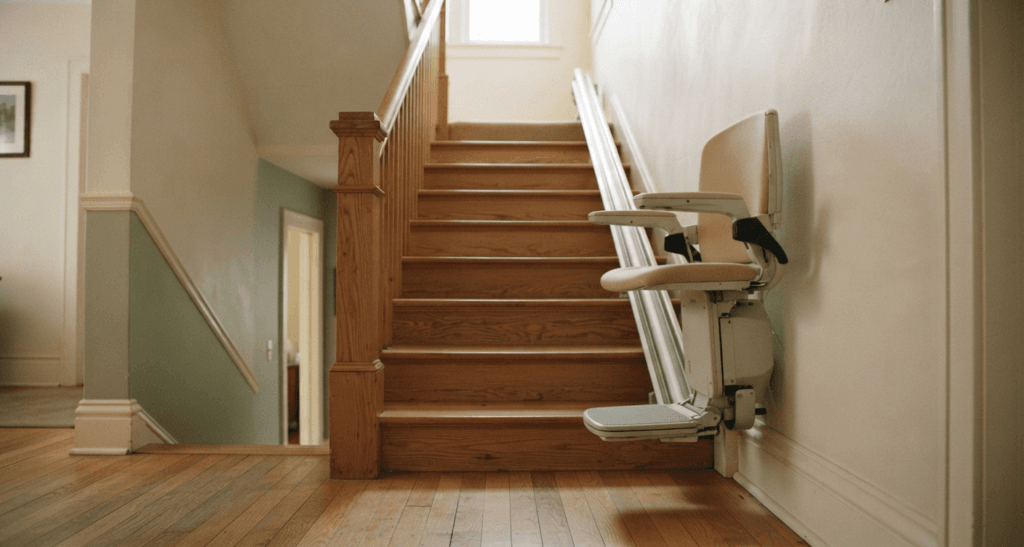
Families often measure from one wall to the other and assume that number provides a yes-or-no answer. In practice, it is only a starting point. A projecting handrail, doorway, radiator, newel post, or trim detail may create a tighter point elsewhere. The rider also occupies space differently from a folded, empty chair.
1Can a Stairlift Be Installed on Narrow Stairs?
A workable installation depends on the occupied chair, not merely whether its rail attaches to the steps. A taller rider or someone unable to bend the knees comfortably may need more clearance. Product specifications, homes, and local requirements also differ.
2What Counts as a Narrow Staircase?
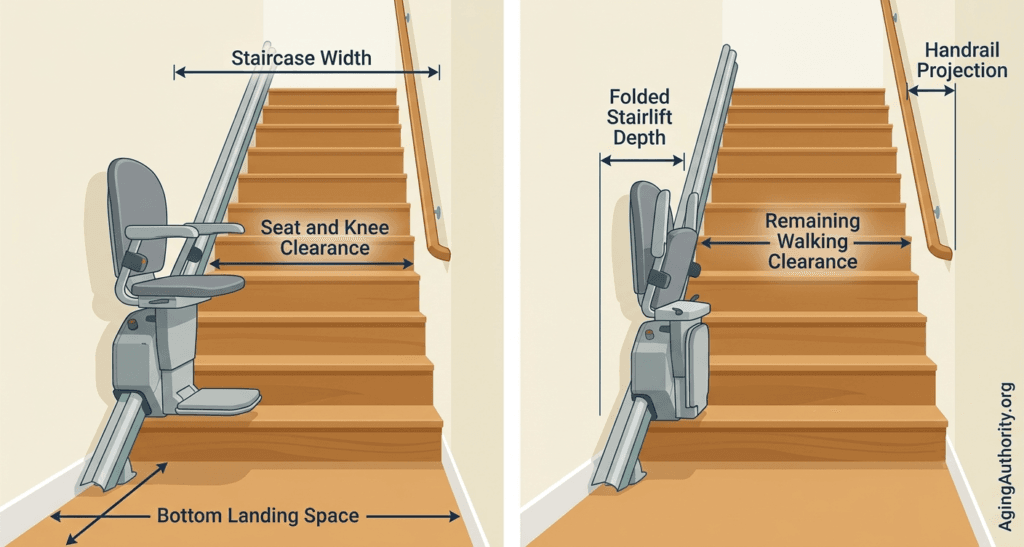
“Staircase width” can describe several different measurements. Total width is commonly measured wall to wall. Clear or usable width subtracts anything projecting into that space, including handrails and trim. The narrowest point may be near the top, at a turn, beside a door, or around a newel post—not halfway up the stairs where families often measure first.
The rail and folded chair reduce usable space, so assessment must map the full route.
3The Measurements That Matter Most
The intended user should be included in measurement. Seated posture, knees, shoulders, ability to rotate, and method of transferring may matter more than compact dimensions in a brochure.
| Factor | What to Measure or Observe | Why It Matters |
|---|---|---|
| Narrowest stair width | Check the entire run, including turns and posts. | One pinch point may govern the installation. |
| Rider clearance | Observe knees, feet, elbows, and shoulders when seated. | The chair may fit while the rider does not. |
| Folded depth | Include seat, arms, and footrest. | Determines the walking space left for others. |
| Landings | Check standing, turning, and transfer space at both ends. | A compact stair run cannot compensate for a difficult transfer. |
| Doors and obstacles | Open nearby doors fully; note radiators, trim, and furniture. | The rail or parked chair may interrupt normal use. |
| Stair shape | Record bends, intermediate landings, and changing angles. | These affect rail design and parking position. |
| Handrails | Note their projection and whether one remains reachable. | Walking users may still need secure hand support. |
4Straight Versus Curved Narrow Staircases
A straight staircase usually allows a simpler rail layout. Curves, wedge-shaped steps, and intermediate landings often require a custom rail, while parking position can affect both usable space and price. A curve is not an automatic barrier, but it adds planning decisions. See Straight vs. Curved Stairlifts and the Stairlift Cost Calculator.
5Will Other People Still Be Able to Use the Stairs?
Measure the remaining passage with the seat, arms, and footrest folded. Consider real routines: children on the stairs, an adult carrying laundry, a caregiver assisting someone, or occupants needing the route during an emergency.
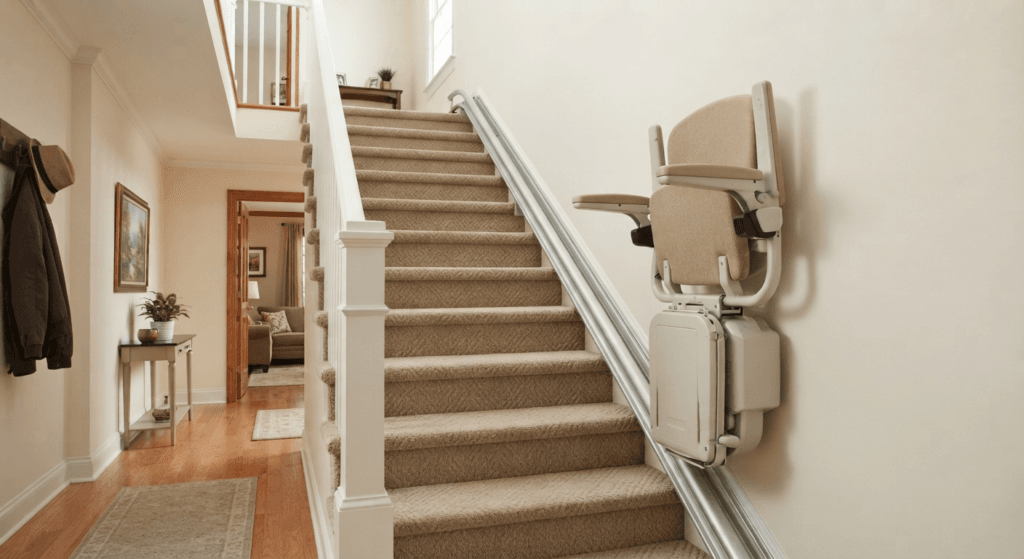
A folded unit can still create a pinch point, especially beside a projecting handrail. Removing the only functional handrail to gain space may create a different problem. Review the Stair Handrail Height and Grip Guide before treating the handrail as expendable.
6Features That May Help in Tight Spaces
Folding seats, arms, and footrests reduce the parked projection. A slim rail may preserve room, while a hinged rail can keep its lower end away from a doorway. Parking beyond the main walking line may also help.
A powered swivel seat can reduce the effort required to turn at a landing, and a powered footrest may help someone who has difficulty bending. Perch-style or standing options exist for selected users, but they require careful clinical and practical judgment. Compact features cannot correct poor knee clearance, instability, or an unsafe transfer area.
7When a Stairlift May Not Be Practical
A stairlift may be a poor fit when the rider’s knees approach the opposite side, the folded chair restricts passage, nearby doors cannot open, or limited landing space makes transfers difficult.
Look beyond today’s installation. If the person cannot transfer reliably, has difficulty remaining seated, or is likely to need substantial assistance soon, the household may outgrow the solution. Unusual structural conditions or a rail that obstructs a required route likewise deserve professional review.
8Alternatives to Consider
Alternatives include relocating the bedroom, adapting a downstairs bathroom, or living on the first floor. A platform or through-floor lift may suit some homes and users. Moving to a more accessible home can sometimes be the more durable choice.
While planning, improvements to lighting, tread contrast, traction, and handrails may reduce avoidable hazards, although they do not resolve every mobility limitation. Our comparison of Stairlift vs. First-Floor Living can help families weigh disruption, independence, household routines, and longer-term adaptability.
9When to Request a Professional Evaluation
Request an in-home evaluation when stairs are unusually narrow, turn, have restricted landings, sit close to obstacles, serve several people, or the intended user struggles to bend, rotate, or transfer.
A qualified stairlift installer can check product-specific tolerances and rail placement. An occupational therapist, accessibility specialist, home modification contractor, or home safety assessor may add a broader view of the user’s abilities and the home’s daily routines. The assessment should observe the person as well as measure the staircase.
10The Bottom Line
A narrow staircase may accommodate a stairlift, but a successful decision requires more than proving that equipment can be attached. Accurate measurements, rider clearance, workable landings, obstacle checks, and continued access for the household should all support the same conclusion.