
Mobility Aids for Seniors: A Complete Guide to Safer Movement at Home
Executive Summary
Mobility aids function as external stability systems that support safe movement when physical ability changes. Their effectiveness depends on how well they align with real-world movement inside the home—especially during high-risk transitions such as standing, turning, and navigating stairs. Independence is preserved not by the device itself, but by integrating movement, environment, and support into a coordinated system that reduces fall risk and maintains daily function.

- Executive Summary
- 1. Introduction
- 2. Assessing Mobility Needs
- 3. What Are Mobility Aids? (System Definition)
- 4. Movement & Environmental Risk Framing
- 5. Deep Dive: Movement Transitions and Stability
- 6. Primary Categories of Mobility Aids
- 7. Selection Criteria
- 8. Home Integration & Universal Design
- 9. Innovation & Assistive Technology
- 10. Visual Summary
- 11. Room-by-Room Movement Support
- 12. Common Mistakes
- 13. Cost & Planning
- 14. Emotional & Psychological Considerations
- 15. When to Seek Professional Help
- 16. Frequently Asked Questions
- 17. Conclusion
- 18. Sources + Editorial Note
1. Introduction
Mobility decline is often misunderstood as a purely medical issue. In reality, it is more accurately understood as a movement system breakdown occurring within a real, lived environment.
The body does not move in isolation. Every action—standing, walking, turning, or stepping—takes place within a physical space that either supports stability or introduces risk. As physical capacity changes with age, that relationship between the body and the environment becomes increasingly fragile.
Most fall incidents are not random. They occur during movement transitions—standing up from a chair, initiating walking, turning in confined spaces, stepping into a shower, or navigating stairs. These actions require precise coordination between strength, balance, timing, and spatial awareness. When even one of these components weakens, the entire movement sequence becomes less predictable.
What begins as a slight hesitation before walking or a reliance on nearby furniture often signals a deeper shift: movement is no longer fully controlled—it is being compensated for.
Mobility risk concentrates at transitions.
For families supporting an older adult, the challenge is not simply to assist movement. It is to restore consistency and stability across the full range of daily movements inside the home.
This requires a fundamental shift in perspective:
From:
“What device should we buy?”
To:
“Where does movement break down—and what type of support stabilizes that specific moment?”
Mobility aids, in this context, are not isolated tools. They function as part of a broader system that includes:
- movement behavior (how the person moves)
- environmental layout (how the home is structured)
- support infrastructure (what stabilizes movement)
When these elements are aligned, movement becomes predictable again. When they are not, even simple daily actions can become high-risk events.
Support must match movement.
A device is only effective if it fits the environment.
Not sure where movement is breaking down at home?
Plan Home Modifications Around Your Needs
Choose the areas you want to improve and get a preliminary budget range and project brief to discuss with providers.
Open the Project Planner →2. Assessing Mobility Needs

Before selecting any mobility aid, it is essential to identify how and where movement breaks down within daily routines.
Mobility decline does not affect all movements equally. A person may walk short distances without difficulty but struggle when standing up, turning, or navigating confined spaces. For this reason, effective assessment should not focus on general ability—it must focus on specific moments of instability.
Movement Breakdown Mapping
Rather than approaching mobility as a medical diagnosis, a more practical and accurate approach is to observe functional movement behavior inside the home.
This means identifying:
- where movement becomes slower or hesitant
- where balance is lost or corrected
- where external support is unconsciously used
These patterns reveal how the body is adapting to reduced stability.
Key Observational Questions
The following questions help identify where movement is no longer fully controlled:
- Does standing require pushing with hands or using nearby surfaces?
- Is there hesitation or pause before initiating walking?
- Are turns slower, wider, or dependent on external support?
- Does fatigue significantly reduce movement quality after short distances?
- Are stairs avoided, delayed, or approached with visible effort?
- Does the bathroom feel unsafe, especially during entry or exit?
Interpreting Movement Patterns
Each of these observations represents a different type of instability:
- Difficulty standing → reduced lower-body strength or balance initiation
- Hesitation before walking → impaired movement initiation
- Unstable turning → compromised rotational control
- Fatigue → reduced endurance and coordination over time
- Avoiding stairs → high-risk vertical movement deficit
- Bathroom discomfort → awareness of complex, high-risk transitions
These are not isolated symptoms. They are indicators of how movement is being compensated for rather than controlled.
System Insight
Mobility challenges rarely exist in a single form. Most individuals experience multiple overlapping limitations, which is why a single device is often insufficient.
Effective support begins with identifying the exact point of failure in movement—not the device itself.
Core Stability Domains
Understanding mobility requires looking beyond visible difficulty and focusing on the underlying stability systems that support movement. These systems do not fail all at once—they degrade in layers, often beginning with subtle changes that are easy to overlook.
Three core domains define how stable and reliable movement remains inside the home:
1. Gait Stability
Walking is not a simple forward motion—it is a continuous process of controlled imbalance and correction. With each step, the body shifts weight, adjusts position, and stabilizes itself in motion.
When gait stability declines, these corrections become less precise. This may appear as:
- uneven or shortened steps
- drifting or loss of directional control
- reliance on walls, furniture, or nearby surfaces
These patterns are commonly evaluated through Gait Analysis, which examines how efficiently and safely a person moves during walking.
In real home environments, reduced gait stability becomes especially noticeable in:
- narrow pathways
- cluttered living areas
- transitions between rooms
Walking may still be possible—but it is no longer consistently stable.
2. Postural Stability
While gait relates to movement, postural stability refers to the ability to maintain balance during stillness and controlled shifts in position.
This includes:
- standing upright without support
- shifting weight when reaching
- maintaining balance when transitioning between positions
Loss of Postural Stability often becomes most visible during transitions such as:
- sitting → standing
- standing → turning
- reaching → returning to neutral position
In many cases, individuals begin to compensate by:
- widening their stance
- moving more slowly
- using nearby objects for support
These adaptations indicate that balance is no longer automatic—it is being actively managed.
3. Fatigue & Endurance
Not all mobility limitations are immediate. Some emerge progressively as energy is depleted.
A person may appear stable at the beginning of a movement sequence, but as fatigue increases:
- coordination declines
- reaction time slows
- balance corrections become less effective
This creates a delayed risk pattern, where:
- early movement is controlled
- later movement becomes unpredictable
Fatigue is particularly relevant in:
- longer walking distances
- repeated transitions (e.g., bathroom trips)
- end-of-day movement inside the home
Movement, in this context, is not just about ability—it is about sustainability over time.
System Insight
These three domains rarely fail in isolation. Most mobility challenges involve a combination of gait instability, reduced postural control, and fatigue accumulation.
Effective mobility support depends on identifying which domain is most compromised—and matching support accordingly.
Mobility Breakdown → What It Means
| Observed Difficulty | What It Indicates | Risk Level | Typical Solution |
|---|---|---|---|
| Difficulty standing from chair | Lower body weakness | High | Lift chair, grab bars |
| Hesitation before walking | Movement initiation issue | Medium | Walker |
| Unstable turning | Rotational imbalance | High | Rollator + environment support |
| Fatigue after short distance | Low endurance | Medium–High | Wheelchair |
| Avoiding stairs | Strength deficit | High | Stairlift |
| Bathroom fear | High-risk transitions | Very High | Grab bars |
3. What Are Mobility Aids? (System Definition)

Mobility aids are best understood not as products, but as external stability systems designed to extend the body’s ability to move safely within a real environment.
As physical capacity changes with age, the body’s internal systems—balance control, coordination, strength, and endurance—become less reliable. Movements that were once automatic begin to require conscious effort, and in many cases, compensation.
Mobility aids function as an extension of these internal systems. They provide additional points of contact, redistribute physical load, and stabilize movement during moments where the body alone can no longer maintain control.
Rather than “helping” movement in a general sense, they serve a more specific role:
- reinforcing balance during instability
- reducing effort during fatigue
- controlling motion during high-risk transitions
- increasing predictability in everyday movement
Beyond Devices: A System Perspective
A mobility aid is only effective when it is aligned with both:
- the type of movement breakdown, and
- the environment in which movement occurs
For example:
- A walker may stabilize forward movement but fail in narrow spaces
- A wheelchair may conserve energy but require environmental adaptation
- Grab bars may provide critical support—but only at specific transition points
This is why mobility aids should not be viewed as interchangeable tools. Each one is designed to solve a specific movement problem within a specific context.
Functional Role in Daily Movement
In practical terms, mobility aids serve as:
- stability enhancers during walking and standing
- transition supports during position changes
- energy conservation systems when endurance declines
- risk reduction mechanisms in high-hazard areas like bathrooms and stairs
They do not eliminate mobility challenges—but they restructure how movement is performed, making it safer and more sustainable.
System Insight
Mobility support is not defined by the device itself, but by how well it integrates into the broader movement system.
A mobility aid is only effective when it matches the specific movement demand—and fits the environment in which that movement takes place.
Functional Categories
Walking Support
- canes
- walkers
- rollators
Seated Mobility
- manual wheelchairs
- powered wheelchairs
Vertical Movement
- stairlifts
- ramps
Transfer Support
- grab bars
- lift chairs
Each category solves a specific movement failure.
4. Movement & Environmental Risk Framing
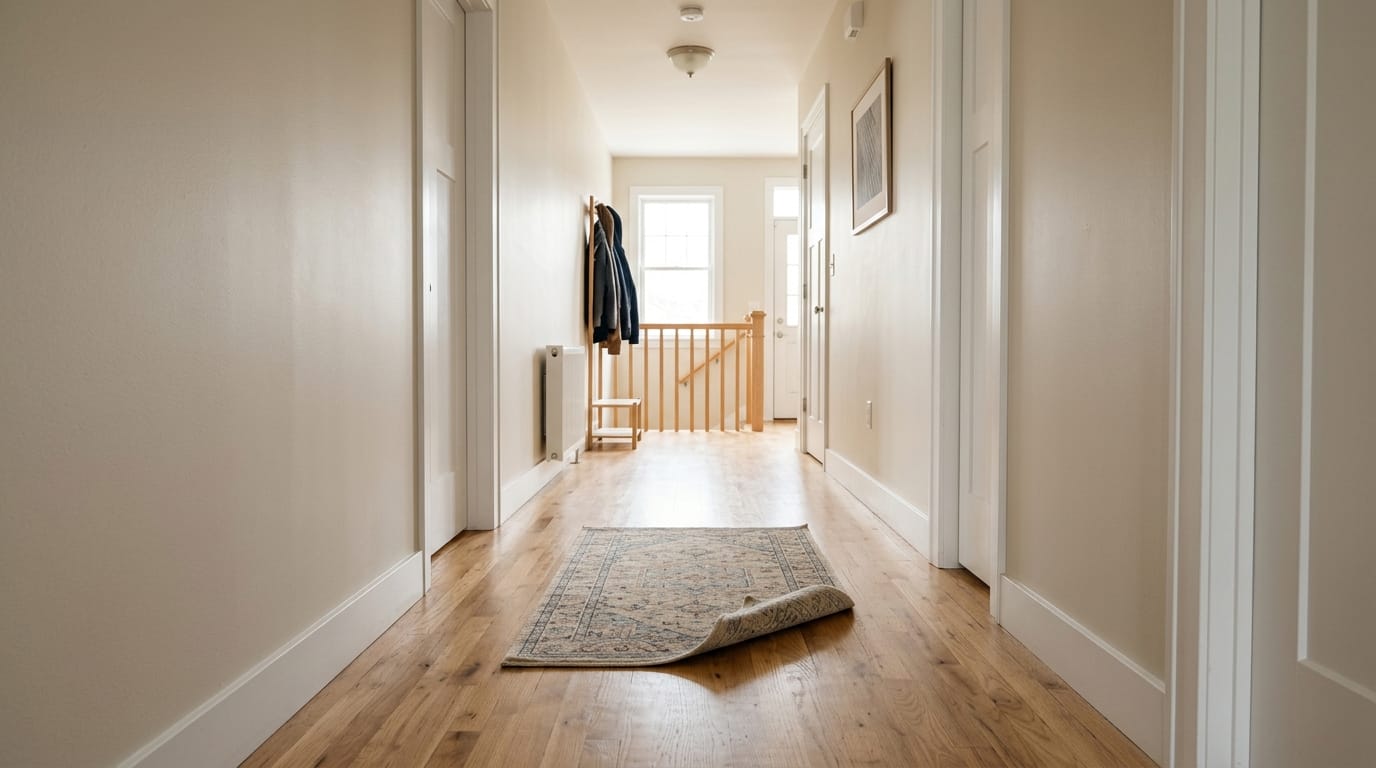
A home is not simply a place where movement happens. It is a movement system that continuously interacts with the body.
Every layout—whether consciously designed or not—either supports stability or introduces hidden risk. As mobility changes with age, this interaction becomes increasingly important. Environments that once felt neutral can begin to demand movements that are no longer safe or sustainable.
The Home as a Movement Environment
Daily movement inside a home follows predictable patterns:
- standing from seating areas
- walking through hallways
- turning in confined spaces
- entering and exiting bathrooms
- navigating stairs
Each of these movements requires a different combination of balance, strength, coordination, and spatial awareness.
When the environment does not align with these requirements, even simple actions become unstable.
Where Risk Emerges
Risk does not come from a single factor. It emerges from the interaction between movement demand and environmental constraints.
Common examples include:
- Narrow pathways → reduce the ability to correct balance during walking
- Low or soft seating → increases difficulty during standing transitions
- Slippery or uneven flooring → reduces traction and increases fall risk
- Poor lighting → limits visual feedback needed for balance
- Bathroom layouts → combine confined space with complex movement and moisture
In many cases, the environment remains unchanged while the individual adapts through compensation—moving slower, using nearby surfaces, or avoiding certain areas altogether.
High-Risk Zones Inside the Home
Certain areas consistently present higher levels of risk due to the complexity of movement involved:
- Bathrooms → multi-directional movement + wet surfaces
- Stairs → vertical movement with high consequences
- Entryways → transitions between surfaces and levels
- Bedrooms (night movement) → reduced visibility and coordination
Research and reporting from the Centers for Disease Control and Prevention consistently highlight these areas as primary locations where falls occur.
The Mismatch Problem
The core issue is rarely the environment alone or the body alone—it is the mismatch between the two.
A person may still have enough strength to climb stairs, but not enough stability to do so safely. A bathroom may function well for a fully mobile individual but become hazardous when balance declines.
Over time, this mismatch leads to:
- avoidance of certain areas
- increased reliance on unstable support (walls, furniture)
- reduced confidence in movement
System Insight
Mobility safety is not achieved by changing one element in isolation. It requires aligning:
- the movement demands of the home
- the physical capabilities of the individual
- the support systems in place
The home either supports movement—or silently increases risk.
5. Deep Dive: Movement Transitions and Stability
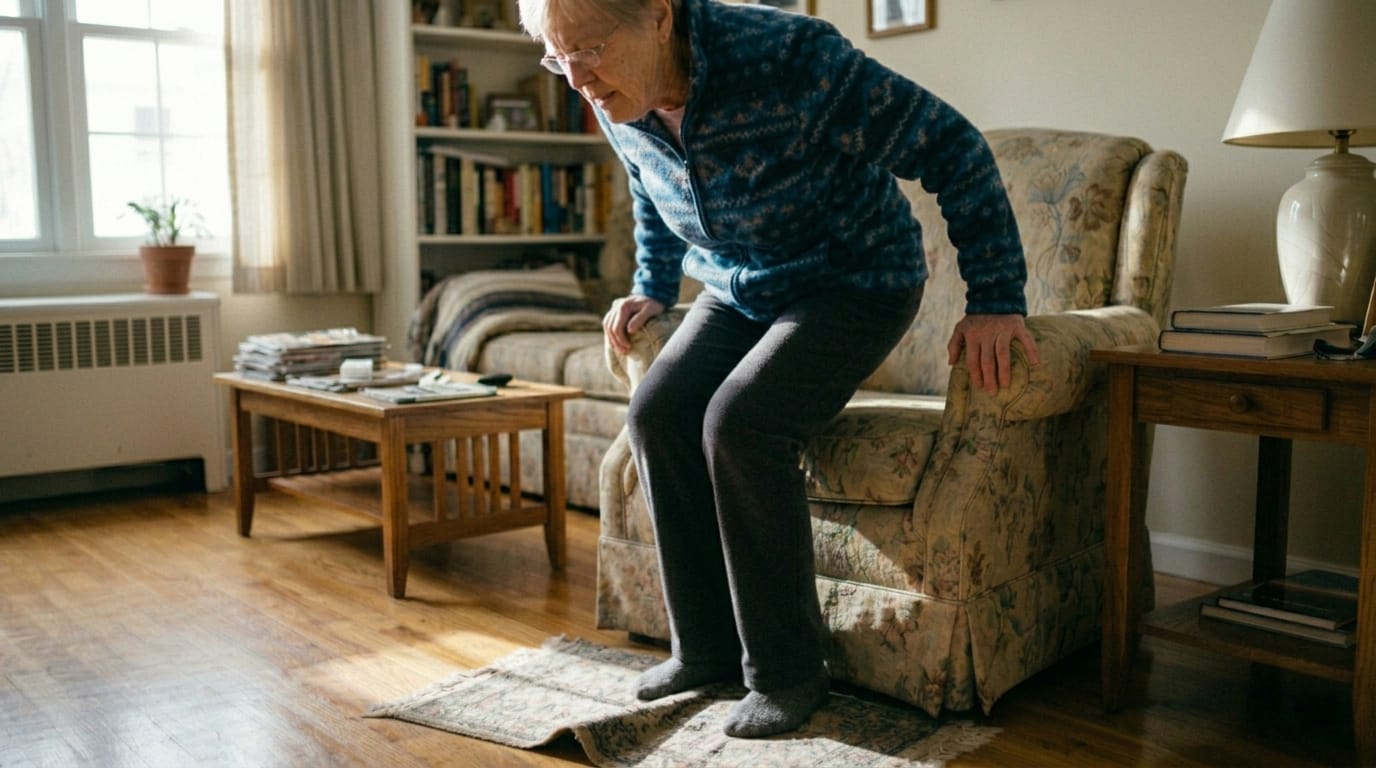
This is where most falls occur—not during steady walking, but during movement transitions such as standing up, sitting down, or turning. These moments require the body to shift weight, adjust balance, and coordinate multiple muscle groups at once. Even a small delay or weakness in this process can lead to instability.
In a home environment, these transitions happen constantly: getting out of a chair, stepping away from a bed, or turning in a narrow space. As physical capacity changes with age, these everyday movements become less predictable and more sensitive to environmental factors like surface friction, furniture height, and available support.
Understanding how instability develops during these transitions is essential. It is not just about strength—it is about timing, positioning, and the interaction between the body and the surrounding space. This is where the right support, whether through mobility aids or environmental adjustments, can make a measurable difference in safety and independence.
Movement Transition Risk Matrix
| Movement Transition | What Breaks Down | Why It’s Dangerous | Required Support |
|---|---|---|---|
| Sitting → Standing | Weight shift | Backward fall risk | Lift chair |
| Standing → Walking | Balance disruption | First-step instability | Walker |
| Continuous Walking | Gait instability | Progressive imbalance | Rollator |
| Turning | Center shift | Sudden fall | Stable support |
| Stairs | Strength + timing | High-impact falls | Stairlift |
| Bathroom entry | Multi-directional movement | Slips | Grab bars |
| Fatigue | Coordination decline | Delayed reactions | Wheelchair |
Detailed Transition Analysis
Sitting → Standing
Requires forward momentum and leg strength. Weakness leads to instability immediately after rising.
Standing → Walking
The first step disrupts balance. Without support, falls often occur here.
Turning
Turning shifts the center of gravity rapidly. Narrow spaces increase risk.
Stair Navigation
One of the most complex movements. Failure leads to severe consequences.
Bathroom Transitions
Wet surfaces + confined movement create compounded risk.
Fatigue
Late-day movement is slower, less coordinated, and more dangerous.
Support must match movement.
6. Primary Categories of Mobility Aids
Mobility Aid Comparison
| Device | Use | Best Environment | Stability | Limitation |
|---|---|---|---|---|
| Cane | Mild support | Open spaces | Low | Limited stability |
| Walker | Balance support | Indoors | High | Slower |
| Rollator | Mobility + support | Large spaces | Medium–High | Needs coordination |
| Wheelchair | Fatigue | Accessible homes | Max | Requires space |
| Stairlift | Stairs | Multi-level homes | Max | Fixed |
| Grab Bars | Transitions | Bathroom | High | Fixed |
| Lift Chair | Standing | Living room | High | Limited scope |
Category Insights
Walkers & Rollators
Provide continuous stability for walking.
→ read our walker selection guide
Wheelchairs
Allow movement without fatigue.
→ compare manual vs electric wheelchairs
Stairlifts
Remove vertical risk entirely.
→ see our detailed guide on stairlifts
Transfer Aids
Stabilize high-risk transitions.
Lift Chairs
Assist standing safely.
7. Selection Criteria
Choosing incorrectly increases risk.
Device Selection Guide
| Situation | Recommended Device | Reason |
|---|---|---|
| Mild instability | Cane | Minimal support needed |
| Frequent imbalance | Walker | Continuous stability |
| Needs mobility | Rollator | Balanced movement |
| Fatigue | Wheelchair | Energy saving |
| Unsafe stairs | Stairlift | Removes risk |
| Standing difficulty | Lift chair | Assists movement |
Key Factors
- stability level
- sizing & ergonomics
- home compatibility
- lifestyle needs
- long-term value
8. Home Integration & Universal Design
Mobility aids require environmental support.
Principles of Universal Design ensure accessibility.
Home Compatibility Table
| Home Feature | Problem | Solution |
|---|---|---|
| Narrow halls | Device doesn’t fit | Rearrange layout |
| Stairs | Fall risk | Stairlift |
| Slippery floors | Low traction | Non-slip flooring |
| Poor lighting | Visibility issues | Add lighting |
| Thresholds | Trip hazard | Remove barriers |
A device without environmental support is incomplete.
9. Innovation & Assistive Technology
Modern mobility support is no longer limited to physical devices. It is increasingly shaped by advances in Assistive Technology, where movement, data, and environmental awareness are integrated into a unified system.
The focus is shifting from reactive support—helping after instability occurs—to predictive safety, where risks are identified before a fall happens.
From Passive Devices to Intelligent Systems
Traditional mobility aids provide physical support. Newer systems extend this by adding layers of monitoring and feedback.
For example:
- smart walkers can track movement patterns and detect instability trends
- fall detection systems can identify sudden changes in position and trigger alerts
- sensor-based environments can monitor movement frequency, speed, and irregular patterns
These technologies do not replace mobility aids. They enhance their effectiveness by providing real-time insight into how movement is changing over time.
Predictive Movement Monitoring
One of the most important developments is the ability to detect subtle changes before they become visible risks.
These include:
- slower walking speed
- increased hesitation during transitions
- irregular movement patterns inside the home
By identifying these early signals, families and caregivers can intervene before a serious fall occurs.
Organizations such as the National Institute on Aging and AARP increasingly emphasize this shift toward proactive safety systems, where monitoring and prevention are integrated into daily living environments.
Integration with the Home Environment
The future of mobility is not device-centered—it is environment-centered.
Emerging systems connect:
- mobility aids
- home sensors
- lighting systems
- emergency response networks
For example:
- motion sensors can trigger lighting during night movement
- monitoring systems can detect unusual inactivity
- connected devices can alert caregivers when movement patterns change
This creates a responsive environment that adapts to the user, rather than forcing the user to adapt to the environment.
System Insight
Technology does not eliminate mobility challenges—it makes them visible, measurable, and manageable.
The future of mobility support lies in combining physical stability with intelligent awareness of movement patterns over time.
10. Visual Summary
| If the challenge is… | The best solution is… | Primary benefit |
|---|---|---|
| Walking instability | Walker/Rollator | Continuous support |
| Fatigue | Wheelchair | Energy conservation |
| Stairs | Stairlift | Eliminates vertical risk |
| Standing difficulty | Grab bars | Stabilizes transitions |
11. Room-by-Room Movement Support
Room-Based Risk Table
| Room | Risk | Challenge | Solution |
|---|---|---|---|
| Bathroom | Slips | Entry/exit | Grab bars |
| Stairs | Falls | Vertical movement | Stairlift |
| Bedroom | Low visibility | Night movement | Lighting |
| Living Room | Clutter | Walking | Clear layout |
| Kitchen | Reaching | Balance | Stable surfaces |
12. Common Mistakes
Mobility challenges are often addressed with good intentions—but without a clear understanding of how movement actually breaks down inside the home. As a result, many well-meaning decisions unintentionally increase risk instead of reducing it.
These mistakes are rarely obvious at first. They tend to emerge over time, as small mismatches between movement, environment, and support begin to accumulate.
Choosing the Wrong Device
One of the most common mistakes is selecting a mobility aid based on general assumptions rather than specific movement needs.
For example:
- using a cane when instability requires full support
- choosing a rollator when balance control is insufficient
- relying on a wheelchair without addressing transition risks
Each device is designed to support a specific type of movement. When the match is incorrect, the device may provide a false sense of security while leaving key instability points unaddressed.
Ignoring the Environment
Mobility aids do not operate in isolation. Their effectiveness depends heavily on the environment in which they are used.
Common issues include:
- walkers that do not fit through narrow spaces
- wheelchairs that cannot navigate room layouts
- absence of support in high-risk areas such as bathrooms
When the environment is not adapted, even the correct device becomes limited or unsafe.
Delaying Intervention
Many families wait until a fall occurs before introducing mobility support.
In reality, early signs are often present:
- hesitation before movement
- reliance on furniture
- avoidance of certain areas
Delaying intervention allows instability to increase, making future movement more difficult to stabilize.
Early support does not reduce independence—it preserves it.
Using One Device for All Needs
Mobility is not a single task. It involves multiple movement types:
- standing
- walking
- turning
- climbing stairs
- navigating confined spaces
Expecting one device to support all of these movements often leads to gaps in safety.
For example:
- a walker may assist walking but not bathroom transitions
- a wheelchair may reduce fatigue but not solve standing instability
Effective mobility support often requires a combination of devices, each matched to a specific movement challenge.
System Insight
Most mobility-related mistakes stem from treating mobility as a single problem rather than a system.
Safe movement is not achieved by choosing a device—it is achieved by aligning movement, environment, and support into a coherent system.
13. Cost & Planning
The cost of mobility support is often underestimated—not because devices are inherently expensive, but because decisions are made without a clear long-term plan.
Many families focus on the immediate need: solving a current mobility issue. However, mobility decline is rarely static. It evolves over time, and support systems must adapt accordingly.
This is why effective planning is not about choosing the cheapest option—it is about anticipating how movement needs will change and investing accordingly.
Realistic Cost Overview
Mobility aids vary significantly in cost depending on complexity, durability, and level of support provided.
| Mobility Aid | Typical Cost Range | Use Duration | Key Consideration |
|---|---|---|---|
| Cane | Low ($20–$80) | Short–Medium | Limited support |
| Walker / Rollator | Low–Moderate ($80–$300) | Medium | Balance vs mobility trade-off |
| Manual Wheelchair | Moderate ($300–$1,000+) | Medium–Long | Requires upper body strength |
| Powered Wheelchair | High ($1,500–$5,000+) | Long | Higher independence, higher cost |
| Stairlift | High ($2,500–$8,000+) | Long | Installation + home fit required |
| Grab Bars | Low ($20–$200 per unit) | Long | Critical for transitions |
| Lift Chair | Moderate–High ($600–$2,500+) | Long | Supports sit-to-stand movement |
Short-Term vs Long-Term Thinking
A common mistake is choosing a device based only on current ability.
For example:
- selecting a cane when stability is already declining
- delaying a stairlift despite increasing difficulty
- avoiding environmental modifications due to cost
These decisions often lead to:
- repeated purchases
- increased fall risk
- higher total cost over time
In contrast, planning for progression allows families to:
- reduce emergency interventions
- avoid multiple device replacements
- create a stable long-term solution
Rental vs Purchase Strategy
Not all mobility needs are permanent. In some cases, renting is more practical.
| Situation | Recommended Approach | Why |
|---|---|---|
| Post-surgery recovery | Rent | Temporary need |
| Rapid condition changes | Rent → Reassess | Avoid premature purchase |
| Long-term mobility decline | Buy | Cost-effective over time |
| Progressive conditions | Hybrid approach | Adapt as needs evolve |
Hidden Costs to Consider
Beyond the device itself, additional costs often emerge:
- home modifications (ramps, widening doorways)
- installation (especially for stairlifts)
- maintenance and repairs
- replacement cycles for lower-cost devices
Ignoring these factors can lead to underestimating the true cost of mobility support.
System Insight
Cost should not be evaluated at the device level—it should be evaluated at the system level.
The true cost of mobility support is determined by how well movement, environment, and support are aligned over time—not by the initial price of a single device.
14. Emotional & Psychological Considerations
Mobility challenges are not experienced purely on a physical level. They are often accompanied by significant emotional and psychological responses that directly influence how—and whether—support is accepted.
For many older adults, the introduction of a mobility aid is not seen as a practical adjustment. It is perceived as a symbol of decline, a visible confirmation that movement is no longer fully under control.
Resistance to Mobility Aids
Resistance is common and often misunderstood.
It may appear as:
- refusal to use recommended devices
- minimizing or denying instability
- avoiding conversations about safety
In reality, this resistance is rarely about the device itself. It is about what the device represents:
- loss of independence
- loss of identity
- loss of control over daily life
When mobility is closely tied to a person’s sense of autonomy, any change can feel like a step toward dependence.
The Identity Factor
Movement is deeply connected to identity. It reflects:
- capability
- self-reliance
- routine
When movement becomes uncertain, individuals often attempt to preserve their identity by continuing familiar behaviors—even when those behaviors are no longer safe.
This is why some individuals:
- prefer to “push through” instability
- rely on furniture instead of using a walker
- delay adopting support despite clear risk
These are not irrational decisions—they are attempts to maintain continuity of self.
Reframing Mobility Support
For mobility aids to be accepted, the narrative must shift.
Instead of presenting them as:
- signs of limitation
They should be framed as:
- tools for maintaining independence
- systems that extend safe movement
- supports that preserve daily routines
This shift is critical. Without it, even the most appropriate device may remain unused.
Practical Communication Strategies
Families and caregivers can support this transition by:
- focusing on safety and continuity, not decline
- introducing devices gradually rather than abruptly
- aligning support with existing routines
- emphasizing what the individual can continue to do—not what they have lost
Small adjustments in language and approach can significantly improve acceptance.
System Insight
Mobility support is not only a physical intervention—it is also a behavioral and emotional adaptation.
The most effective mobility solution is one that is not only technically correct, but also psychologically accepted and consistently used.
15. When to Seek Professional Help
While many mobility challenges can be identified through observation, there are situations where professional input becomes essential to ensure safety, accuracy, and long-term effectiveness.
Mobility is not always straightforward. What appears as a simple balance issue may involve multiple overlapping factors, including strength limitations, coordination deficits, environmental constraints, and behavioral adaptation patterns. In these cases, relying solely on trial-and-error solutions can lead to incomplete or ineffective support.
When Professional Assessment Is Needed
Consider seeking professional guidance when:
- movement instability is increasing over time
- falls have already occurred or nearly occurred
- multiple movement challenges are present (e.g., walking + stairs + transfers)
- the correct type of mobility aid is unclear
- the home environment presents structural limitations
- previous solutions have not improved safety
These situations often require a more structured evaluation than what can be achieved through general observation alone.
Role of Occupational Therapists
Occupational therapists (OTs) specialize in analyzing how individuals perform daily activities within their environment.
They assess:
- movement patterns during real tasks (standing, walking, bathing)
- how the home layout affects safety
- which mobility aids or modifications are most appropriate
Rather than recommending devices in isolation, they focus on how movement, environment, and support interact as a system.
Role of Home Safety Assessors
Home safety assessors evaluate the physical environment itself.
They identify:
- high-risk areas within the home
- layout constraints that limit safe movement
- opportunities for modifications (grab bars, ramps, lighting, layout changes)
Their role is to ensure that the environment supports the individual’s current and future mobility needs.
Why Professional Input Matters
Incorrect assumptions about mobility can lead to:
- choosing the wrong device
- overlooking critical risk areas
- implementing incomplete solutions
Professional assessment reduces uncertainty and helps create a coherent, system-level plan rather than isolated fixes.
System Insight
Mobility safety is most effective when decisions are informed by structured evaluation rather than guesswork.
Professional guidance helps align movement capability, environmental design, and support systems into a single, stable framework.
16. Frequently Asked Questions
Are mobility aids covered by insurance?
Some mobility aids may be partially covered depending on insurance provider policies and whether the device is considered medically necessary. In many cases, basic equipment such as walkers or manual wheelchairs may qualify under certain conditions, while more complex solutions like stairlifts or home modifications are typically not covered.
Coverage often depends on:
- medical documentation
- prescription requirements
- whether the device is intended for in-home use
Families should verify eligibility, supplier requirements, and out-of-pocket costs before making a decision.
How do I choose the right size mobility aid?
Proper sizing is essential for both safety and effectiveness. A mobility aid that is too high, too low, or improperly adjusted can increase instability rather than reduce it.
Sizing should consider:
- user height and posture
- arm positioning and grip level
- walking pattern and stride
- overall balance control
Whenever possible, professional guidance or in-person fitting can help ensure that the device supports movement correctly, especially during transitions such as standing and walking.
What is the difference between a walker and a rollator?
A walker is designed to provide maximum stability and typically requires the user to lift or advance it in stages. It is best suited for individuals who need consistent support and have limited balance control.
A rollator, on the other hand, is equipped with wheels and allows for smoother, more continuous movement. It is more suitable for users who have moderate stability but require support during walking.
In simple terms:
- walkers prioritize stability
- rollators prioritize mobility with support
The choice depends on how stable movement currently is—not just preference.
Is it better to rent or buy a mobility aid?
The decision to rent or buy depends largely on how long the device will be needed.
- Renting is often appropriate for short-term situations, such as post-surgery recovery or temporary mobility limitations.
- Buying is generally more cost-effective for long-term or progressive mobility needs.
In some cases, a hybrid approach may be useful—starting with rental to assess needs, then transitioning to purchase once requirements are clearer.
Can one person use multiple mobility aids?
Yes. In fact, many individuals benefit from using different mobility aids for different situations.
For example:
- a walker for indoor movement
- a wheelchair for longer distances or fatigue management
- grab bars for bathroom transitions
Mobility is not a single activity—it involves multiple movement types. Using more than one device allows support to be matched to each specific movement demand.
When should a senior start using a mobility aid?
A mobility aid should be considered as soon as movement becomes less stable, more effortful, or less predictable.
Early signs include:
- hesitation before walking
- difficulty standing without support
- reliance on furniture or walls
- avoiding certain areas of the home
Introducing support early can help prevent falls and maintain independence, rather than waiting until a serious incident occurs.
What is the safest mobility solution for stairs?
Stairs represent one of the highest-risk areas in the home. For many individuals, a stairlift is the safest long-term solution because it eliminates the need to physically navigate stairs.
The best approach depends on:
- balance and strength
- frequency of stair use
- home layout
In some cases, alternative strategies such as relocating living spaces or adding additional support systems may also be considered.
Do mobility aids work without home modifications?
Not always. A mobility aid is only effective if it fits the environment in which it is used.
Common limitations include:
- narrow hallways
- poor lighting
- uneven or slippery flooring
- lack of support in key transition areas
In many homes, combining mobility aids with targeted modifications—such as grab bars, improved lighting, or layout adjustments—provides significantly better results.
System Insight
Mobility decisions are most effective when they are based on real movement needs, environmental conditions, and long-term planning—not just device selection.
The right mobility aid is not defined by the product itself, but by how well it supports safe movement in everyday life.
17. Conclusion
Mobility safety is not defined by the presence of equipment—it is defined by how reliably a person can move through their daily environment.
As mobility changes, the challenge is not simply to maintain movement, but to maintain controlled, predictable movement across the entire home. This requires more than adding a device. It requires understanding where instability occurs, how the environment influences movement, and what type of support restores balance at each critical moment.
Most risks do not emerge during obvious activity. They appear during transitions—when standing, turning, stepping, or navigating confined spaces. These moments place the greatest demand on coordination and balance, and they are where effective support has the greatest impact.
Mobility risk concentrates at transitions.
When mobility aids are selected based on these real movement demands—and integrated into an environment that supports their use—they become more than assistive tools. They become part of a system that enables safer, more sustainable independence.
Support must match movement.
A device is only effective if it fits the environment.
When movement, environment, and support are aligned, independence is not reduced—it is extended, protected, and preserved over time.
18. Sources + Editorial Note
This article is informed by established research, safety guidelines, and aging-in-place frameworks developed by leading health and senior care organizations, including:
- Centers for Disease Control and Prevention
- National Institute on Aging
- AARP
These sources provide foundational insights into fall risk prevention, mobility changes with age, and the role of environmental safety in maintaining independence.
Editorial Note
The content provided on AgingAuthority is intended for educational and informational purposes only. It does not constitute medical advice, diagnosis, or treatment recommendations.
Mobility needs vary significantly between individuals, and decisions regarding mobility aids, home modifications, or safety interventions should be based on professional evaluation when necessary.
Readers are encouraged to consult qualified professionals, such as occupational therapists or home safety specialists, for personalized guidance tailored to their specific situation.