
For a complete overview of safer stairs, explore our Complete Stair Safety Guide for Aging in Place .
Can You Still Use Your Stairs Safely? An Aging-in-Place Self-Assessment
Stairs often remain part of daily life long after they begin to feel slightly harder, slower, or less predictable. This guide helps older adults and families look at stair safety realistically before a serious fall forces the conversation.
Executive Summary
Stair safety depends on more than strong legs. Balance, vision, confidence, lighting, handrails, footwear, clutter, and recent health changes all interact. This self-assessment helps families identify mild concerns, repeated patterns, and warning signs that may justify home improvements, closer monitoring, or professional evaluation before stair use becomes a daily source of risk.
1Introduction
Many families ask whether an older adult can “still do the stairs.” The question sounds simple, but in real homes the answer is rarely yes or no. A person may still climb the stairs every day, yet only when fully rested. Someone else may manage the steps in daylight but avoid them after dinner. Another person may appear physically capable but quietly grip the handrail harder than before, pause halfway, or carry laundry one item at a time.
Those details matter. Stairs place several demands on the body at once: leg strength, balance, depth perception, attention, foot placement, hand support, lighting, and confidence. When one area changes slightly, the person may compensate without even realizing it. Over time, these small compensations can become the new normal.
This aging-in-place self-assessment is designed to help older adults, spouses, adult children, and caregivers observe stair use with more clarity. It is not a medical test, a diagnosis, or a guarantee of safety. It is a structured way to notice whether the current staircase and the person using it still work well together.
If you are still learning why stairs become harder with age, start with our guide on
why stairs become more dangerous with age before falls occur
. If you have already noticed specific concerns, you may also find our article on
5 signs the stairs in your home are becoming unsafe
useful.
Plan Your Stair Project
Use the checklist in this article to note concerns, then organize stair project priorities and questions before comparing written proposals.
2Why Stair Safety Changes Gradually
Stair problems often appear slowly. Very few people wake up one morning and suddenly say, “I am unsafe on the stairs.” More commonly, they begin making small adjustments. They stop carrying full baskets. They hold the rail with two hands. They wait until the hallway light is on. They avoid the basement unless something is truly necessary. These changes may look like preference, but sometimes they are early signs that the stairs are demanding more effort than before.
Physical ability and confidence do not always decline at the same pace. Some older adults still have enough strength to climb stairs but begin to feel less secure when turning, descending, or stepping in dim light. Others remain confident but have slower reaction time, weaker grip, reduced vision, or medication-related dizziness that makes a familiar staircase less forgiving.
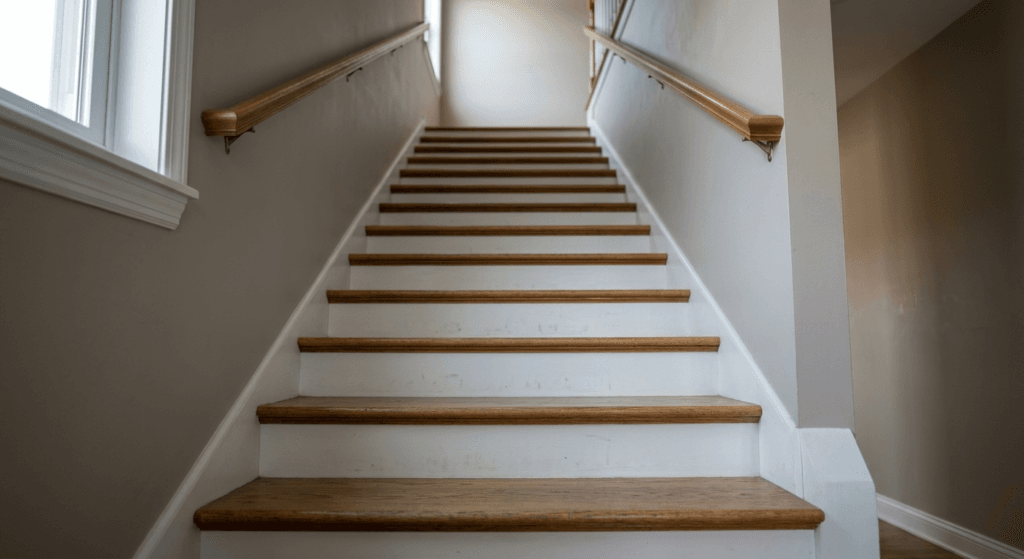
This is why stair safety is best understood as a system. The person, the staircase, and the daily routine all affect one another. A narrow tread may not be a major issue for someone with strong balance and excellent lighting. The same tread can become more concerning when combined with bifocals, slippery socks, a loose handrail, and a habit of carrying laundry downstairs.
Guidance from organizations such as the CDC and National Institute on Aging commonly emphasizes practical home fall-prevention steps: keeping stairs clear, fixing uneven steps, improving lighting, and using secure handrails. These recommendations are useful because they reduce the number of small demands placed on balance and vision at the same time.
3Self-Assessment Instructions
Choose a normal day, not an unusually good or unusually bad one. Observe stair use during the times the stairs are actually used: morning, evening, when carrying something, and if relevant, at night. The goal is not to test bravery. The goal is to understand how the stairs are working in daily life.
For each item below, mark one of three responses:
No concern:This does not appear to be a problem in ordinary use.
Mild concern:
This happens sometimes, has recently changed, or deserves monitoring.
Clear concern:
This happens often, affects stair use, or creates noticeable risk.
Be honest about recent changes. A person who has always moved slowly on stairs may not have the same risk pattern as someone who has slowed down noticeably over the past year. Likewise, one mild concern may not mean the stairs are unsafe, but several mild concerns together may deserve more attention than one obvious issue.
4Complete Stair Safety Self-Assessment Checklist
Use the following checklist as an educational self-assessment. It is meant to help you identify patterns worth discussing with family members, healthcare professionals, or home safety specialists.
1Fatigue on the stairs
Do the stairs cause unusual tiredness, shortness of breath, or the need to pause more often than before?
2Pulling on the handrail
Is the handrail being used for balance, or is it now being used to pull the body upward or stop a descent?
3Balance while turning
Does turning at the top, bottom, or landing feel less steady than walking straight?
4Carrying objects
Does carrying laundry, groceries, a pet, or household items make stair use feel noticeably less secure?
5Nighttime confidence
Are the stairs avoided at night, or used only with extra caution because visibility or alertness feels reduced?
6Step visibility
Can each step edge be seen clearly, especially at the top step, bottom step, and any landing?
7Handrail reach and grip
Is the handrail easy to reach, continuous, secure, and shaped so the hand can grip it comfortably?
8Stair consistency
Are the steps even, predictable, and in good condition, without loose carpet, worn edges, or uneven heights?
9Lighting quality
Is there reliable lighting at the top and bottom of the stairs, with switches that are easy to reach?
10Slip hazards
Are there loose rugs, polished wood, clutter, cords, papers, shoes, or objects near or on the stairs?
11Footwear habits
Are stairs often used in socks, slippers without backs, loose sandals, or footwear with poor traction?
12Near-misses
Has there been a stumble, missed step, sudden grab for the rail, or “almost fall” in recent months?
13Changes over the past year
Has stair use become slower, more stressful, more tiring, or more dependent on support than it used to be?
14Avoidance patterns
Are the stairs avoided whenever possible, even when the person does not openly say they feel unsafe?
Pay special attention to items that involve descending stairs. Going down often feels more threatening than going up because balance, vision, braking strength, and depth judgment are all involved. A person may climb up with effort but feel far less secure when coming back down.
5How to Interpret Your Results
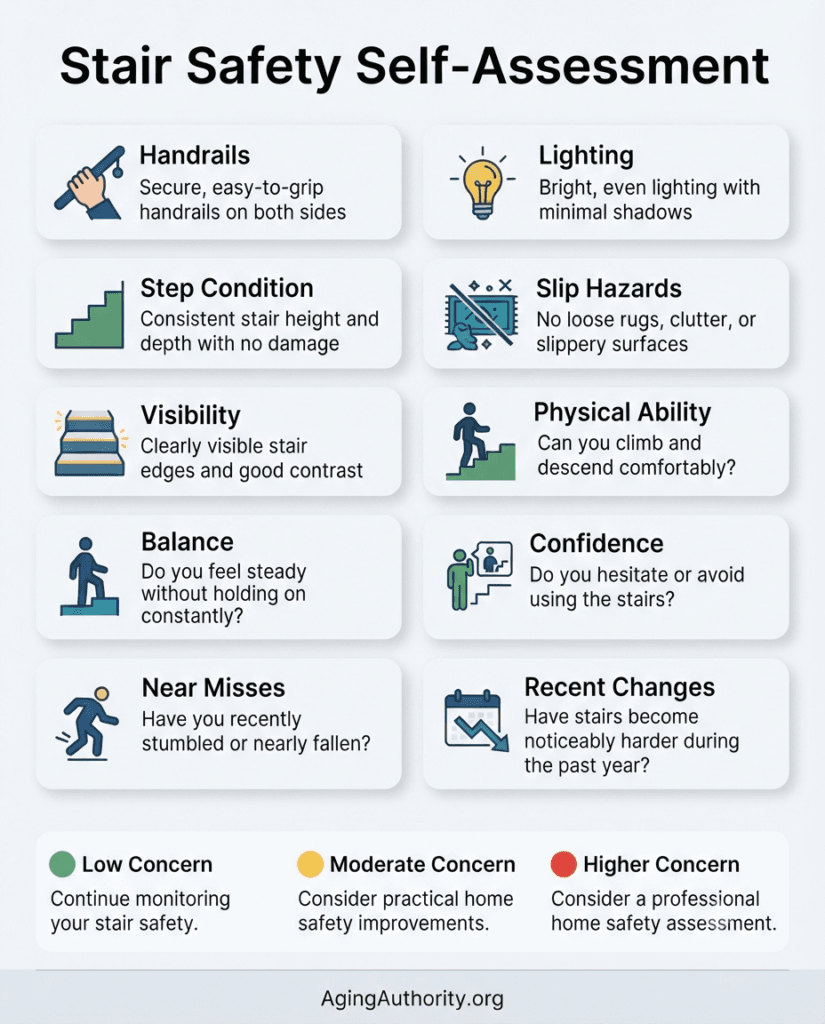
This scoring system is intentionally simple. It does not replace a professional home safety assessment, medical evaluation, or contractor inspection. It can, however, help families decide whether the current situation should simply be monitored or discussed more seriously.
Mostly no concerns
If most items show no concern, continue monitoring stair use and maintain safe habits. Keep stairs clear, replace burned-out bulbs quickly, wear stable footwear, and check handrails periodically.
Several mild concerns
If several items are marked as mild concerns, consider targeted improvements. Lighting, handrails, clutter removal, tread visibility, and footwear changes may help reduce daily strain.
Multiple clear concerns
If multiple areas show clear concern, or if near-misses are occurring, consider a comprehensive home safety evaluation and discuss mobility, vision, or health changes with appropriate professionals.
The pattern matters more than the number alone. One mild issue, such as moving more slowly, may simply reflect caution. But slower movement combined with poor lighting, frequent rail-gripping, avoidance, and a recent medication change deserves a different level of attention.
Families should also consider direction. Are things stable, improving, or gradually worsening? A staircase that was manageable last year but now causes hesitation every evening is telling you something. It may not mean the person must stop using stairs immediately, but it does suggest that the home and daily routine should be reviewed before the next near-miss.
Thinking About a Stairlift Later?
If stairs are becoming a long-term concern, estimate the possible cost range before you speak with providers or contractors.
6Common Patterns Families Often Miss
Families frequently recognize stair risk only after repeated near-misses. Before that point, the warning signs may look ordinary: taking longer, asking someone else to bring items upstairs, avoiding the basement, or insisting that the stairs are “fine” while visibly gripping the rail.
The person says they are fine, but their behavior has changed
Many older adults do not want stairs to become a family issue. They may minimize the problem because they fear losing independence, being pressured to move, or being treated as fragile. Behavior often tells the clearer story. If the person no longer uses the stairs spontaneously, waits for someone else to be nearby, or plans the day around fewer trips, that change deserves attention.
The handrail is doing more work than before
A handrail is supposed to provide support and stability. But when a person begins pulling hard on it, leaning into it, or using it as the main method of movement, the stair task has changed. This may reflect weaker legs, reduced balance confidence, pain, fatigue, or fear of falling. It also means the handrail itself must be secure, reachable, and comfortable to grip. Our guide to
stair handrail height and grip requirements for aging in place
explains why those details matter.
Confidence declines before obvious physical ability
A person may still have the strength to climb stairs but feel less certain about foot placement, depth perception, or what would happen if they stumbled. This kind of confidence change can be easy to dismiss, especially when the person “can still do it.” But confidence affects movement. Hesitation, stiff posture, and fear can make stair use less fluid and may increase the chance of missteps.
The environment adds too many small demands
Dim lighting, patterned carpet, shiny treads, loose slippers, and an awkward handrail may each seem minor alone. Together, they create a more demanding stair environment. Environmental improvements sometimes provide more benefit than families expect because they reduce several small challenges at the same time.
How the change is introduced can affect whether it is accepted
Older adults may resist a modification when it is presented as evidence that they are becoming incapable. The same change may feel more acceptable when it is framed as a general home improvement. Motion-sensor lighting can be described as an energy-saving upgrade. New stair-edge contrast can be introduced as a visibility and design improvement. A second handrail can be discussed as making the staircase more comfortable for everyone who uses it.
This does not mean hiding serious concerns or avoiding an honest conversation. It means choosing language that protects dignity and supports cooperation. Families often get better results when they discuss the home and the task rather than blaming the person. “These steps are hard to see at night” usually opens a more constructive conversation than “You are no longer safe on the stairs.”
7Practical Adjustments That May Improve Stair Safety
Not every stair concern requires major renovation. In many homes, the first step is to remove unnecessary risk from the existing staircase. The goal is to make the stairs easier to read, easier to grip, and less dependent on perfect balance.
Improve lighting before relying on memory
Good stair lighting should make each step edge visible. Ideally, lights should be available at both the top and bottom of the stairs, and switches should be reachable before stepping onto the staircase. Motion-sensor lighting, glow switches, and brighter bulbs may be useful in some homes, especially when stairs are used at night.
Make handrails more usable
Handrails should feel secure, continuous where possible, and easy to grip. A decorative rail that is too wide, too flat, loose, or interrupted may not provide the support an older adult needs. In many homes, adding a second rail on the opposite side can help, especially when one side is preferred because of weakness, pain, or turning direction.
Reduce slip and trip hazards
Objects on stairs should be treated as urgent clutter, not temporary storage. Shoes, books, laundry, extension cords, and papers can turn a familiar staircase into an unpredictable path. Loose carpet, curled stair runners, and worn stair nosings should also be addressed.
Reconsider footwear habits
Stairs used in socks, loose slippers, long robes, or backless sandals can become more risky than the person realizes. Footwear should stay on the foot, provide traction, and allow the person to feel stable on each step. This is a simple change, but it often reveals whether the stairs feel easier when one variable is improved.
Try Simple Technology Before Considering Major Equipment
Before moving directly to a larger solution such as a stairlift, families may benefit from testing smaller changes that reduce visual and balance demands. Motion-activated LED strip lighting installed beneath stair tread edges can make each step easier to identify without requiring someone to search for a switch. This may be especially useful for people who have reduced contrast sensitivity, cataracts, or difficulty judging steps in dim light.
Anti-slip stair strips are another relatively simple option. Clear or colored textured strips can be applied near the front edge of wooden, tile, or stone steps to improve traction. The material, placement, and maintenance matter: strips should lie flat, remain firmly attached, and avoid creating a raised edge that becomes a new trip hazard.
Use Step-Edge Contrast to Improve Visual Clarity
When every stair tread and riser is the same color, the staircase can visually blend together. Age-related changes in depth perception and contrast sensitivity may make it harder to see where one step ends and the next begins. A clearly contrasting line at the front edge of each step can make the stair sequence easier to read.
The contrast should be obvious rather than subtle. For example, a light-colored strip on dark wood or a dark strip on a pale surface may work better than a decorative tone that closely matches the stair. The goal is not to make the staircase look institutional. It is to create a consistent visual cue that remains easy to see in the lighting conditions the household actually uses.
Change routines when needed
Some adjustments are behavioral. Keep frequently used items on the main floor. Avoid carrying large loads. Use smaller baskets. Turn lights on before approaching the stairs. Schedule laundry or storage tasks when the person is rested. These changes may seem small, but they can reduce the number of times the stairs are used under poor conditions.
Organize Your Stair Priorities
Build a project brief for stair lighting, handrails, surfaces, and the changes you are considering.
8Assessment Area Table
The table below summarizes the most important areas to observe. Use it after completing the checklist to identify which concerns are personal, environmental, or both.
| Assessment Area | What to Observe | Why It May Matter |
|---|---|---|
| Physical effort | Fatigue, pauses, shortness of breath, leg weakness, or pain during stair use. | Stairs require repeated strength and control. New effort may signal a need to review health, pacing, or home layout. |
| Balance and confidence | Hesitation, stiff movement, fear of descending, or sudden grabs for support. | Confidence changes can affect movement even before a person appears physically unable to use stairs. |
| Handrail use | Pulling, leaning, two-handed gripping, loose rails, poor reach, or uncomfortable rail shape. | Changing rail use may show that the person is relying more heavily on external support. |
| Vision and lighting | Dim areas, shadows, poor step-edge contrast, hard-to-reach switches, or nighttime avoidance. | Reduced visibility makes each step harder to judge, especially when combined with age-related vision changes. |
| Stair condition | Uneven steps, loose carpet, worn edges, slippery surfaces, or inconsistent tread depth. | Irregular stairs demand more attention and leave less margin for slower reaction time or reduced balance. |
| Daily habits | Carrying loads, rushing, using stairs in socks, leaving items on steps, or avoiding stairs. | Habits can either reduce risk or quietly increase it, especially when they become automatic. |
| Recent changes | Medication changes, vision changes, surgery, illness, dizziness, new pain, or reduced endurance. | A staircase that was manageable before a health change may need to be reassessed afterward. |
9When to Consider Professional Evaluation
A professional evaluation may be appropriate when the concern is more than a single loose object or burned-out bulb. Repeated near-misses, increasing avoidance, recent health changes, worsening vision, and multiple environmental hazards all suggest that a more complete review may be useful.
Different professionals look at stair safety from different angles. An occupational therapist may evaluate how the person moves through the home and what tasks are becoming harder. A Certified Aging-in-Place Specialist may help identify practical home modifications that support long-term use. An accessibility specialist or home safety assessor may review environmental risks. A qualified contractor may be needed to repair steps, install handrails, improve lighting, or modify the staircase.
Consider getting professional input if:there have been repeated near-misses, the stairs are now avoided whenever possible, the person recently had a fall, dizziness, surgery, vision change, or new mobility limitation, or the family is unsure whether simple changes are enough.
Professional input is especially valuable when the family is trying to decide between small improvements, first-floor living changes, or larger modifications such as a stairlift. The right answer depends on the person, the home, the budget, and whether needs are expected to change over time.
10Frequently Asked Questions
How do I know if stairs are becoming unsafe for an older adult?
Look for patterns rather than one isolated sign. Increasing fatigue, hesitation, pulling on the handrail, avoiding stairs, poor lighting, unstable footwear, near-misses, and recent health changes may all suggest that stair safety deserves closer attention.
Is moving slowly on stairs a warning sign?
Not always. Moving slowly can be a sensible safety habit. It becomes more concerning when it is new, worsening, combined with fear, or paired with other issues such as poor balance, vision problems, or frequent gripping of the handrail.
Should an older adult stop using stairs after one near-miss?
One near-miss does not automatically mean stairs must be avoided completely, but it should not be ignored. Review what happened, check lighting and hazards, consider footwear, and discuss repeated or unexplained incidents with appropriate professionals.
Are two handrails better than one?
Two secure, reachable handrails can often improve support, especially when going down stairs or when one side of the body is weaker. The benefit depends on the staircase layout, the person’s needs, and proper installation.
Can lighting really make a major difference on stairs?
Yes, lighting can make a meaningful difference because stair use depends heavily on seeing step edges clearly. Better lighting may reduce hesitation and help the person judge each step more accurately, especially at night.
When should we consider a stairlift?
A stairlift may be worth discussing when stair use is increasingly exhausting, avoided, or unsafe despite smaller improvements. It should be considered alongside health status, home layout, budget, and whether first-floor living is possible.
11Conclusion
Stair safety is not decided by one question: “Can they still climb the stairs?” A better question is whether the stairs can still be used with reasonable confidence, visibility, support, and consistency during real daily life.
The most useful signs are often subtle. A person may still use the stairs but avoid them at night. They may still climb them but no longer carry anything. They may say they are fine but grip the rail differently, pause more often, or plan the day around fewer trips. These are not reasons to panic. They are reasons to look carefully.
Aging in place works best when families respond before a fall forces urgent decisions. By assessing physical ability, confidence, lighting, handrails, stair condition, footwear, habits, and recent changes together, you can make better decisions about simple improvements, professional evaluation, and long-term planning.
Build a Stair Project Brief
Use your notes from this checklist to plan the work and compare the scope of written proposals.
12Disclaimer
This self-assessment is intended for general educational purposes only.
It does not replace a professional home safety assessment, medical evaluation, or advice from a licensed contractor or accessibility professional. Stair safety should be evaluated individually based on the person, the home, current health, and any recent changes in mobility, vision, balance, or confidence.
.