
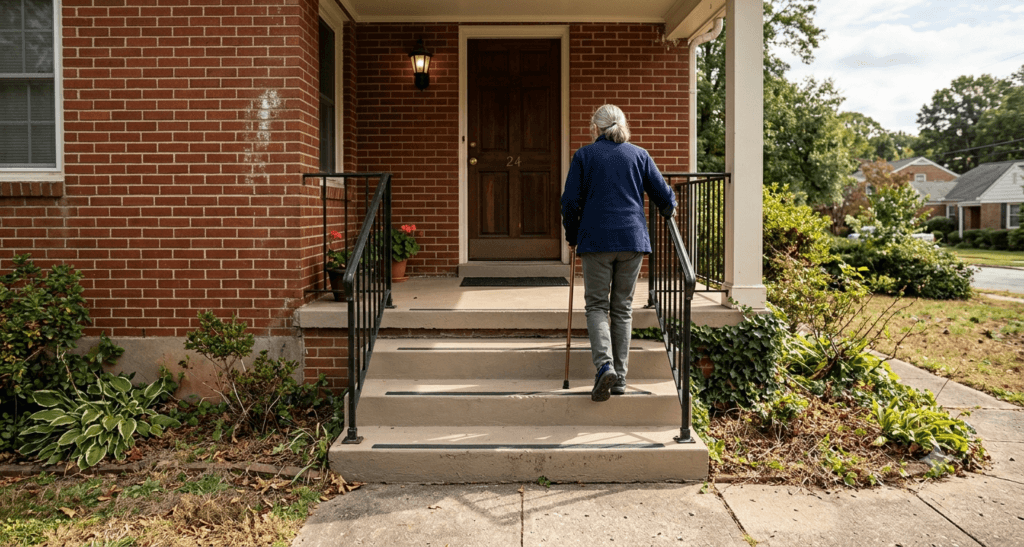
For a complete overview of safer home entrances, explore our Complete Entryway Safety Guide for Aging in Place .
A home entrance can look perfectly ordinary when no one is using it. The difficulty becomes visible in motion: walking over an uneven path, climbing a step, finding a key, pulling a heavy door, and crossing a threshold—sometimes while carrying groceries or managing a cane or walker. Making the entrance safer therefore means improving the entire route, not fixing one feature in isolation.
A safer entrance usually combines a stable approach, manageable steps or ramp, a usable landing, reachable handrails, clear lighting, an easy-to-operate door, a low and visible threshold, and an uncluttered transition indoors.
Begin where the older adult pauses, loses balance, reaches for support, struggles with the door, or avoids the route. Address immediate instability and access barriers first; then improve everyday usability, weather protection, and future accessibility.
An entrance may become difficult even when the house has not changed. A person may have less lower-body strength, reduced grip, joint stiffness, slower visual adaptation, or less endurance than a few years earlier. A new mobility aid can also turn previously adequate clearance into a daily obstacle.
The clearest evaluation comes from watching a normal arrival—from the car or sidewalk through the doorway. That sequence reveals where the environment asks for too much balance, reach, strength, or divided attention.
Stabilize the route
Reduce daily effort
Plan for change
For a broader planning framework that explains how approaches, steps, doors, thresholds, lighting, and mobility-aid access work together, see our Complete Entryway Safety Guide for Aging in Place.
What Makes a Home Entrance Safer for an Older Adult?
A safer entrance is stable, predictable, visible, and manageable from beginning to end. Support should be available before the person steps up, and the landing should allow door operation without standing near an edge or backing toward a step.
The door should open without excessive force or awkward movement, and the threshold should be visible but manageable. Clearance must suit the person’s current way of moving.
Weather changes the standard. A secure dry surface may become slippery in rain, while an uncovered doorway can make someone rush. No single modification removes every risk; the appropriate solution depends on the person, entrance, climate, and local requirements.
Why the Same Entrance Can Become More Difficult Over Time
Entrance use combines movement and problem-solving. Reduced leg strength may make a step harder; limited grip complicates a stiff lock; joint pain restricts turning; and slow visual adjustment can briefly hide the threshold.
These changes vary widely. What matters is the fit between person and environment. A raised threshold, for example, may be manageable alone but harder while holding a heavy door and positioning a walker.
Behavior often provides the earliest clue. Reaching for a wall, pulling on the door handle for balance, turning sideways at the threshold, or avoiding the route after dark may reveal extra demands. These behaviors do not diagnose a medical problem.
This is one reason understanding what aging in place really means involves more than remaining in the same house. The home must continue to work as the person’s needs and routines evolve.
Start Where the Person Arrives, Not at the Front Door
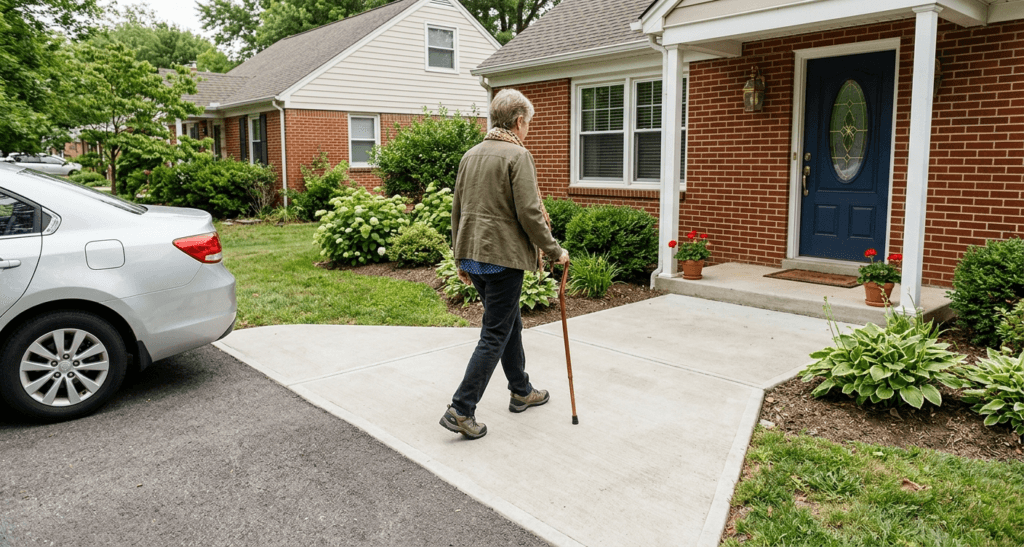
Begin at the sidewalk, driveway, parking space, or garage. Walk the actual route slowly and look for cracks, loose gravel, abrupt changes in level, excessive slope, narrow sections, encroaching plants, hoses, planters, or other obstacles. Check whether water drains away or collects in the walking line.
Repeat the inspection after dark and, when possible, after rain. Daylight can conceal weak lighting, while dry weather can hide poor drainage or slippery surfaces. Seasonal hazards may require a maintenance plan rather than a one-time fix.
Watch for effort, not only obvious hazards
Arriving tired may point to a route that is too long, steep, or lacks a place to pause. Asking someone to carry bags may preserve a hand for balance; using another entrance may signal that the formal one is impractical.
During a real arrival, is there a stable place for a package? Can the person unlock the door under cover, and can a helper stand alongside without blocking its swing?
Observe the route without turning it into a performance test
People often move differently when they know they are being watched. Asking an older adult to demonstrate the entrance repeatedly may produce an unusually careful performance that hides the problem. A better approach is to notice an ordinary return home: after a short outing, with the shoes normally worn, carrying the items usually carried, and using the usual key or mobility aid. The aim is not to judge how well the person performs. It is to identify which parts of the environment are demanding unnecessary effort.
Look at the order of events. A pause before the first step may mean the edge is difficult to see, but it may also mean the handrail starts too late. Setting groceries on the ground may reveal that the lock needs two hands. Pulling the door partly open, moving the walker, and then pulling again may show that the landing does not provide a workable maneuvering pattern. Each behavior points toward a different response, which is why simply asking, “Do you have trouble with the entrance?” may not produce enough information.
Record the exact location, the movement that becomes difficult, and the condition at the time. “Pauses while reaching for the rail on the bottom step after dark” is far more useful than “steps seem unsafe.”
Organize entryway priorities and questions before comparing written proposals.
Improve Steps, Landings, and Handrails as One System
Check exterior steps for loose materials, damage, inconsistent heights or depths, shallow treads, and edges that blend visually into one another. Contrast at the leading edge can make the change in level easier to interpret, but contrast is not a substitute for repairing an unstable step.
A handrail should be secure, graspable, and reachable before the first step. It should continue wherever balance is challenged. Support installed only where construction is convenient may leave a gap at the critical transition; in some situations, rails on both sides offer more choice.
The landing deserves equal attention. A small landing can force someone to stand close to an edge, turn sharply, or step backward while pulling the door open. Space must be considered with the door fully moving and with any mobility aid in its normal position—not merely by measuring the empty platform.
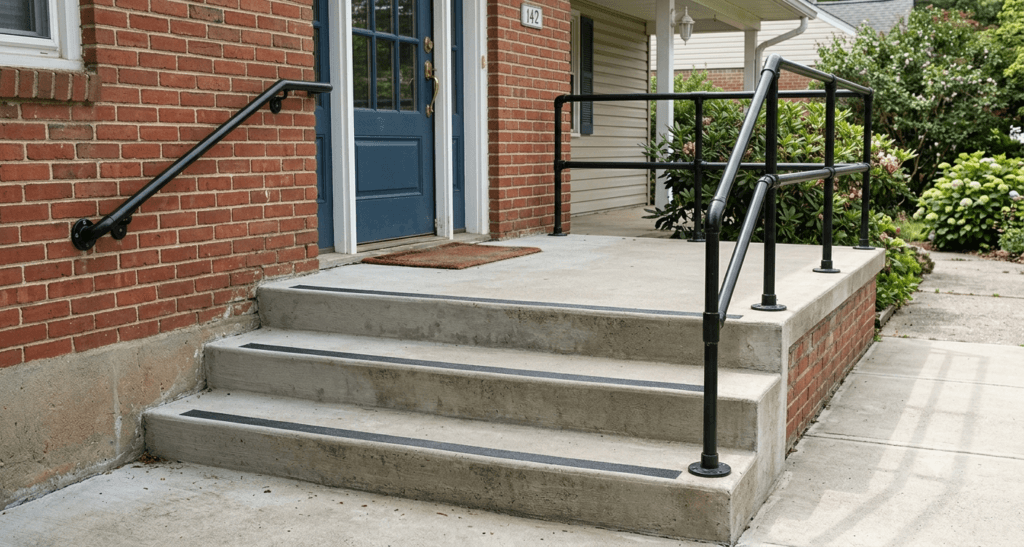
Loose steps and rails warrant prompt repair. Rebuilding steps, enlarging a landing, or adding a ramp requires planning for slope, drainage, structure, permits, and local codes. Public accessibility standards can inform design but do not automatically govern every private residence.
Make the Route Easier to Interpret, Not Merely Brighter
Effective entrance lighting helps a person see the walking surface, step edges, landing, lock, handle, and threshold. A powerful fixture in the wrong location can produce glare while leaving deep shadows across the path. Light should be placed so it reveals changes in level without shining directly into the person’s eyes.
Motion-activated fixtures can help when both hands are occupied, but range, duration, power reliability, and maintenance matter. The light should remain on through door operation, and bulbs and covers need periodic checks.
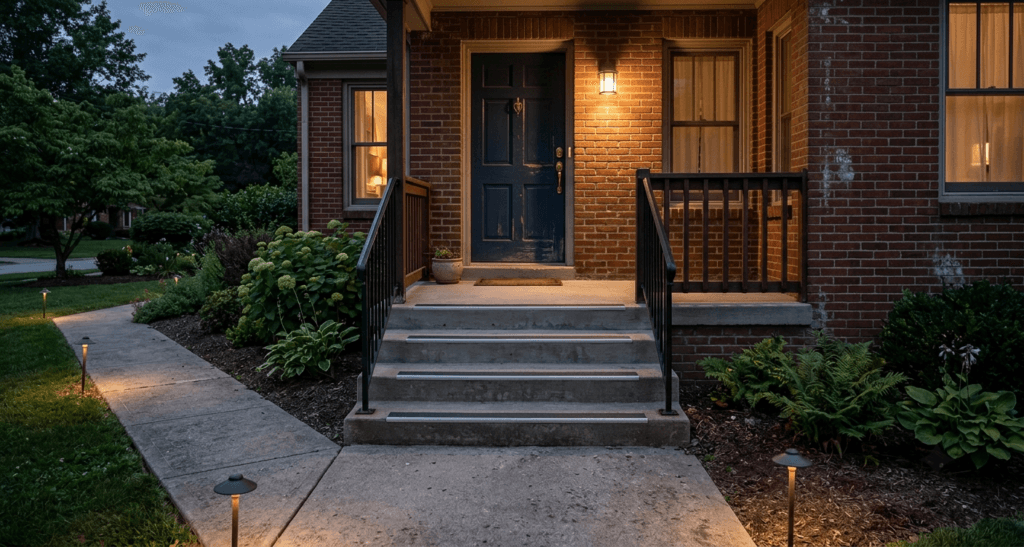
Contrast can further clarify where one surface ends and another begins. It should be visible without creating a pattern that looks like a false step. A clearly illuminated house number can also help visitors and emergency responders locate the property.
Weather protection can change how the person uses the entrance
Rain affects more than traction. It can make a person hurry, hold an umbrella instead of the rail, stand farther from the lock, or step across the threshold before the door is fully controlled. A covered landing or well-positioned canopy may make the sequence calmer, but it must discharge water away from the walking route rather than create a new drip line or puddle near the steps.
Maintenance should match local conditions. Leaves can hide level changes, algae or moss can alter surface grip, and wind may move lightweight mats or decorations into the path. In colder climates, snow and ice management needs a realistic plan that does not depend on the older adult clearing the route before every use. The important question is not whether the entrance looks orderly on inspection day, but whether it remains predictable during the conditions in which it is actually used.
Reduce the Physical Work of Unlocking and Opening the Door
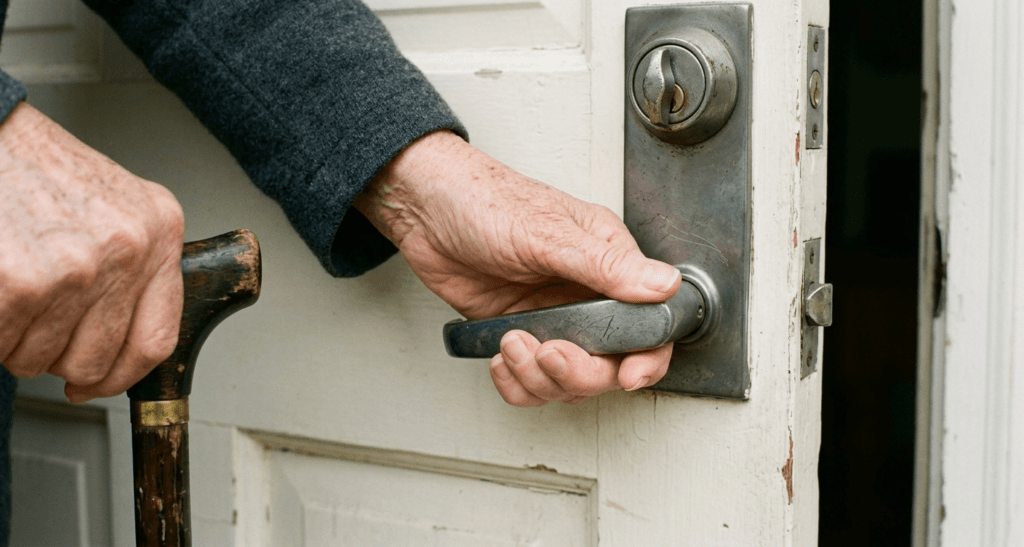
Lever-style hardware may be easier for some people than a round knob, while servicing hinges, adjusting a latch, or correcting swelling may reduce unnecessary door force. A shelf or stable package surface can free one hand, provided it does not narrow the route.
Keyless entry may remove the need to manipulate a small key, but it introduces battery, connectivity, familiarity, security, maintenance, and emergency-access tradeoffs. It needs a confident user and a workable backup.
With a walker or wheelchair, the real question is whether the person can approach, operate the door, maneuver around its swing, and pass through—not merely whether the device fits.
Treat the Threshold and Interior Floor as One Transition
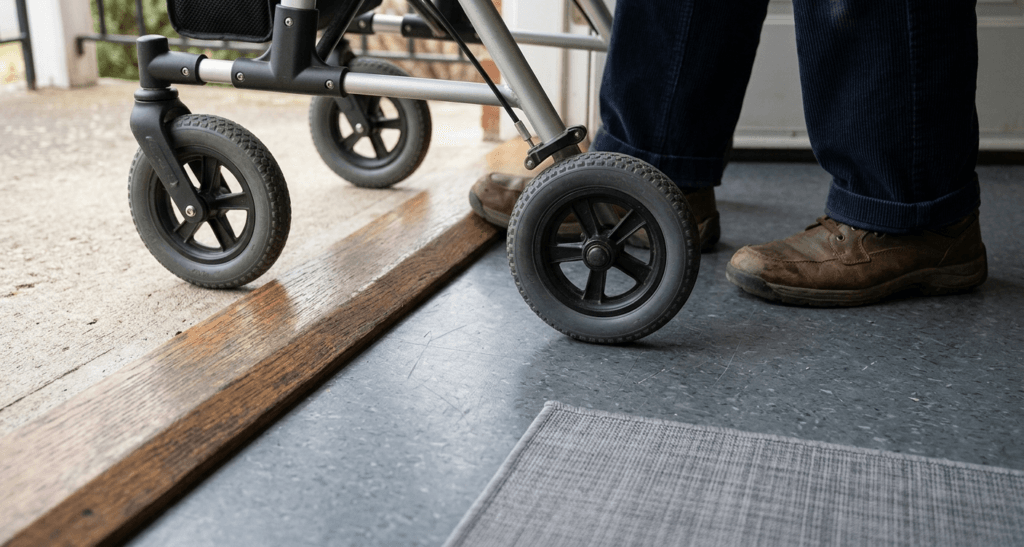
A raised threshold can catch a toe, interrupt a walker, or require more wheelchair effort—especially while controlling the door or entering a darker interior. Loose mats and curled edges also interfere with foot placement and mobility aids.
Inside, look for abrupt flooring changes, slippery finishes, clutter, and tracked water. Any moisture-control mat should lie flat, remain secure, and preserve clearance.
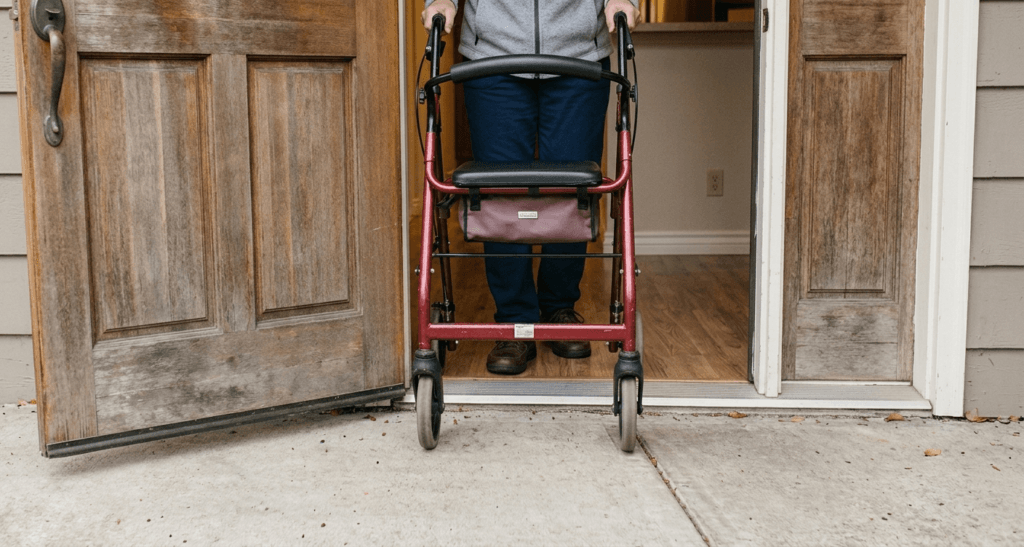
Threshold modification can affect weather sealing, drainage, door operation, and structure. Significant changes should therefore be assessed as part of the full doorway.
Common Entrance Conditions and Practical Responses
| Entrance condition | What it may require | Response to consider | Typical priority* |
|---|---|---|---|
| Uneven or unstable walkway | Frequent balance correction | Repair, level, or replace the unstable area | Address promptly |
| Missing or poorly placed rail | Unsupported step transition | Add secure, reachable, continuous support | Address promptly |
| Dim or shadowed step edges | Extra visual interpretation | Reposition lighting; improve useful contrast | Important |
| Small landing and outward door swing | Backing or turning near an edge | Assess door operation and landing enlargement | Important |
| Heavy door or difficult lock | Grip, pulling force, divided attention | Service door; change usable hardware if suitable | Important |
| Raised threshold or loose mat | Higher foot clearance or mobility-aid control | Secure/remove mat; evaluate threshold safely | Address promptly |
| Frequently wet surface | Shorter, more cautious steps | Correct drainage; add suitable weather protection | Address promptly |
| Route too narrow for mobility aid | Sideways movement or repeated repositioning | Plan route or doorway alteration | Plan ahead |
*Priority depends on the individual, frequency of use, severity of the condition, and entrance configuration.
What Should You Change First?
1. Reduce immediate instability and access barriers
Clear obstacles, secure or remove loose mats, replace failed lighting, correct frequently wet areas, and repair loose steps or handrails. These actions deserve early attention because they affect the basic predictability of the route.
2. Make routine entry easier to manage
Improve door hardware, useful lighting, visual contrast, handrail coverage, and weather protection. Add a suitable place for packages if it preserves clear passage. These changes reduce the number of difficult tasks the person must perform simultaneously.
3. Plan structural and future-access work
Rebuilding steps or landings, widening a doorway, modifying a threshold, constructing a ramp, regrading the approach, or creating an accessible secondary entrance requires longer-range planning. Consider both present ability and plausible future use of a walker or wheelchair. A project that solves only today’s problem may be expensive to alter again.
Priority should reflect severity and exposure. A modest problem on the main daily entrance may matter more than a larger defect on a rarely used route.
A new handle will not solve a landing that forces backward movement, and brighter lighting will not stabilize a loose step.
Low-Cost Adjustments or Structural Modification?
Maintenance and small changes may solve loose mats, clutter, failed bulbs, stiff locks, minor door adjustment, vegetation, or poor package handling. Structural work becomes more likely when the route has excessive slope, inadequate drainage, unstable or inconsistent steps, insufficient landing space, a doorway that cannot accommodate the mobility aid, or no realistic room to maneuver.
Be cautious about layering temporary fixes onto an entrance that is fundamentally unsuitable. Multiple portable surfaces, mats, makeshift supports, or badly fitted transition pieces can create clutter and new level changes. At that point, one coherent modification may be more usable than several disconnected additions.
When does a ramp become the more realistic option?
A ramp should not be treated as the automatic answer to every difficult step. It needs sufficient space, a manageable route, stable landings, drainage, edge protection or rails where required, and a connection to the door that can actually be used. A poorly planned ramp may create a long, exposed route or end at a landing where the door still cannot be operated comfortably.
It becomes more relevant when steps are no longer practical with the person’s mobility aid, when repeated lifting or physical assistance is being used to enter the home, or when future wheelchair access is a realistic planning need. Before construction, compare the front, side, garage, and rear approaches. The shortest route is not necessarily the most workable; available slope, parking location, weather cover, and the direction of the door swing may make another entrance the better candidate.
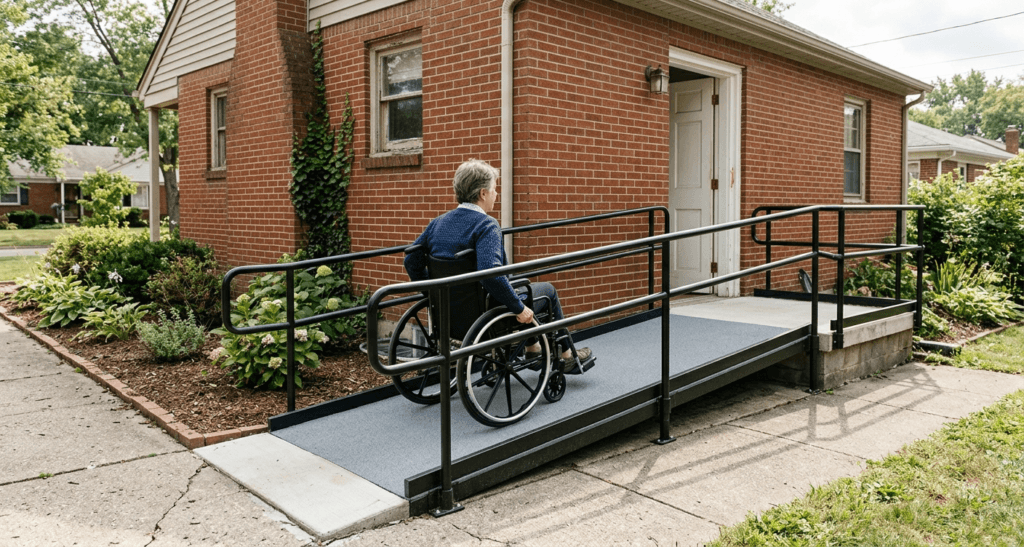
Portable ramps can help in limited situations, but their suitability depends on the height, length, surface, securing method, frequency of use, and the user’s equipment. They should not be assumed to convert any set of steps into a dependable everyday route. Permanent work should be evaluated against local permits and building requirements as well as the individual’s movement needs.
Get a personalized cost range based on entrance height, ramp layout, materials, landings, and installation needs.
Larger projects should be considered within the wider plan for home modifications for aging in place, especially when changes elsewhere in the house will also need to accommodate mobility aids or caregiver assistance.
The Front Door Is Not the Only Possible Solution
A garage, side, or rear entrance may offer fewer steps, closer parking, better weather cover, or more space for a ramp. Modifying that route can sometimes be more practical than forcing accessibility into a constrained formal entrance.
Evaluate the alternative for security, lighting, drainage, emergency access, and everyday convenience. It should feel dignified and practical—not merely technically possible.
When Professional Evaluation May Be Useful
Consider professional input after a fall or near fall at the entrance, when the person avoids the route, when a walker or wheelchair no longer fits comfortably, or when steps, slopes, drainage, thresholds, and landings require reconstruction. It is also sensible before adding a ramp or when temporary changes are accumulating without resolving the difficulty.
- An occupational therapist can observe how the individual performs the task and relate the entrance demands to mobility, strength, vision, habits, and equipment.
- A home safety assessor or accessibility specialist can review the route as a whole and help identify practical modification priorities.
- A qualified home modification or licensed contractor can evaluate structure, drainage, feasibility, permits, and applicable local requirements.
- A relevant healthcare professional should be consulted when balance, strength, or mobility changes suddenly rather than gradually.
Not every entrance needs every professional. The right input depends on whether the unresolved question concerns the person’s function, the design of the route, or construction safety and compliance.
Bring useful evidence to the evaluation
A professional visit is more productive when the family can describe what happens rather than only what the entrance looks like. Note whether difficulty occurs on arrival or departure, in rain or darkness, with groceries, after fatigue, or only with a particular mobility aid. Photos taken from the user’s eye level and a short description of the normal route can help explain conditions that are not present during the appointment.
Also describe expected changes. If a walker is being considered, a caregiver regularly assists at the door, or a wheelchair may be needed after an upcoming procedure, that information can affect landing, clearance, and route decisions. Planning around the real routine helps avoid a modification that is technically sound but awkward in daily use.
A Safer Entrance Is the Result of a Better Sequence
A safer entrance is not defined by one product. It results from how well the approach, walking surfaces, steps or ramp, handrails, landing, lighting, door, threshold, and interior transition work together for the person using them.
Observe the older adult arriving during a normal routine rather than judging the empty space. Notice where movement slows, support is sought, an item must be put down, or the person changes strategy. Those moments show where a small repair, usability improvement, or larger modification may provide the most practical benefit.
Disclaimer: This content is for general educational purposes only and does not replace a professional home safety assessment, medical advice, or licensed contractor evaluation.