
For a complete overview of safer stairs, explore our Complete Stair Safety Guide for Aging in Place .
Executive Summary
A stair handrail can look solid yet still be hard for an older adult to use. Height, grip shape, rail continuity, wall clearance, and mounting strength all affect how confidently someone can steady themselves. The best handrail is not merely present or code-aware; it is reachable, graspable, predictable, and comfortable during real stair use.

1Introduction
Families often inspect stairs by looking at the steps first. They notice worn carpet, dim lighting, steep treads, or clutter on the landing. The handrail, because it feels familiar, is often treated as a fixed background feature. Yet for an older adult, the handrail may be the most important part of the staircase.
A stair handrail is not just a finishing detail. It is the surface a person reaches for when a knee feels stiff, depth perception is uncertain, balance shifts unexpectedly, or the body needs a second point of contact. That support depends on details that are easy to miss: whether the rail is at a usable height, whether the hand can wrap around it, whether it continues through the stair run, and whether it feels solid when pulled.
Many older homes have rails that look sturdy but do not function especially well for aging in place. Some are too wide to grasp. Some stop before the first or last step. Some are decorative rather than supportive. Others meet a general building expectation but still feel awkward for someone with arthritis, shoulder pain, limited grip strength, or slower balance reactions.
This guide explains how stair handrail height and grip characteristics influence stair safety, confidence, and everyday mobility. It is not a building code manual and it does not suggest that every staircase needs a major renovation. In many homes, a targeted handrail improvement may be more practical than replacing the entire staircase.
For a broader stair-risk review, families can also compare this article with why stairs become more dangerous with age before falls occur, the early signs that stairs are becoming unsafe in a home, and the broader home modifications for aging in place planning guide.
Not Sure If the Handrail Is the Real Problem?
Many stair risks hide in small details: loose rails, poor lighting, slippery surfaces, missing second-side support, and weak transitions at the top or bottom. A structured review can help you see what is actually happening before spending money on bigger changes.
2Why Handrails Become More Important With Age
A younger adult may touch a stair rail casually or skip it entirely. If a foot lands slightly wrong, the body can often recover quickly through ankle strength, hip reaction, core control, vision, and speed. With age, those systems may still work, but they often provide less margin for error.
Grip strength may decline. Arthritis may make the fingers less willing to close around a hard or awkward shape. Shoulder stiffness can make a high rail uncomfortable. Reaction time can slow. Vision changes can make stair edges harder to read, especially in low light. Knee, hip, or back discomfort can change how weight is transferred from one step to the next.
These changes do not mean a person is unable to use stairs. They mean the staircase has to offer more predictable support. A well-designed handrail can help the body organize movement. It gives the hand a reference point, gives the arm a way to assist, and gives the mind reassurance that a small misstep may be recoverable.
Confidence on stairs is not only emotional. It is partly mechanical. A person feels more confident when the environment gives them a reliable way to correct balance. If the rail is too thick, too slick, too far away, or interrupted, the person may move more slowly, hold their breath, look down too much, or avoid the stairs altogether.
Handrails are especially important while descending. Going down requires controlled lowering, forward balance, and accurate foot placement. If the rail is comfortable and continuous, it can help the user regulate speed. If it is awkward, the user may touch it lightly instead of gripping it, which provides less support during a sudden shift.
This is why handrail design deserves attention in any serious stair-safety plan. Before assuming that stairs are unsafe because of age alone, families should ask whether the support system has kept up with the person’s current body mechanics.
3What Is the Recommended Handrail Height?
In many residential references, stair handrail height is commonly discussed in the range of 34 to 38 inches above the stair nosing. The stair nosing is the front edge of the tread, not the baseboard or the nearby wall floor. Local requirements can vary, and older homes may not match current standards, so families should treat this as a starting point rather than a complete answer.
The real question is whether the height allows the person to use the rail without strain. A rail that is too low may cause bending or leaning. A rail that is too high may lift the shoulder, reduce pulling ability, or make the user feel as if the arm is reaching upward instead of guiding the body. Either problem can reduce the rail’s practical value.
Height also affects how the rail works in different directions. While climbing, the rail may help with pulling and steadying. While descending, it may help with controlled lowering and balance correction. If the rail is uncomfortable in either direction, the person may use it inconsistently.
A handrail that technically fits a general height range may still feel wrong for an individual. Someone with shoulder arthritis, reduced reach, a stooped posture, or shorter stature may experience the same rail differently than a taller or more mobile person. This is one reason code-aware does not automatically mean senior-friendly.
Families can do a simple observation test. Watch the person use the stairs at a normal pace. If the shoulder rises, the torso leans toward the wall, the hand slides without gripping, or the person releases the rail at awkward moments, the height or placement may not be working well.
When the staircase structure is otherwise sound, repositioning or replacing the handrail may be more realistic than rebuilding the stairs. A qualified installer can evaluate wall structure, bracket placement, local code expectations, and whether the new rail can be placed at a more usable height.
4Why Grip Size Matters as Much as Height
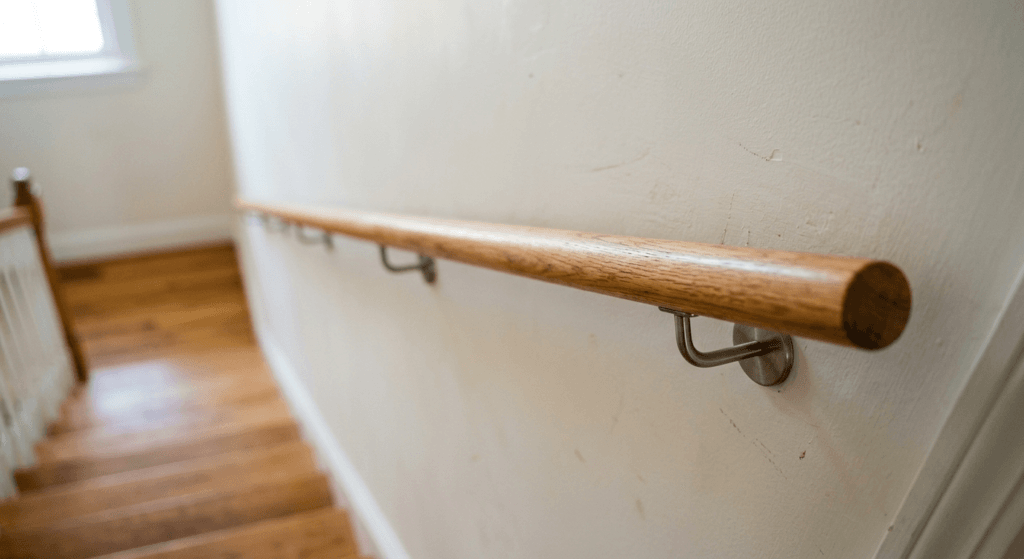
Height decides where the hand meets the rail. Grip size decides whether the hand can actually hold it. For older adults, that second detail is often where a handrail succeeds or fails.
A useful handrail should allow the fingers to wrap around the rail enough to create a secure hold. If the rail is too large, the hand may rest on top rather than grip around it. That may feel acceptable during calm movement, but it may not provide enough control during a sudden balance correction.
If the rail is too small, sharply edged, or uncomfortable, it may create pressure in the fingers. For someone with arthritis, neuropathy, reduced sensation, or painful joints, an awkward rail can be avoided without the person consciously explaining why. Many people instinctively release a poorly sized handrail before they realize the grip is the problem.
Grip comfort often becomes more important than grip strength as arthritis progresses. A person may still have enough hand strength for a well-shaped rail but avoid a rail that requires a painful pinch or an unnatural wrist angle. This is one reason round or gently oval rails are often easier to use than oversized, flat, or ornate shapes.
Surface feel matters too. A glossy rail may look polished but feel slick with dry hands, lotion, sweat, or dim lighting. A rough rail may irritate the skin. A good support surface should feel smooth, predictable, and easy to hold without being slippery.
Families sometimes assume thicker means safer. Structurally, strength depends on correct installation and materials, not simply bulk. From a usability standpoint, a handrail that is too thick may be less helpful because the hand cannot secure itself around it. The better question is: can the person hold the rail firmly and comfortably while moving, not just while standing still?
5Round vs. Decorative Handrails
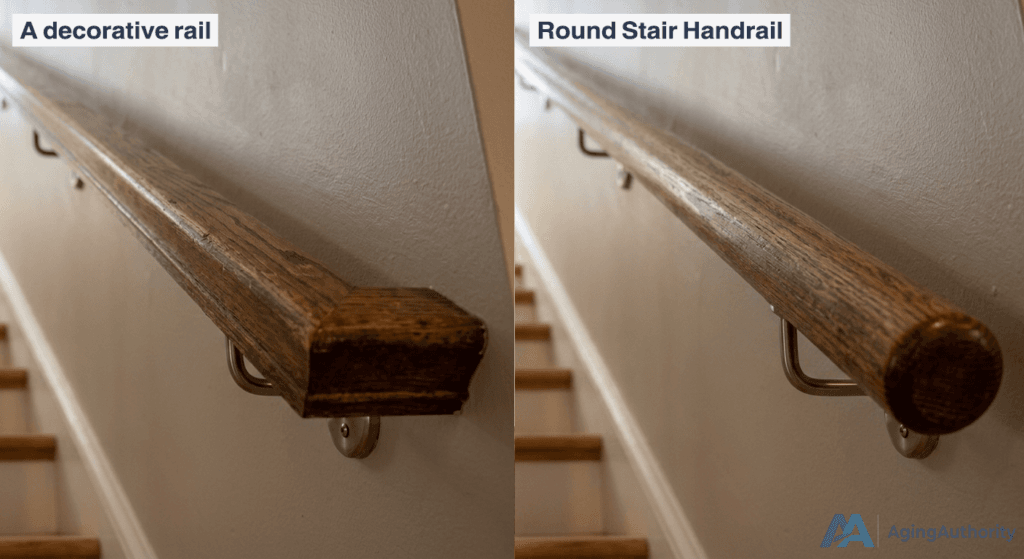
Decorative handrails are common in older homes and renovated interiors. They may be wide, flat, carved, squared, glossy, or integrated into a larger railing design. Some are beautiful. Some are strong. But not all are easy to grip.
A round or gently contoured rail usually allows the hand to approach from more than one angle. The fingers can curl naturally, and the wrist does not need to find one exact position. This matters because stair use happens during motion. The user is not carefully testing the rail like a showroom sample; they are moving, turning, stepping, carrying things, and sometimes reacting quickly.
Decorative profiles can interfere with that natural grip. A flat rail may invite the palm to slide on top. A carved rail may have ridges that feel uncomfortable. A square rail may create pressure at the finger joints. A large wooden cap rail may look substantial but be too wide for smaller hands.
This is one of the places where families can be surprised. A rail may look expensive and sturdy, yet still be functionally weak as a handrail. It may serve as a visual boundary more than a usable support surface. In some staircases, the guard and the handrail are treated as one feature, but they are not the same. A guard protects an open edge; a handrail supports movement.
Replacing an oversized decorative rail with a more graspable profile may improve daily confidence more than expected. It may not change the stairs themselves, but it can change how the user experiences them. The hand now has a predictable place to hold, guide, and recover.
Appearance still matters. A home does not need to look institutional to be safer. Many modern handrails are both attractive and graspable. For aging in place, the best design is not the most medical-looking option; it is the option that blends into the home while still working when the person needs support.
6Continuous Handrails and End Returns
A continuous handrail allows the user to maintain contact throughout the stair run. That continuity is more than a neat design preference. It supports rhythm, confidence, and balance planning.
Interrupted rails force the person to let go, search, and re-grip. For a younger adult, that interruption may feel minor. For an older adult with slower reactions or fear of falling, it can be the moment when confidence drops. The body has to manage the stairs and the missing support at the same time.
Interruptions happen in several ways. A rail may begin after the first step, stop before the top step, disappear at a landing, or be blocked by trim, brackets, posts, or decorative elements. Sometimes the rail appears continuous visually, but the hand cannot move smoothly along it.
The first and last steps deserve special attention because they are transition points. The person is changing from level walking to stair movement, or from stair movement back to level walking. These moments often require more support, not less. A handrail that stops early may remove support exactly where the user expects it.
End returns are another practical detail. A returned end curves or turns back toward the wall, post, or floor. This can reduce the chance that clothing, bags, robe sleeves, or loose items catch on an abrupt rail end. For aging in place, this is not simply cosmetic. It can reduce a small but realistic snagging hazard.
Continuity also helps people who rely on the rail as a spatial cue. A person with low vision, reduced depth perception, or anxiety on stairs may use the handrail to sense where they are in the stair sequence. A break in the rail interrupts that cue and may make movement feel less predictable.
7Wall Clearance and Reachability
A handrail needs enough clearance from the wall for the fingers to fit behind it. Without that space, the user cannot wrap the hand around the rail. The fingers may scrape the wall, press into trim, or remain partially open. That turns a potential grip into a light palm rest.
Wall clearance is easy to overlook because the rail still appears to be installed correctly. The problem only becomes obvious when someone tries to grip it during movement. Thick trim, textured walls, decorative paneling, or replacement rails installed on old brackets can all reduce usable clearance.
Reachability is the broader issue. A rail may be the right height and shape, but if it is too far from the walking path, the person may have to lean or shift weight sideways. On a narrow staircase, this can feel cramped. On a wide staircase, one handrail may not be close enough for someone walking near the center.
Stair width affects how well a handrail functions. In a narrow stairway, one rail may be naturally close. In a wider stairway, a single rail may require the user to choose that side deliberately. If the person sometimes carries laundry, guides a pet, or walks with a caregiver nearby, rail placement becomes even more important.
One useful sign is shoulder position. If the user lifts the shoulder, reaches across the body, or leans toward the wall to hold the rail, the rail may not be reachable in a relaxed way. Good support should not require awkward posture before the user even starts climbing or descending.
8One Handrail vs. Handrails on Both Sides
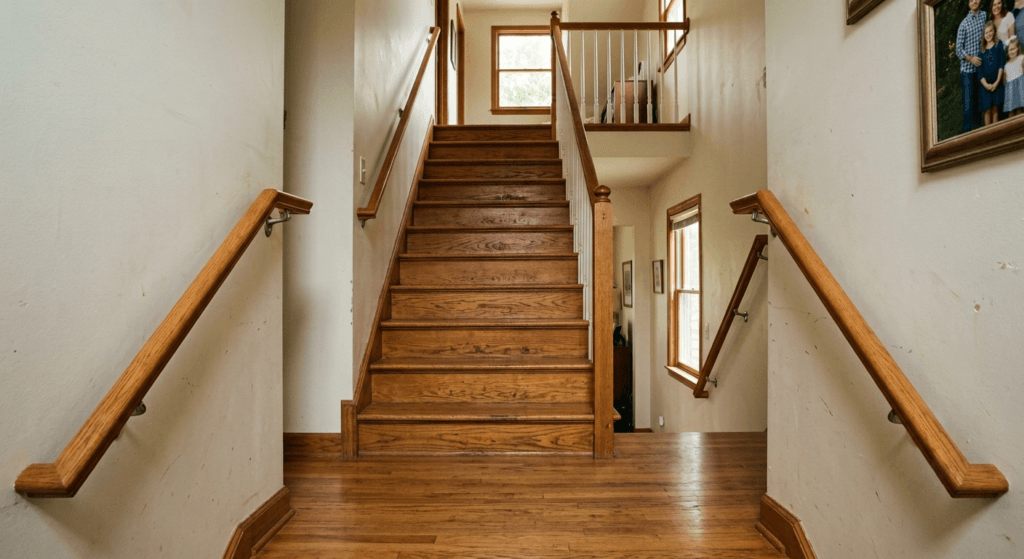
Many homes have one handrail. For aging in place, one rail may be better than none, but two rails can offer practical advantages that are easy to underestimate.
Going up and going down are different movements. A person who likes using the right-side rail while climbing may prefer the left-side rail while descending. If only one rail exists, the preferred support side changes depending on direction. This can matter for someone with one painful knee, one weaker hip, one shoulder limitation, or a one-sided balance issue.
Two-sided handrails provide choice. The user can select the side that feels stronger that day. A caregiver may have more options for positioning. A person who becomes tired halfway up may be able to use both sides for reassurance. Even when mobility limitations are mild, dual support can make stairs feel more predictable.
The benefit is not always that the person holds both rails at the same time. Often the benefit is psychological and practical: there is support available whichever direction feels more natural. Predictability can reduce hesitation, and hesitation itself can make stair movement less smooth.
There are tradeoffs. Adding a second rail may narrow the usable stairway. In tight staircases, that can affect furniture movement, caregiver assistance, or general comfort. Installation must also consider wall structure, brackets, clearance, and local code. A second rail should improve support without creating a new obstacle.
AARP HomeFit guidance and the National Institute on Aging both emphasize secure handrails, and age-friendly home planning often favors support on both sides where practical. In private homes, the final decision should reflect the user, the stair width, and the quality of installation.
Thinking Beyond Handrails?
If stairs are becoming harder even after handrail improvements, compare realistic stairlift cost factors before guessing. Stair type, turns, rail length, power options, and installation complexity can change the range quickly.
9Common Handrail Problems Found in Older Homes
Older homes often have stair rails that were installed for a different stage of life. They may have served the family well for decades, but aging in place changes the standard. The rail now has to support someone who may move more slowly, grip differently, or depend on the rail more often.
A common problem is looseness. A rail may shift slightly when pulled. Family members may dismiss this because it has not detached, but even small movement can reduce trust. When a person relies on a rail to steady the body, wobble sends the wrong message: this may not hold.

Poor mounting is another issue. Brackets may be fastened into weak material, old anchors may have loosened, or screws may no longer hold properly. A handrail should be evaluated under real use, not just by appearance. If it flexes, clicks, or pulls away from the wall, it deserves attention.
Some handrails are too short. They begin after the first step or end before the last. This is especially concerning because stair transitions require support. A person needs help preparing for the first step and finishing the last one, not just support in the middle.
Paint and finish can also change usability. Multiple layers of glossy paint can make a rail slick. Old wood can become rough or splintered. Exterior metal rails can rust or feel slippery when wet. A rail surface should feel predictable in the conditions where it is actually used.
Another overlooked problem is obstruction. A coat rack, storage basket, holiday decoration, narrow table, or wall-mounted item near the stairs can block the natural reach to the rail. The handrail may technically be there, but if the user cannot easily access it at the start of the stairs, it may not help when needed.
These issues are part of a larger pattern discussed in 5 signs the stairs in your home are becoming unsafe. Handrails are often the visible clue that the staircase needs a more complete safety review.
10Handrail Feature Comparison Table
The table below can help families evaluate handrails as functional support features rather than decorative details. It is not a formal inspection, but it can make hidden usability problems easier to recognize.
| Handrail Feature | Why It Matters | Potential Aging-in-Place Impact |
|---|---|---|
| Height above stair nosing | Affects whether the arm can assist balance without bending, leaning, or lifting the shoulder. | A comfortable height may improve control. A rail that is too high or low can make stair use feel awkward or less secure. |
| Grip diameter and profile | Determines whether the fingers can wrap around the rail instead of resting only on top. | A graspable rail may support better balance recovery. Oversized or awkward rails may discourage real use. |
| Round or contoured shape | Allows the hand to approach from different angles and close naturally. | Often more comfortable for older adults with arthritis, smaller hands, or reduced grip strength. |
| Decorative or flat shape | May look attractive but provide limited grip security. | Can function more like a visual railing than a support rail if the hand cannot hold it well. |
| Surface texture | Influences whether the rail feels secure in dry, wet, glossy, or low-light conditions. | A predictable surface may improve trust. Slick or rough finishes can reduce comfort and confidence. |
| Continuity | Lets the user maintain contact through the stair run instead of releasing and re-gripping. | May improve confidence at landings, turns, first steps, and final steps. |
| End returns | Reduce abrupt rail ends that can catch clothing, bags, or loose sleeves. | May reduce snagging risk and create a more predictable rail end. |
| Wall clearance | Provides space for the fingers to fit behind the rail. | Insufficient clearance can turn a good rail into a palm-rest surface rather than a true grip. |
| Secure mounting | Determines whether the rail feels stable under pulling, steadying, or partial body-weight support. | A loose rail may cause avoidance. A secure rail can increase trust and consistency of use. |
| Handrails on both sides | Provide support options for different directions, weaker sides, and changing daily ability. | May improve confidence and usability, especially when one-sided pain, balance issues, or caregiver assistance are present. |
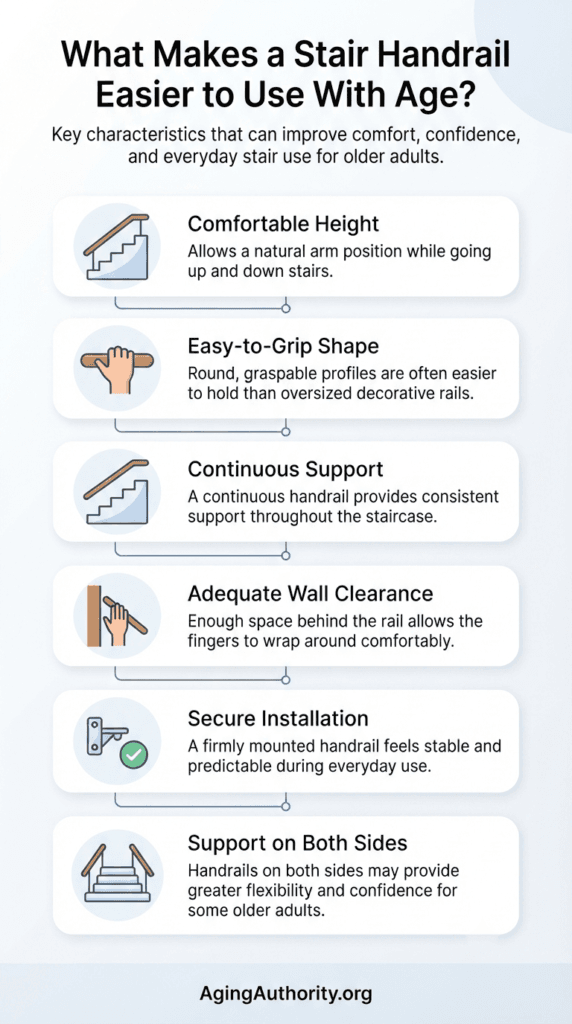
11Practical Checklist: How to Evaluate Your Existing Stair Handrail
Use this checklist as a practical first review. It cannot replace a professional assessment, but it can help families decide whether the handrail deserves closer attention.
Position and Reach
- Can the older adult reach the handrail without leaning, twisting, or lifting the shoulder?
- Does the rail begin before the first step and continue to the final step where practical?
- Does it feel usable while going both up and down?
- Can the person reach it naturally when carrying a small item?
Grip and Comfort
- Can the fingers wrap around the rail, or does the hand only rest on top?
- Does the rail feel too thick, too thin, too sharp, too slick, or too hard?
- Does the person naturally hold the rail, or only hover over it?
- Is the surface free from splinters, sticky paint, rust, or slippery finishes?
Strength and Installation
- Does the rail move, wobble, click, flex, or pull away under pressure?
- Are brackets secure and properly spaced?
- Are screws, anchors, posts, or supports damaged or loose?
- Does the rail feel trustworthy during real stair use, not only when touched lightly?
Continuity and Transitions
- Does the rail stop too early at the top or bottom?
- Are there gaps at landings or turns?
- Do brackets, trim, posts, or decorative elements interrupt the hand?
- Are rail ends returned or designed to avoid catching clothing?
Two-Sided Support
- Is there only one handrail?
- Does the user prefer a different side when going up versus down?
- Would a second rail improve confidence without narrowing the staircase too much?
- Would a caregiver need rail support or extra positioning space?
If several items raise concern, the next step does not need to be dramatic. A better rail profile, stronger mounting, improved continuity, or a second handrail may be a practical first improvement before considering larger stair modifications.
12When Professional Evaluation May Be Appropriate
Some handrail problems are obvious. A loose bracket, a rail that stops too soon, or a decorative profile that cannot be gripped is easy to notice once you know what to look for. Other problems require more judgment because they involve the person’s movement, confidence, medical history, and daily habits.
An occupational therapist can evaluate how the person actually uses the staircase. This is valuable because stair safety is not only a construction issue. It involves balance, vision, strength, pain, footwear, medication effects, attention, and routine. An occupational therapist may notice that the handrail is only one part of a larger mobility pattern.
A Certified Aging-in-Place Specialist, often called a CAPS professional, can help families think through modifications in a broader home plan. The goal is not to add equipment randomly. It is to prioritize improvements that fit the home, the budget, the person’s current abilities, and likely future needs. For bigger planning decisions, families may also need to compare handrail improvements with broader options such as stairlift vs. first-floor living.
Accessibility consultants, home modification contractors, and qualified stair or handrail installers can help evaluate wall framing, bracket strength, rail profile, clearance, rail returns, and whether a second rail can be added without creating a new obstruction.
Professional evaluation may be especially useful if the older adult has already fallen, nearly fallen, avoids the stairs, has progressive mobility changes, uses a cane or walker near the staircase, or needs caregiver assistance on steps. It is also important when the staircase is steep, narrow, unusually shaped, open-sided, or located outdoors.
Small problems often combine. A slightly awkward rail, dim lighting, worn stair surface, and one painful knee may each seem manageable alone. Together, they can make the stairs feel unpredictable. A professional review can help families understand which changes will likely matter most. Lighting and stair surface are often part of that same review, especially when families are comparing staircase lighting for seniors and carpet vs. wooden stairs safety.
Find the Stair Problems Families Usually Miss
Before choosing a handrail replacement, review the full stair environment: lighting, tread visibility, surface traction, clutter, nighttime use, and rail support. Small issues often matter most when they appear together.
13FAQ
What is the standard stair handrail height?
Residential stair handrail height is commonly discussed as 34 to 38 inches above the stair nosing, though local requirements can vary. For aging in place, the rail should also feel reachable and comfortable for the person using it.
Can a decorative railing be difficult to grip?
Yes. A decorative railing may be attractive and sturdy but still hard to grasp. Wide, flat, carved, glossy, or squared profiles can make the hand rest on top instead of wrapping securely around the rail.
Should both sides of the staircase have handrails?
Handrails on both sides can provide more support options, especially when one side of the body is weaker or more painful. Stair width, clearance, installation quality, and local requirements should be reviewed before adding a second rail.
Is a thicker handrail better for seniors?
Not necessarily. A thicker rail may look stronger, but it can be harder to grip if the fingers cannot wrap around it. A senior-friendly handrail should be secure, comfortable, and graspable.
Can an existing handrail usually be replaced without rebuilding the stairs?
Often, yes. If the staircase structure is sound, a qualified installer may be able to replace, reposition, or extend the handrail without rebuilding the entire staircase.
How can I tell if my current handrail is too high or too low?
Watch real use. If the person raises the shoulder, leans toward the wall, bends down, twists the torso, or avoids gripping the rail, the height or placement may not be working well for them.
Do building codes automatically make a handrail senior-friendly?
No. Building codes provide important minimum requirements, but they do not guarantee that a handrail is comfortable, continuous, easy to grip, or ideal for a specific older adult.
When should a family consider professional help?
Professional help may be appropriate if the rail is loose, the staircase is steep or narrow, the older adult has fallen or nearly fallen, or the person avoids stairs because of fear or discomfort.
14Conclusion
Stair handrails are easy to underestimate because they are familiar. A rail may have been in place for years without anyone questioning whether it still works for the person using it today. Aging in place changes that question.
The issue is not only whether a handrail exists. The issue is whether it is reachable, graspable, continuous, secure, and comfortable during real movement. Height affects body mechanics. Grip size affects control. Shape affects comfort. Continuity affects confidence. Wall clearance affects whether the hand can actually hold the rail. Mounting strength affects trust.
For many families, the handrail is a practical place to begin. It may be possible to improve stair usability without rebuilding the staircase. A better rail will not remove every risk, and it may not be enough for someone with significant mobility limitations, but it can make daily stair use feel more predictable.
When handrail improvements are not enough, the next decision may involve broader stair access planning, including whether the home is better suited to a stairlift, a first-floor living setup, or another modification strategy. Families comparing equipment options may also find it useful to understand the difference between straight vs. curved stairlifts.
The best aging-in-place decisions are based on observation rather than panic. Watch where the person hesitates. Watch how they hold the rail. Notice where they let go. Notice whether the stairs feel different at night, when tired, or when carrying something. Those small details often reveal whether the handrail is quietly helping or quietly failing.
15Sources
The following reputable sources were used for general aging-in-place, fall-prevention, and handrail context. Local building requirements and individual needs may vary.
- Centers for Disease Control and Prevention (CDC) STEADI: Check for Safety, A Home Fall Prevention Checklist for Older Adults
- National Institute on Aging: Preventing Falls at Home, Room by Room
- AARP HomeFit Guide
- International Code Council (ICC): International Residential Code guidance and residential stair/handrail provisions
- ADA Design Standards and Guidance Context only ADA standards generally apply to public accommodations and certain covered facilities, not most private single-family homes.
- NAHB Certified Aging-in-Place Specialist (CAPS) educational designation
16Disclaimer
This content is for general educational purposes only and does not replace a professional home safety assessment, medical advice, building code review, or licensed contractor evaluation. Individual needs and local building requirements may vary.
Editorial Review
This AgingAuthority article is written for educational home safety planning and reviewed for practical aging-in-place relevance. For more about our standards, visit the AgingAuthority Editorial Team.