
For a complete overview of safer stairs, explore our Complete Stair Safety Guide for Aging in Place .
Stairs rarely become dangerous all at once. In most homes, risk develops gradually as movement becomes slower, less stable, more cautious, or more physically demanding. Early warning signs—such as using walls for support, difficulty descending, visible hesitation, avoidance, or repeated near-misses—often appear before a serious fall occurs. Recognizing these signs early allows families to intervene with targeted improvements like better handrails, lighting, traction, and layout adjustments that support safer aging in place.
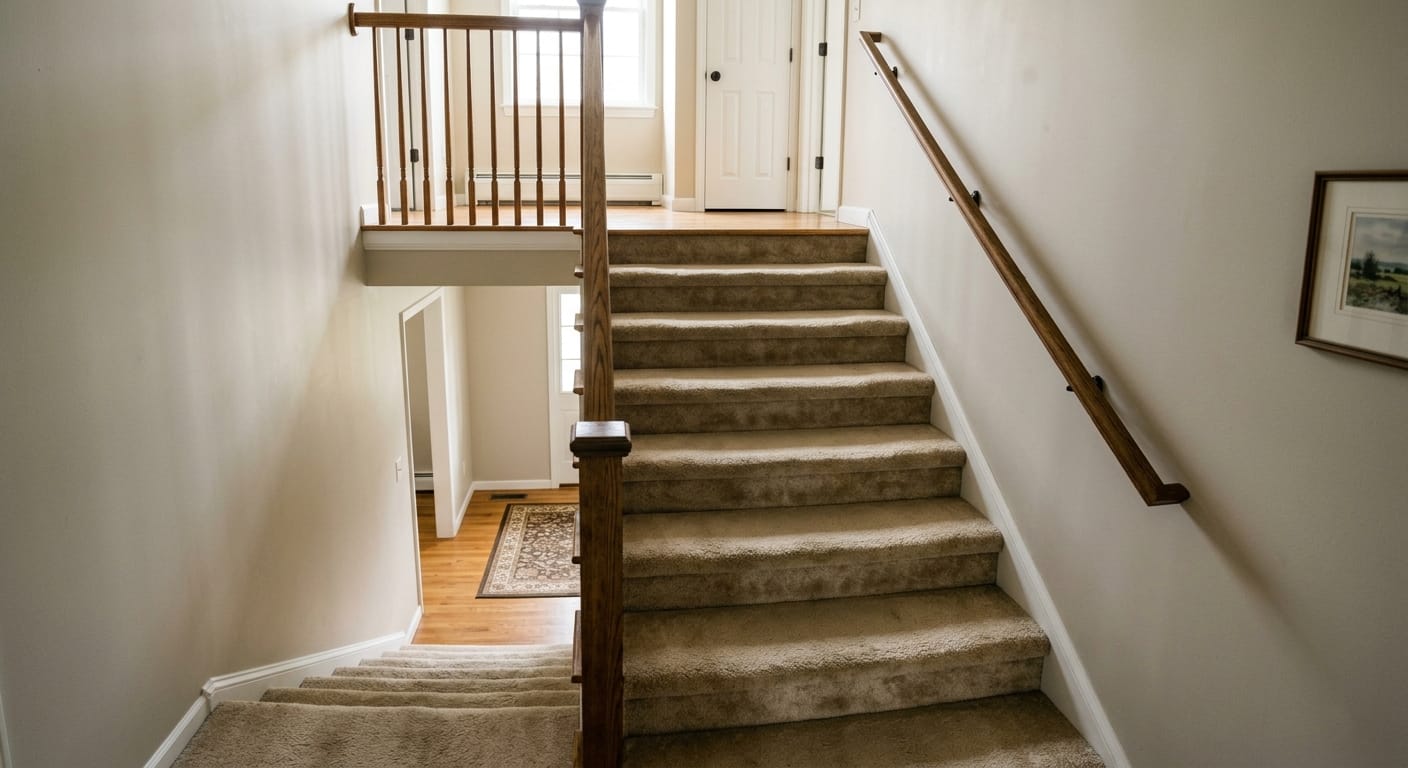
In many homes, stair danger does not begin with a visible defect. It begins when ordinary stair use starts requiring more effort, more caution, or more compensation than before. That shift is easy to dismiss, particularly when the staircase itself still appears structurally sound.
Stairs are becoming dangerous when movement is no longer stable, controlled, or confident. Early warning signs include hesitation, relying on walls instead of handrails, difficulty descending, avoiding stairs, and repeated near-misses. These signs often appear before a fall happens and indicate that the current stair setup may no longer be safe.
Families often expect stair risk to be obvious—a broken step, a loose railing, or a clear hazard. In practice, the early warning signs are usually behavioral. Movement slows. Hands reach for support more often. Descending becomes less controlled. These changes develop gradually, and because they happen within familiar routines, they are often overlooked.
A staircase can remain visually normal while functionally unsafe.
At AgingAuthority, stair safety is approached as an interaction between the person and the environment. Risk increases when the physical demands of the stairs begin to exceed the individual’s strength, balance, visual clarity, or confidence. This same movement-based approach is central to home modifications for aging in place, where the goal is not just to change the home, but to make everyday movement safer and more controlled. Recognizing that mismatch early is one of the most effective ways to prevent a serious fall.
Plan Your Stair Project
Organize stair project priorities and questions before comparing written proposals.
Table of Contents
- Are Stairs Becoming Unsafe in Your Home?
- What Makes Stairs Dangerous for Older Adults?
- Why Stair Risk Often Goes Unnoticed at First
- The 5 Signs Stairs Are Becoming Dangerous in Your Home
- What These Signs Usually Mean From a Safety Perspective
- Practical Changes That Can Reduce Stair Risk
- Smart Home Safety Technology
- Cost of Stair Safety Improvements / Practical Planning
- When to Hire a Professional
- Conclusion
Are Stairs Becoming Unsafe in Your Home?
Stairs may be becoming unsafe when a person starts moving differently on them. The early clues are often subtle: using the wall for support, gripping the rail with both hands, slowing down during descent, avoiding stairs when possible, or recovering from small slips that almost became falls.
These signs matter because they show that stair use is no longer automatic. The person may still be able to use the stairs, but the margin for error is smaller. That is the point where families should pay closer attention and look at the stairway as a safety system rather than a normal part of the house.
What Makes Stairs Dangerous for Older Adults?
Stair safety is often misunderstood as a purely structural issue. While broken steps or missing railings are clear hazards, most stair-related risk in aging homes develops even when the staircase is technically in good condition.
Safety depends on whether the stairs still support controlled, stable movement for the person using them.
Three categories of risk tend to overlap:
1. Structural Stair Hazards
- Uneven step height or depth
- Worn or slippery surfaces
- Inconsistent riser dimensions
- Poorly installed or absent handrails
2. Functional Movement-Related Hazards
- Reduced leg strength or joint flexibility
- Declining balance control
- Slower reaction time
- Fatigue during repeated stair use
3. Environmental Support Failures
- Poor lighting or shadowed stair edges
- Lack of visual contrast between steps
- Clutter near stair entry or exit
- Limited or unstable handhold options
A staircase becomes dangerous when these factors combine in a way that reduces movement control. The structure may not change, but the user’s ability to navigate it safely does.
| Risk Category | What It Includes | Why It Matters |
|---|---|---|
| Structural | Step inconsistency, slippery surfaces, weak or missing rails | Reduces mechanical safety of the staircase itself |
| Functional | Weakness, reduced balance, fatigue, slower movement | Reduces the user’s ability to control stair movement |
| Environmental | Low lighting, poor contrast, clutter, weak support options | Makes safe navigation harder even on a structurally sound stairway |
Why Stair Risk Often Goes Unnoticed at First
Stair-related risk rarely appears suddenly. It usually emerges from gradual changes that interact with daily routine, familiar surroundings, and the body’s increasing need for support.
Risk often increases when there is a growing mismatch between:
- Leg strength and joint control — making lifting and lowering the body more difficult
- Balance stability — reducing the ability to recover from a small misstep
- Vision and contrast sensitivity — making it harder to judge step edges accurately
- Fatigue levels — especially in homes where stairs are used many times per day
- Handrail availability and positioning — limiting safe support during transition
- Lighting quality — creating shadows, glare, or uneven visibility
- Surface traction — increasing slip potential during descent
- Routine familiarity — masking risk because the environment feels known
This mismatch often develops quietly. The person adapts. Movements change. Small compensations appear. Families may interpret these changes as normal aging, but in practice they often signal a rising loss of safety margin.
Risk often appears before the fall. By the time a visible incident happens, the warning pattern has often been present for weeks or months.
| Before You Modify the Stairs | What to Look For | Why It Helps |
|---|---|---|
| Watch how the person descends | Hesitation, rail dependence, one-step-at-a-time movement | Descent often reveals risk earlier than ascent |
| Check where support is being used | Walls, furniture, door frames, or both hands on one rail | Shows whether the current support system is inadequate |
| Observe stair use at night | Dark zones, shadows, delayed light activation | Many stair failures are partly visibility failures |
| Notice avoidance patterns | Staying on one floor, delaying tasks, asking for help | Functional avoidance often signals rising risk before a fall |
The 5 Signs Stairs Are Becoming Dangerous in Your Home
The most important warning signs are often not structural. They are behavioral and functional changes that show the person is no longer using the stairs with the same level of control, confidence, or stability.
Sign 1: The Person Needs the Wall, Furniture, or Both Hands for Support
This often looks subtle at first—fingers brushing the wall, a hand sliding along nearby furniture, or both hands gripping a single rail more tightly than before.
Why it matters:
- Indicates reduced balance or insufficient support
- Suggests the existing handrail is not adequate, reachable, or properly positioned
- Limits the ability to recover safely from a slip or missed step
Using both hands on a single rail also reduces movement flexibility and may indicate that the current support system is no longer enough.
This is not a minor adjustment. It reflects a loss of stability.
Sign 2: Going Down Feels Harder or Less Controlled Than Going Up
Many families notice that ascending stairs remains manageable, while descending becomes slower, more cautious, and less smooth.
Why it matters:
- Descending requires controlled lowering of body weight
- It places greater demand on balance, joint control, and reaction timing
- Visual depth perception becomes more critical during downward movement
Loss of control during descent significantly increases fall risk because errors on the way down are harder to recover from.
Stair safety depends on control, not familiarity.
Sign 3: Stair Use Has Become Slower, Hesitant, or Visibly Effortful
This may appear as:
- Pausing between steps
- Holding position mid-stair
- Taking one step at a time instead of alternating steps
- Visible concentration during movement
Why it matters:
- Signals reduced strength or endurance
- Indicates increased cognitive load during movement
- Often reflects early fear of falling
Hesitation is not a minor detail. It is often one of the earliest indicators that stair use is no longer automatic, efficient, or stable.
If you are noticing hesitation, effort, or reliance on support, it may be time to assess the stair environment more closely. Plan a Stair Project →
Sign 4: The Person Avoids Stairs Unless Necessary
Avoidance is one of the clearest functional warning signs.
This may include:
- Staying on one floor most of the day
- Delaying tasks that require stair use
- Asking others to retrieve items from another level
Why it matters:
- Suggests that stair use has become physically or psychologically demanding
- Indicates the environment may no longer feel safe
- Can reduce mobility and independence over time
Avoidance is not convenience. It is adaptation.
Sign 5: Near-Misses, Missteps, or “Small Slips” Are Starting to Happen
These incidents are often dismissed because they do not cause injury.
Examples include:
- Catching a foot on a step edge
- Losing balance briefly but recovering
- Slipping slightly but grabbing a rail in time
Why it matters:
- Indicates declining movement precision or inadequate traction
- Signals that control margins are shrinking
- Often precedes a more serious fall
A staircase can remain visually normal while functionally unsafe.
| Warning Sign | What It May Indicate | Why It Matters |
|---|---|---|
| Using walls or both hands for support | Reduced balance or poor handrail support | Signals declining control during stair use |
| Difficulty going down stairs | Reduced joint control and balance during descent | Descending is a higher-risk movement phase |
| Slower, hesitant stair use | Fatigue, weakness, or fear of falling | Often appears before a serious fall |
| Avoiding stairs | Functional strain, fear, or loss of confidence | Indicates stairs may no longer be manageable |
| Near-misses or slips | Reduced traction or movement precision | Early warning of rising fall risk |
| Movement Change | What It Suggests | Risk Level |
|---|---|---|
| Using the wall for support | Balance reserve is shrinking | Moderate |
| Taking stairs one step at a time | Reduced strength, control, or confidence | Moderate to High |
| Slow, careful descent | Controlled lowering has become difficult | High |
| Avoiding stairs completely | The stair environment no longer feels manageable | High |
| Repeated near-misses | Safety margin is already compromised | Very High |
What These Signs Usually Mean From a Safety Perspective
These warning signs rarely occur in isolation. They typically reflect a broader shift in how the body interacts with the staircase and surrounding environment.
From a safety perspective, they often indicate:
- Reduced lower-body strength affecting stability during stepping and lowering
- Declining balance control, especially during directional changes
- Increased fear of falling, which changes movement patterns
- Inadequate handrail support, limiting safe grip options
- Poor lighting or contrast, reducing visual clarity of the step edge
- Low traction surfaces, increasing slip potential
- Excessive stair demand in multi-level homes
Importantly, these signs should not be dismissed simply because no serious fall has happened yet.
The absence of injury does not mean the absence of risk. In many homes, the near-miss is the warning phase that families overlook.
Practical Changes That Can Reduce Stair Risk
Improving stair safety does not always require a major renovation. In many cases, targeted changes can significantly improve movement control and reduce fall risk.
1. Better Handrail Support
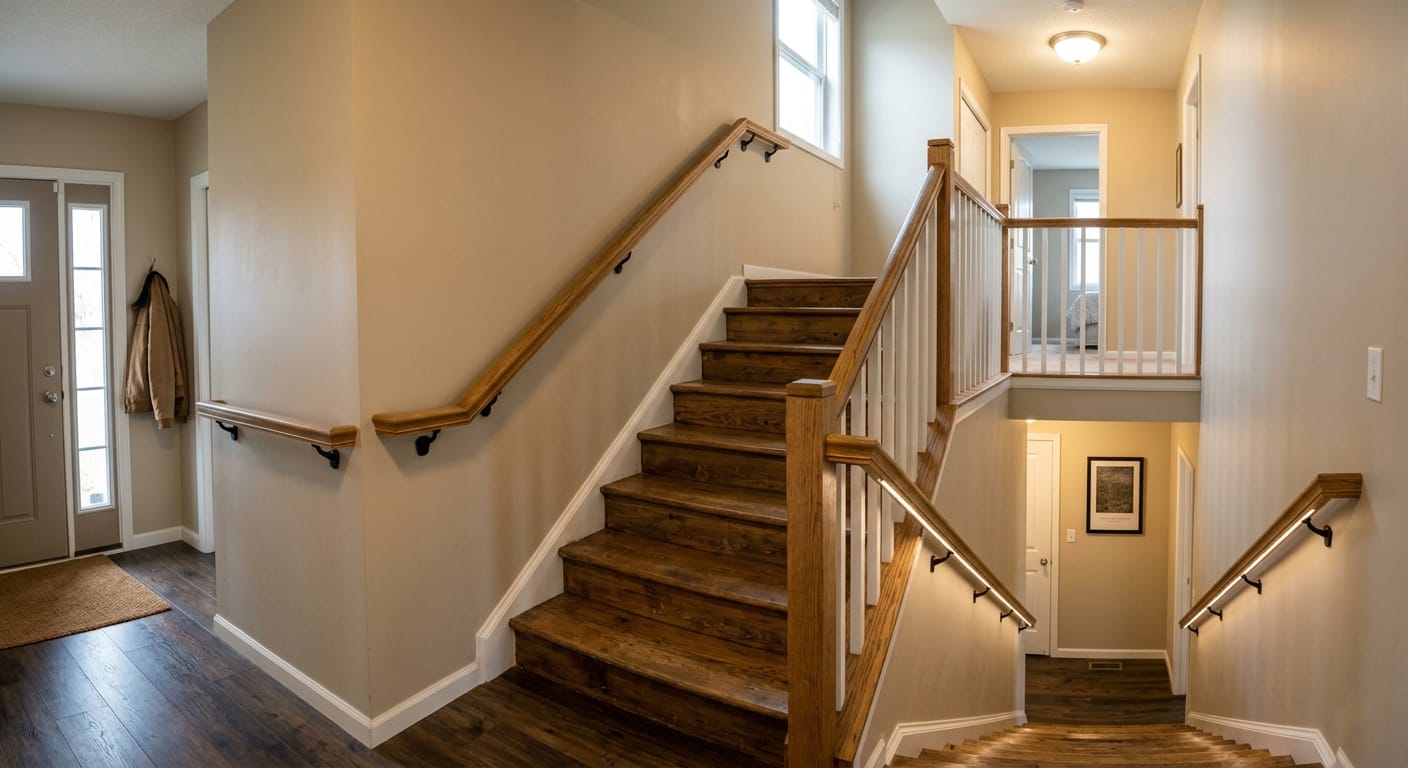
- Install handrails on both sides when possible
- Ensure continuous grip along the full stair length
- Position rails at a comfortable, reachable height
- Make sure the rail is easy to grasp, not decorative only
This improves stability and gives the user a more reliable recovery option during slips or loss of balance.
2. Improved Stair Lighting
- Add consistent overhead or wall-mounted lighting
- Reduce shadows and dark zones
- Consider motion-activated lighting for night use
- Make sure top and bottom landings are clearly illuminated
Lighting improves depth perception and helps define step transitions more clearly.
3. Non-Slip Stair Surfaces
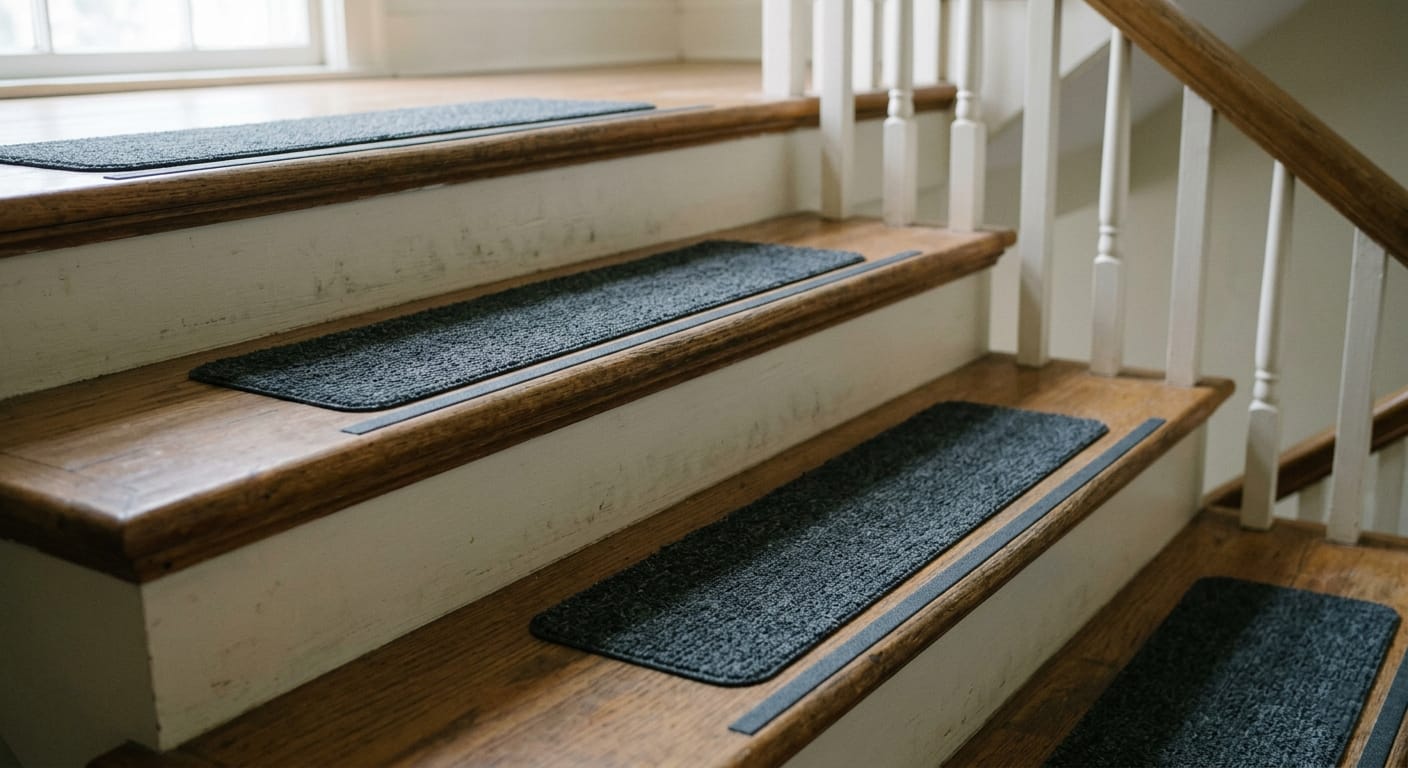
- Apply anti-slip treads or coatings
- Avoid highly polished or worn finishes
- Replace loose coverings that shift underfoot
This directly reduces slip risk during ascent and descent.
4. Visual Edge Contrast
- Use contrasting strips on step edges
- Improve visibility for users with reduced contrast sensitivity
- Avoid visual patterns that make edge definition harder
This helps users judge step boundaries more accurately.
5. Decluttering Circulation Areas
- Remove objects near stair entry and exit
- Keep landings clear
- Avoid baskets, decorative items, or shoes in transition zones
This reduces trip hazards where many falls begin or end.
6. Reducing Stair Demand
- Relocate frequently used items to one floor
- Adjust daily routines to reduce unnecessary trips
- Store essentials where they are most often needed
Reducing exposure lowers cumulative risk across the day.
7. Considering First-Floor Living Arrangements
- Temporary or permanent relocation of sleeping or bathing functions
- Especially important when multiple warning signs are present
8. Stairlift Evaluation (When Appropriate)
- Consider when stair use becomes physically unsafe rather than merely inconvenient
- Particularly relevant in multi-story homes with essential daily stair use
A stairlift is a functional safety solution, not a last resort or a cosmetic upgrade. It should be considered within the broader context of aging in place when stairs become a daily barrier to safe movement.
| Observed Problem | Most Relevant Change | Main Safety Benefit |
|---|---|---|
| Using walls instead of rails | Add or improve handrails | Better grip access and recovery support |
| Difficulty seeing steps | Upgrade lighting and edge contrast | Improves visual definition and foot placement |
| Slipping on stair surface | Add anti-slip treads or coatings | Reduces slip potential |
| Fatigue from repeated stair trips | Reduce stair demand | Lowers cumulative exposure to risk |
| Unsafe daily stair dependence | Evaluate stairlift or first-floor living | Reduces high-risk stair use altogether |
Smart Home Safety Technology
Technology can support stair safety, but it should not be treated as a substitute for physical improvements. Its role is strongest when it reinforces visibility, communication, and emergency response around an already safer environment.
Useful options include:
- Motion-activated stair lighting — improves visibility at the moment of approach, especially at night
- Smart lighting schedules — keeps stair zones consistently illuminated during high-use periods
- Emergency alert systems — supports fast assistance after a fall or near-fall event
- Wearable fall detection devices — useful when stair use is still necessary and the person lives alone
- Voice assistants — supports hands-free communication when immediate help is needed
The key distinction is this: technology can improve visibility and response, but it does not correct poor traction, weak handrail support, step inconsistency, or unsafe movement mechanics. For a broader whole-home view, families can also use the Home Remodeling Cost & Project Planner to check risk areas beyond stairs.
Technology works best when paired with environmental changes. If the stairs are already causing hesitation or near-misses, start with the physical risk factors first. Plan My Stair Project →
Cost of Stair Safety Improvements / Practical Planning
Costs vary depending on the scope of changes, labor conditions, materials, and the existing stair configuration. Planning should prioritize interventions that directly address the warning signs already present in the home.
| Improvement | Typical Cost Range | Best Use Case |
|---|---|---|
| Improved lighting | $100 – $500 | Poor visibility or frequent nighttime stair use |
| Anti-slip treads or coatings | $50 – $300 | Slippery, polished, or worn stair surfaces |
| Handrail installation or upgrade | $200 – $1,500+ | Insufficient, missing, or poorly positioned support |
| Visual contrast strips | $50 – $200 | Low step-edge visibility |
| Stairlift installation | $2,000 – $10,000+ | Significant mobility limitation or unsafe daily stair dependence |
Costs vary by region, stair design, material quality, and installation requirements. Curved or customized stair systems may increase cost substantially.
Planning tip: if the household is already seeing hesitation, rail dependence, or near-misses, start with the highest-impact fixes first: handrails, lighting, traction, and stair-use reduction.
When to Hire a Professional
Professional input becomes more important when warning signs indicate increasing risk beyond simple environmental adjustments.
Common triggers include:
- Repeated near-falls or slips
- Severe difficulty descending stairs
- One-sided weakness or major mobility limitation
- Missing, inadequate, or poorly placed handrails
- Major vision or balance changes
- Multi-story living arrangements that are no longer practical
Relevant professionals may include:
- Home modification contractors
- Occupational therapists
- Accessibility specialists
- Home safety assessors
A structured assessment can identify risks that are not immediately obvious and can help families prioritize improvements based on actual movement difficulty rather than guesswork. These decisions often overlap with broader home safety upgrades, especially in bathrooms, bedrooms, and other daily transition areas.
Conclusion
Stair danger rarely begins with a broken structure. It begins when movement becomes less stable, less controlled, more effortful, or more dependent on compensation.
The most important warning signs are often behavioral:
- Hesitation
- Increased reliance on support
- Difficulty descending
- Avoidance
- Near-misses
These signals reflect a growing mismatch between the person and the staircase. A stairway does not need to look damaged to become unsafe. Recognizing the pattern early allows for targeted changes that can meaningfully reduce fall risk and support safer aging in place.
Plan Your Stair Project
Organize stair project priorities and questions before comparing written proposals.
Sources
- Centers for Disease Control and Prevention (CDC) — Older Adult Falls Data
- National Institute on Aging — Fall Prevention and Home Safety
- AARP — HomeFit Guide
- U.S. Department of Housing and Urban Development (HUD) — Aging in Place Resources
Reviewed by the AgingAuthority Editorial Team — specialists in senior home safety and aging-in-place planning.