
Executive Summary:
Shower grab bars only improve safety when they are placed where the body actually needs support during movement. In real bathrooms, fall risk concentrates at transitions: stepping in, turning, sitting, and standing. The safest placement is not decorative or symmetrical. It is functional. Proper shower grab bar placement must match transfer stability, reach patterns, layout constraints, and the user’s real movement needs.
1. Introduction
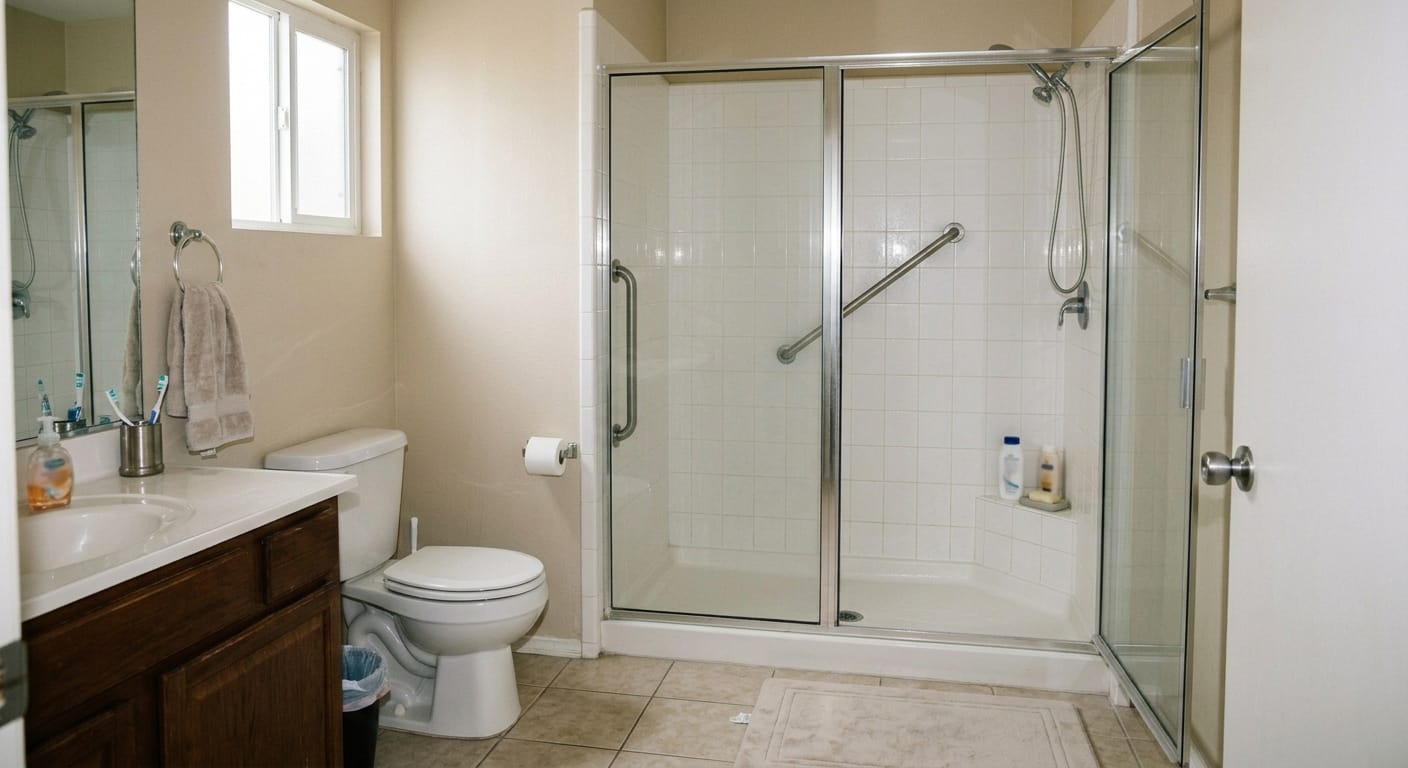
Most shower grab bars fail for one reason: they are installed where they look correct, not where the body actually needs support.
That distinction matters because shower safety is not defined by whether a bar exists. It is defined by whether the user can reach and use that bar at the exact moment balance becomes unstable.
Showering is one of the highest-risk activities in the home. It combines wet surfaces, confined space, visual distraction, shifting body positions, and repeated balance transitions. For older adults, fall risk does not usually appear during stillness. It concentrates during movement: stepping into the shower, turning while washing, lowering onto a shower chair, and standing back up.
In many bathrooms, grab bars are added as a general safety upgrade. But in practice, placement—not presence—determines whether they reduce risk or simply create a false sense of security.
A bar that cannot be reached during step-in has little value. A bar that sits too high to provide leverage during standing may not help at all. A bar positioned behind the body instead of beside it may look substantial while remaining functionally unusable.
At AgingAuthority, shower grab bar placement is evaluated through one lens: transfer stability during real movement.
Because in the shower, safety is not static.
Risk concentrates at transitions.
Plan Your Bathroom Project
Organize bathroom project priorities and questions before comparing written proposals.
2. What Is Proper Shower Grab Bar Placement?
Proper shower grab bar placement is not about symmetry, standard spacing, or visual neatness. It is about functional support during movement.
A shower grab bar is only effective if it meets three conditions:
- It can be reached exactly when support is needed
- It aligns with the user’s natural hand path during movement
- It can support body weight during a transition or balance correction
This is the difference between having a grab bar and being able to use a grab bar safely.
Many installations fail because the bar is placed where someone can see it after entering the shower, but not where they can grab it before or during instability.
That is why proper placement must begin with movement analysis, not hardware selection.
For broader bathroom placement principles beyond the shower, see Grab Bar Placement in Bathroom: Safe Locations for Seniors.
This guide focuses specifically on the shower environment, where placement precision becomes more important because wet conditions reduce reaction time and punish small errors more quickly.
3. Environmental and Shower Risk Framing
The shower is not simply a wet zone. It is a concentrated transition environment.
Several risk factors overlap inside a shower at the same time:
- Water reduces surface traction
- Space is limited, especially in smaller stalls
- Turning and reaching are frequent
- One hand is often occupied with washing
- Steam and water flow can interfere with vision
- Unstable surfaces may be mistaken for support
Most importantly, shower use involves repeated shifts in center of gravity. A person steps in, adjusts footing, rotates the trunk, transfers weight from one leg to the other, bends, reaches, sits, or stands. Each of these movements creates a brief moment where stability is challenged.
Falls in the shower rarely happen while someone is standing still in a centered posture. They happen when the body is transitioning between positions and there is no stable support exactly where the hand needs it.
This is why shower grab bars should not be thought of as general accessories. They are part of a support system designed to protect the body during instability.
4. Transfer Stability and Placement Logic
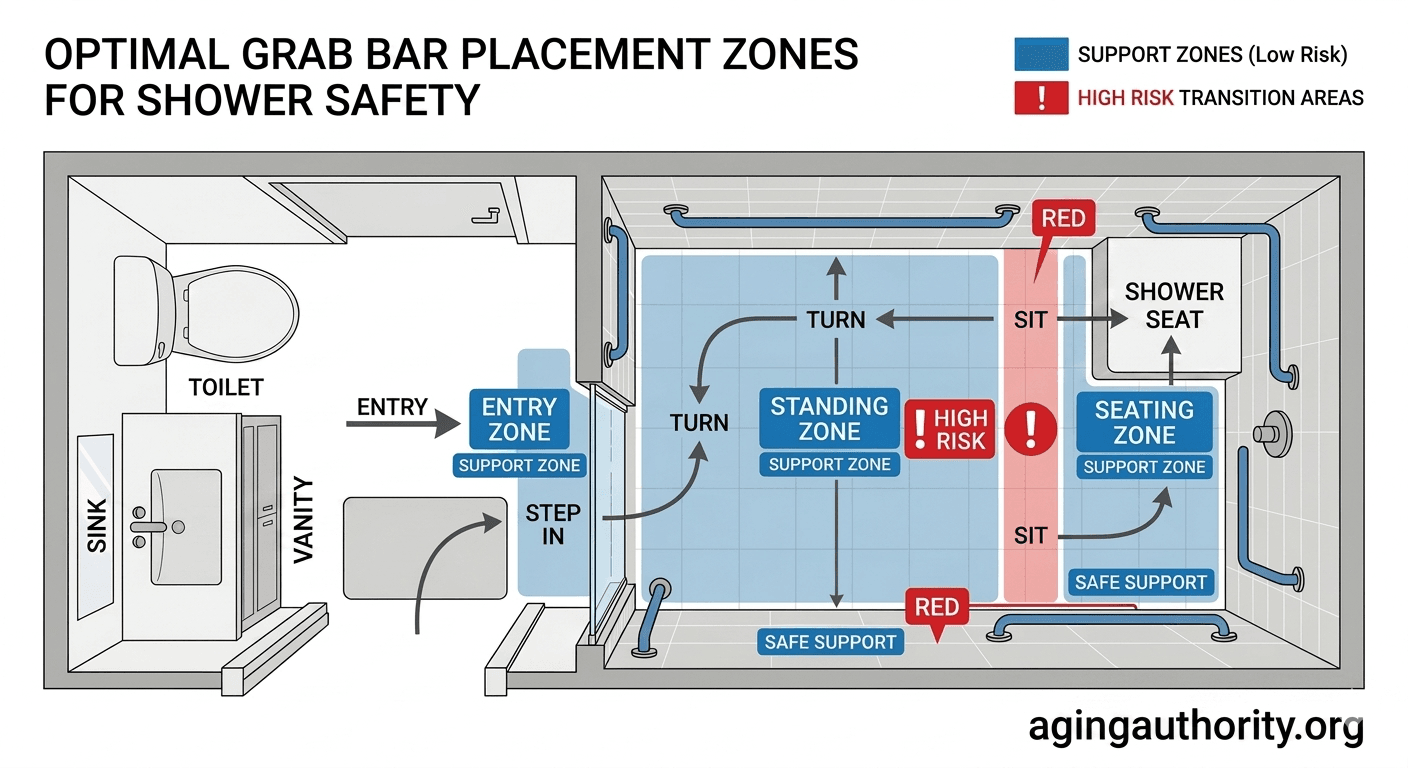
To understand where a shower grab bar should go, it helps to break the shower into its highest-risk movement phases.
4.1 Entry Into the Shower
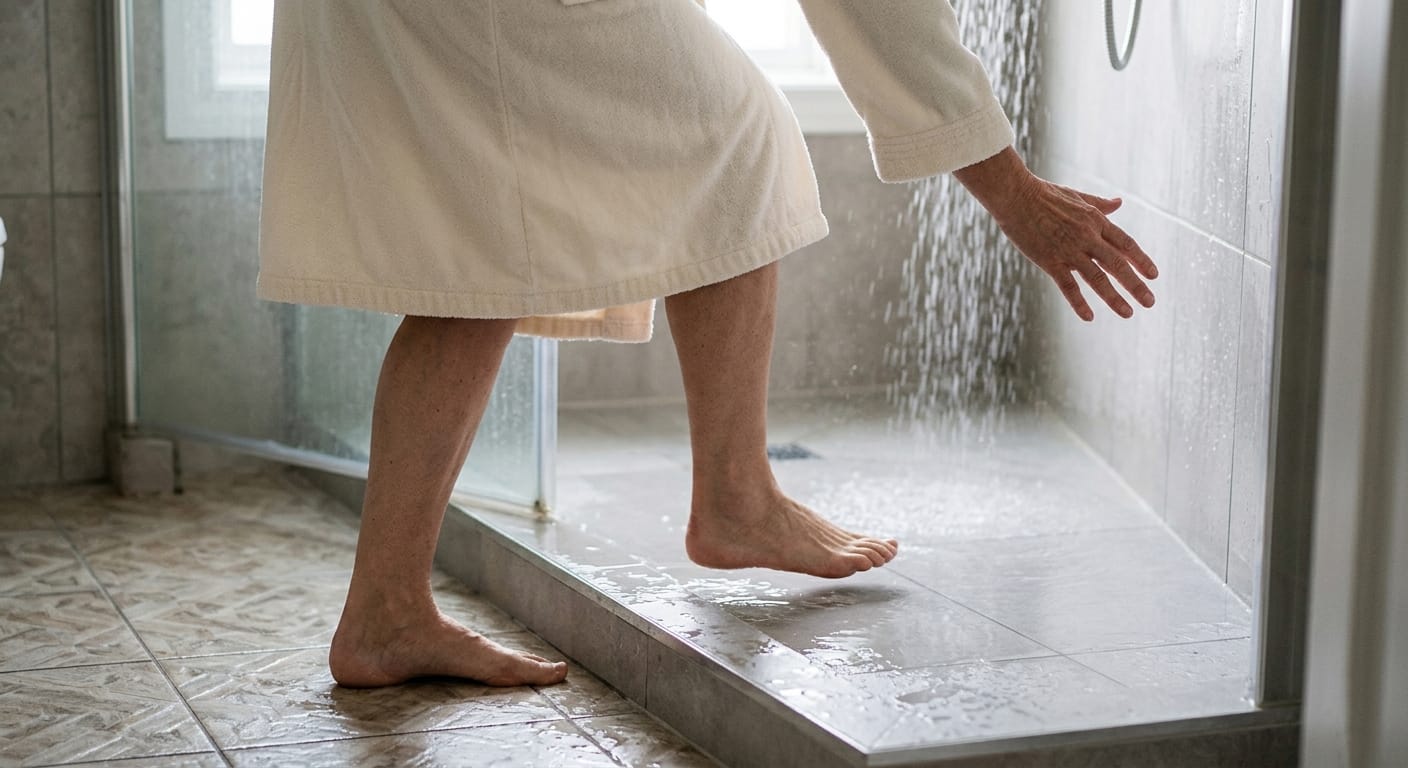
This is the first major instability point.
During entry, one foot leaves the stable dry surface, the body shifts weight forward or sideways, and the leading foot lands on a wet surface. In a tub-shower combination, the movement becomes even riskier because the user must step over the tub wall while changing weight distribution.
The natural hand path during entry is usually forward and slightly to the side, searching for a stable anchor before full weight shift occurs.
That is why the entry zone often benefits from a vertical or slightly angled grab bar placed directly beside the point of entry and within immediate reach before the leading foot lands on the wet surface.
If the bar is positioned too far inside the shower, the user may already be unstable before reaching it. If only a horizontal back-wall bar is present, it may not provide the hand orientation needed for a secure step-in grip.
4.2 Standing While Washing
Standing in the shower is not a static posture. Even when the user appears still, the body is making constant micro-adjustments to maintain balance.
Weight shifts from one foot to the other. The trunk rotates. One arm reaches for soap, shampoo, or the shower controls. Vision may be partially disrupted by water. At any moment, the user may need lateral support to stabilize.
For this phase, a horizontal grab bar along the main standing wall is often the most effective option. It allows the hand to slide or reposition as needed while maintaining contact during balance corrections.
If the bar is too short, support disappears exactly when the body changes position. If there is no side support at all, the user may instinctively grab unstable fixtures or lean on the wall without real assistance.
4.3 Sitting Down Onto a Shower Chair
Sitting is one of the highest-risk movements in the shower because it requires controlled lowering, coordination, and a backward shift of body weight.
The hand path during this movement is usually downward and slightly forward or to the side, depending on the position of the chair and the user’s dominant movement pattern.
For this reason, a horizontal support bar beside the seating area is often more useful than a bar behind the chair. A bar behind the body may appear logical on paper but is often difficult to use during actual descent.
The goal is not to decorate the shower wall behind the seat. The goal is to provide a reachable support surface where the user can control the lowering movement without twisting or overreaching.
For related guidance, see Shower Chair for Seniors: Do You Really Need One?.
4.4 Standing Up From a Seated Position
Standing up requires force production, forward trunk lean, lower-body strength, and balance recovery during upward movement.
The natural hand movement is often forward and upward, not backward. That is why a correctly positioned side bar at push height can provide meaningful leverage, while an incorrectly placed high bar may be difficult to use effectively.
If the bar is too high, the shoulder may elevate without generating helpful lift. If the bar is too low, the user may have to bend excessively or lose mechanical advantage.
In some layouts, a secondary vertical bar near the front edge of the seating zone can improve directional support during the stand-up phase, especially for users who need help controlling forward transfer.
4.5 Turning and Reaching
Turning is often overlooked, but it is a major source of rotational instability in the shower.
The center of gravity shifts, foot friction changes, and one hand may be occupied. If support coverage is interrupted, the user may lose stability during a simple rotation to reach shampoo, the shower controls, or a towel.
This is why continuous or well-positioned horizontal support along the primary standing wall can be so valuable. It reduces support gaps and allows the user to maintain contact during changing body orientation.
5. How a Safe Shower Support Layout Should Work
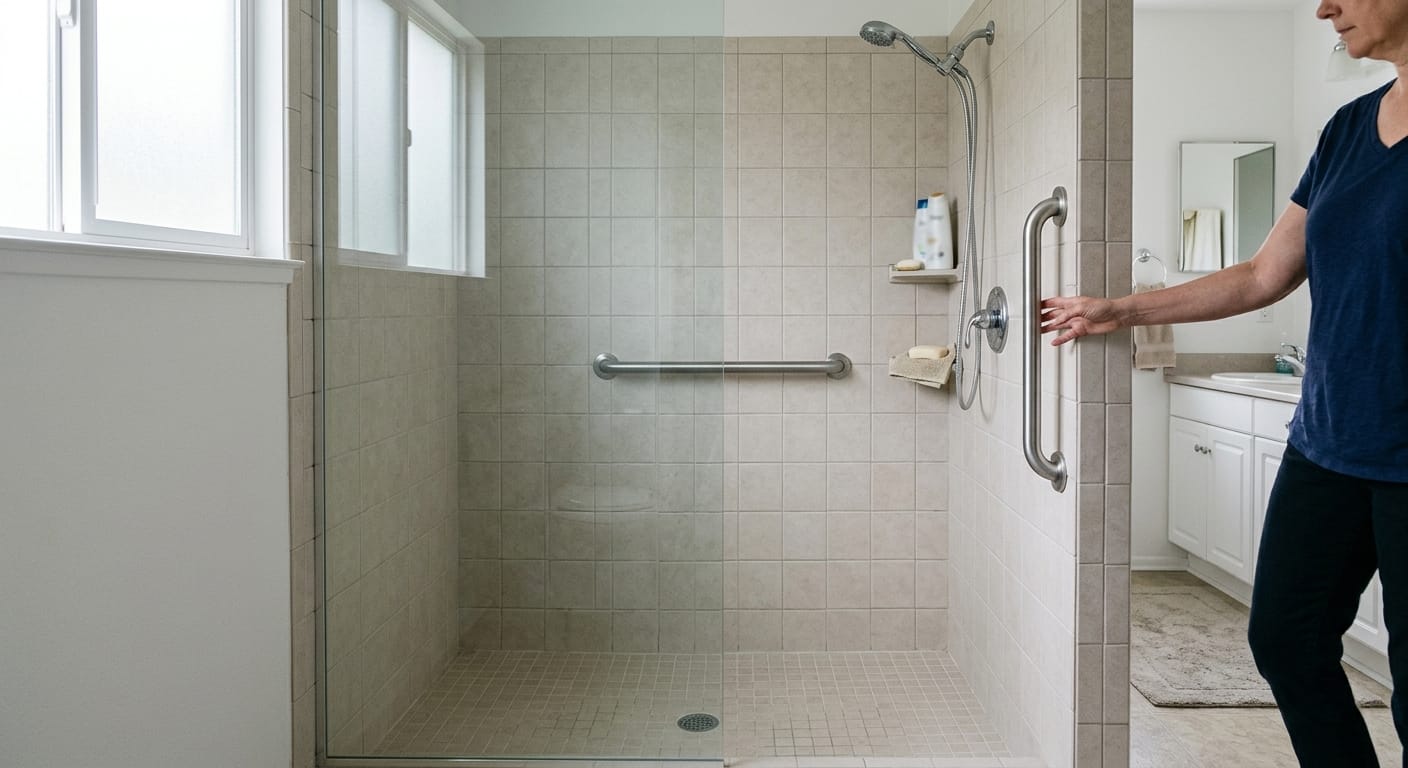
Many families ask what a safe shower grab bar setup should look like in simple terms.
The answer is not one universal pattern. But conceptually, a safe layout usually follows this logic:
- At the entry: support should be available before or during the first weight shift onto the wet surface
- At the main standing wall: support should be available during washing, turning, and balance corrections
- At the seating zone: support should assist controlled lowering and standing, not just decorate the wall behind the chair
A common real-world failure is a single bar installed on the back wall of the shower. It may look correct. It may even feel reassuring during inspection. But when the user steps in, there is nothing within immediate reach. When the user lowers onto a chair, the bar may be behind the body instead of beside it. When the user turns, support may disappear.
That is not a support system. It is a partial installation.
A functional shower layout treats the grab bar system as movement infrastructure. Each bar exists to support a specific instability point.
6. Shower Grab Bar Planning by Scenario
6.1 Walk-In Shower
In a walk-in shower, the most effective configuration often includes:
- A vertical bar mounted directly beside the entry point
- A horizontal bar along the main standing wall
The vertical entry bar helps stabilize the initial step onto the wet surface. The horizontal wall bar supports standing balance, turning, and reaching during washing.
This arrangement addresses two separate movement problems: entry instability and lateral balance while standing.
6.2 Tub-Shower Combination
A tub-shower combination creates one of the most demanding bathroom transitions because the user must step over the tub threshold while managing height change and wet-surface risk.
In this setup, placement often works best when it includes:
- A vertical bar at the tub entry zone
- A horizontal bar along the back or side wall inside the shower area
The entry bar should be positioned where the user can grip it before and during step-over movement. The inner horizontal bar then provides continued stabilization once inside.
For the broader decision between these bathroom designs, see Walk-In Shower vs Walk-In Tub for Seniors.
6.3 Shower With a Chair
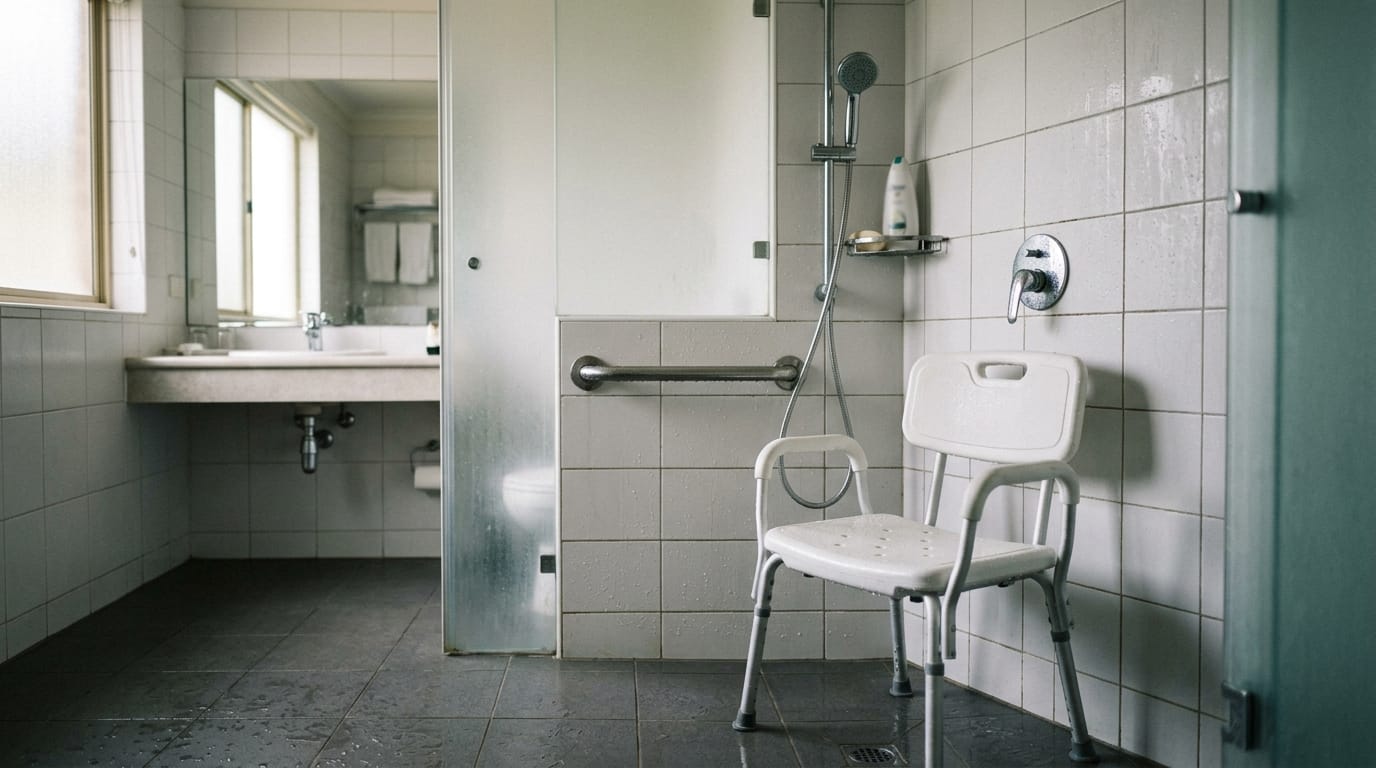
When a shower chair is used, bar placement must support both seated transfer and standing recovery.
The most useful configuration often includes:
- A horizontal bar beside the seat at functional transfer height
- An optional vertical bar near the front or entry side if additional directional support is needed
The side bar is usually more important than a rear bar because it aligns more naturally with the hand path during sitting and standing.
6.4 Small Shower Stall
In a small shower stall, space limitations do not remove the need for support. They increase the need for precise support.
Where full coverage is impossible, placement should prioritize:
- Immediate support at entry
- At least one accessible bar in the main standing or transfer zone
A compact but correctly positioned bar can still provide meaningful protection. A larger but poorly located bar may not.
7. Height and Positioning Guidelines
The ADA Standards specify dimensions for covered bathing facilities, but they do not supply a universal placement plan for every private bathroom. Ask a qualified installer or accessibility professional to check the applicable local requirements, wall structure, product instructions, and the user’s reach and transfers before choosing dimensions.
| Project area | Movement to review | Questions for the installer | Person-specific check |
|---|---|---|---|
| Shower entry | Approaching and crossing the threshold | Where can secure backing or an approved mounting system be provided without compromising waterproofing? | Can the person reach the proposed support before changing level? |
| Main shower wall | Standing, turning, and reaching | What bar location and length fit the actual wall, fixtures, and product instructions? | Can the user grasp the bar throughout the movements they make? |
| Shower seating | Sitting and standing | How will the seat, bar, and wall structure work together for the specific transfer? | Have an occupational therapist assess transfers when balance or strength is limited. |
| Small or irregular stall | Entry, turning, and exit | Which arrangement is feasible under local requirements and the manufacturer’s mounting instructions? | Check that the bar does not obstruct movement or create a new snag point. |
Use the table as a discussion guide, not an installation specification. Dimensions in the ADA Standards apply where those standards govern; local residential requirements and the person’s needs must be checked for the actual project.
A comfortable reach does not replace the structural and code checks for a weight-bearing grab bar.
8. Quick Placement Decision Guide
Families often need a simple answer to the practical question: how many shower grab bars are actually needed, and where should they go first?
| Shower setup | Movement to observe | Question for a qualified professional |
|---|---|---|
| Limited wall space | Entry, standing, and exit | Which support arrangement is feasible with the wall structure and actual user route? |
| Walk-in shower | Threshold crossing and turning | Can support remain reachable without interfering with the door or controls? |
| Tub-shower combination | Stepping over the tub edge | What arrangement fits the transfer and the available structural backing? |
| Shower chair | Sitting and standing | Should an occupational therapist review the transfer and bar location? |
| Small stall | Turning and reaching | How can support fit without obstructing movement or waterproofing? |
The number and location of bars depend on the person, the shower layout, structural backing, product instructions, and applicable requirements.
Plan Your Bathroom Project
Organize bathroom project priorities and questions before comparing written proposals.
9. Common Placement Mistakes
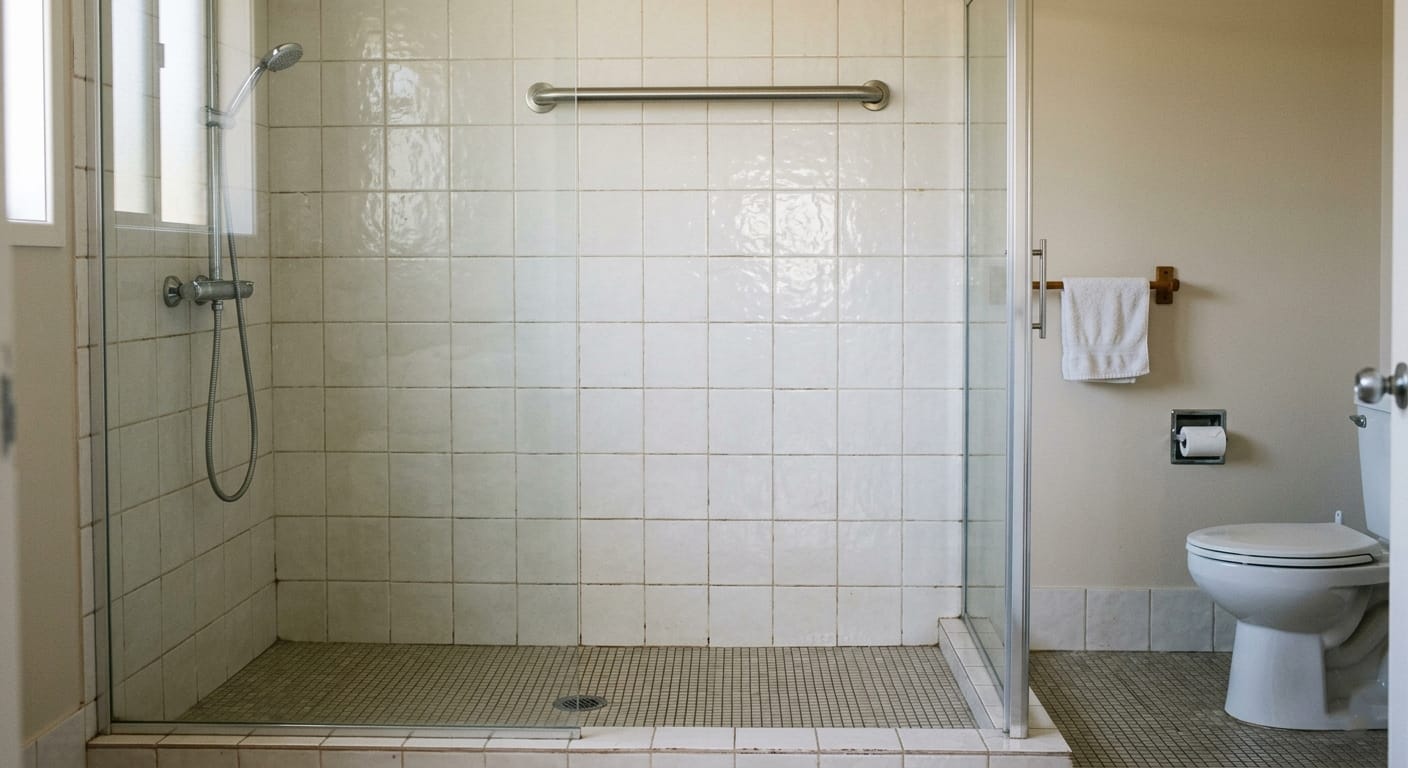
Most shower grab bar problems come from placement errors, not from the idea of using grab bars in the first place.
| Condition to review | Why it matters | Question for the professional |
|---|---|---|
| Bar beyond the entry reach | The user may have no handhold during the threshold crossing. | Can a structurally sound location be reached before stepping in? |
| Bar difficult to grasp | Height, orientation, or nearby fixtures can affect reach. | Can the user grasp the proposed bar during the actual movement? |
| Bar behind a shower chair | It may be inaccessible during a seated transfer. | Would a different configuration work better for this person and chair? |
| Interrupted support | A gap may require releasing the grip while turning. | How can the layout be assessed without obstructing the shower? |
| Mounting based only on appearance | Wall finish does not establish structural support. | What backing or approved anchors and waterproofing details are needed? |
In real bathrooms, these mistakes often lead to delayed reaction time, improvised support behavior, and increased reliance on unstable surfaces such as towel bars, faucet controls, or wet walls.
10. Integration With Other Bathroom Safety Elements
Shower grab bars do not work in isolation. They are one part of a larger bathroom transfer system.
That system may include:
- Shower seating
- Slip-resistant flooring or surface treatment
- Proper toilet transfer support
- Accessible shower design
- Clear entry and turning space
A grab bar can be placed correctly and still underperform if the user cannot approach it safely, if the chair blocks access to it, or if the surrounding layout forces awkward movement.
That is why shower safety must be evaluated as an integrated movement system, not a collection of separate products.
11. Real Bathroom Constraints
Real homes rarely offer ideal installation conditions.
Common constraints include:
- Small shower footprints
- Tile or stone walls that complicate installation
- Stud locations that do not match ideal placement points
- Shower doors or fixtures that limit usable wall space
- Existing layouts that make full support coverage impossible
These limitations do not remove the need for functional placement. They make prioritization more important.
When full coverage is not possible, the best approach is to prioritize the highest-risk zones first:
- Entry transition
- Seated transfer zone if a chair is used
- Main standing and turning wall
Compromise may sometimes be necessary, but compromise should never ignore function. A less-than-perfect placement can still improve safety if it meaningfully supports the most dangerous movement in that bathroom.
12. Cost and Installation Considerations
Grab bars themselves are often relatively affordable. Typical product costs may range from around $20 to $100 per bar, depending on size, material, and design. Professional installation commonly adds additional cost per bar.
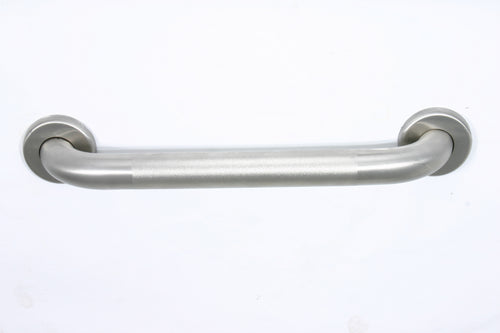
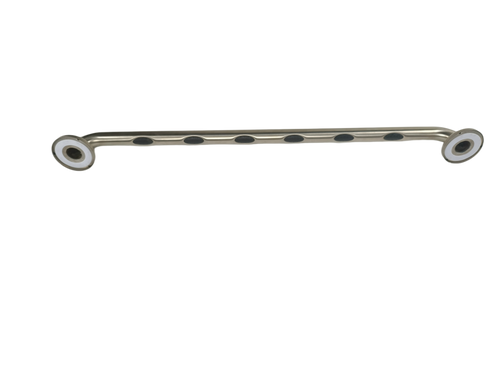
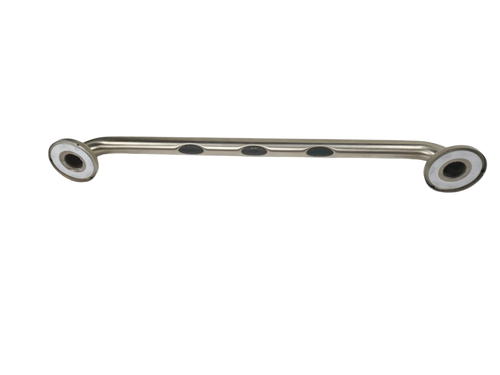
But the real issue is not the price of the hardware. It is whether the installation is structurally safe.
Shower grab bars must be able to withstand real load. That usually means secure mounting into wall studs or the use of certified anchoring systems appropriate for the wall type and product specifications.
An improperly anchored grab bar can create one of the most dangerous conditions in the bathroom: false security during weight-bearing use.
In other words, a loose grab bar is often worse than no grab bar at all.
13. When to Hire a Professional
Professional help is often worth considering when:
- The older adult has significant balance or transfer limitations
- The bathroom layout is complex
- The safest position is unclear
- Wall construction makes anchoring difficult
- The shower includes a chair, tub threshold, or multiple movement challenges
The most useful professionals may include:
- Occupational therapists
- Certified aging-in-place specialists
- Experienced contractors familiar with bathroom safety installation
What matters is not just technical drilling ability. It is the ability to evaluate movement patterns, reach zones, transfer mechanics, and real-life use.
14. Conclusion
In the shower, safety is not defined by equipment alone. It is defined by how that equipment supports real movement.
A grab bar that cannot be reached during entry has no meaningful function. A bar placed too high, too far away, or in the wrong direction may offer visual reassurance without providing real stability. A well-placed bar, by contrast, becomes part of a functional support system that helps the user move safely through the bathroom’s highest-risk transitions.
The core principle is simple:
Placement determines stability. Stability determines safety.
That is why shower grab bar placement should never be reduced to aesthetics, symmetry, or generalized rules. It should be based on the body, the layout, and the movement that creates risk.
Plan Your Bathroom Project
Organize bathroom project priorities and questions before comparing written proposals.
15. Frequently Asked Questions
What is the best height for a shower grab bar?
There is no single best height for every shower. A qualified installer should check the applicable requirements, structural backing, the product instructions, and the user’s reach and transfer movements before setting the height.
Where should a grab bar be placed in a walk-in shower?
A vertical entry bar and a horizontal wall bar may be useful in some walk-in showers. The position and mounting should follow the user’s actual transfers, wall structure, and a qualified assessment.
Are vertical or horizontal shower grab bars better?
Neither is universally better. Vertical bars are often more useful for entry and directional transitions, while horizontal bars are often better for standing balance, turning, and continuous support along a wall.
Should a grab bar go behind or beside a shower chair?
In many cases, a bar beside the chair is more functional than one behind it because it aligns better with natural hand movement during sitting and standing. The best location depends on how the user transfers.
Is one shower grab bar enough?
Sometimes, but not always. If only one bar can be installed, it should be placed at the highest-risk transition point. In many bathrooms, that means entry or seated transfer—not simply the most visually convenient wall.
Can shower grab bars be installed on tile walls?
Yes, but installation must be handled carefully and anchored correctly. Tile does not remove the need for structural safety. Proper mounting matters more than surface appearance.
16. Safety Note
This article is for general home safety education. It does not replace evaluation by an occupational therapist, qualified contractor, or medical professional. Grab bar placement should be adapted to the user’s mobility, strength, reach, wall structure, and bathroom layout.
17. Published by AgingAuthority
Published by AgingAuthority for general educational purposes. Placement and installation need assessment of the person, wall structure, product instructions, and applicable local rules. Learn more about our editorial standards on our Editorial Process page.
18. Sources
Sources
- Centers for Disease Control and Prevention (CDC) — STEADI Older Adult Fall Prevention
- CDC STEADI — Patient and Caregiver Resources
- National Institute on Aging — Preventing Falls at Home: Room by Room
- National Institute on Aging — Six Tips to Help Prevent Falls
- U.S. Access Board — Chapter 6: Bathing Rooms
- U.S. Access Board — ADA Standards, Chapter 6: Plumbing Elements and Facilities
- National Council on Aging — How to Prevent Falls With Home Safety Modifications