
For a complete overview of safer home entrances, explore our Complete Entryway Safety Guide for Aging in Place .
A practical guide to evaluating whether an exterior handrail is reachable, graspable, continuous, structurally dependable, and positioned for the way a person actually moves through the entrance.
Executive Summary
A useful outdoor handrail depends on more than height. It must offer a secure grip, continuous support, practical beginning and ending points, adequate clearance, and stable structural attachment. Its placement also needs to work with the steps, landing, door, weather, and the person’s actual route through the entrance.
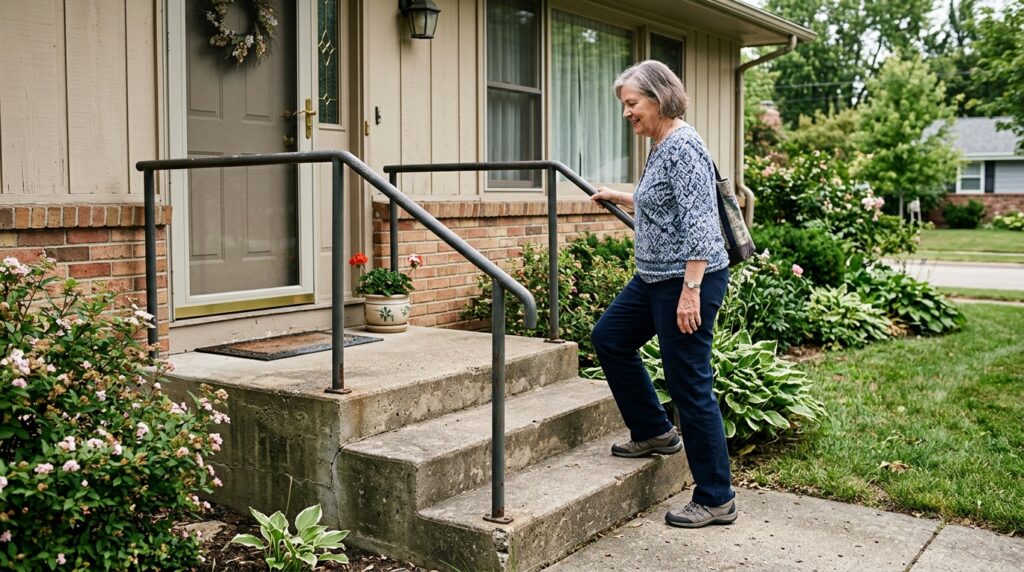
An outdoor handrail may appear adequate from the sidewalk yet become difficult to use once someone approaches the first step, changes direction, reaches for the door, or encounters rain. From a distance, the rail looks present. During movement, its limitations become visible.
A person may be unable to reach it until after stepping up. The top may be too broad to wrap a hand around. A storm door may force the user to release the rail and step backward. Slight movement at a post may make the entire system feel untrustworthy. These are not isolated hardware problems; they arise from the relationship among the person, rail, steps, landing, door, and surrounding environment.
This guide focuses on outdoor handrails for older adults. For a broader review of the approach, drainage, landing, threshold, and door, see the Complete Entryway Safety Guide for Aging in Place.
01What Makes an Outdoor Handrail Usable?
A usable rail is available at the moment support is needed and remains usable throughout the movement. That requires an appropriate, consistent height; a shape the hand can grasp; clear space for the fingers; continuity along the steps; useful start and end points; and attachment that does not shift under ordinary pulling or leaning forces.
Placement matters just as much. The rail should relate logically to the walkway approach, stair width, landing, preferred hand, and door operation. Outdoor durability also affects use: corrosion, splinters, rain, ice, hot metal, or a slippery coating can turn a technically present rail into something a resident avoids touching.
“Railing” is commonly used as a catch-all term, but the components do different jobs:
Some assemblies combine a guard and a separate graspable handrail. In others, the top of a guard may serve both functions only when its height, profile, continuity, and construction comply with the applicable requirements. Appearance alone does not establish function.
02Outdoor Handrail Height: A Reference Point, Not the Whole Answer
A commonly referenced code-based range places the top of the gripping surface 34–38 inches above the stair nosings. The measurement is taken vertically from an imaginary sloped line connecting the front edges, or nosings, of the treads—not from the ground beside the stairs and not from the back of each tread.
Consistency is central to the measurement. A hand moving along the rail anticipates a predictable path. If the rail rises, dips, or changes abruptly because brackets and posts were aligned visually rather than to the stair run, the user may need to adjust grip and arm position mid-step.
Irregular outdoor steps complicate the issue. Sloped landings, inconsistent tread depths, settled concrete, and added overlays can produce different measurements along the same run. In that situation, selecting a nominal rail height does not correct the step geometry. The steps and rail need to be evaluated together.
Individual needs still matter within a code-aware plan. A rail can fall within a common dimensional range yet sit too far away, require uncomfortable shoulder elevation, or fail to support a shorter user at a landing. When mobility, reach, posture, or balance has changed significantly, an occupational therapist or accessibility professional can help evaluate the person in the actual setting without treating a preferred measurement as a substitute for code compliance.
03Grip Shape, Size, and Finger Clearance
Resting a palm on top of a railing is different from securing a functional grip. A graspable handrail lets the fingers and thumb wrap around enough of the profile to steady the body and respond to a small loss of balance. Wide deck caps, flat boards, and ornate shapes may offer a surface to touch without offering dependable purchase.
Widely used accessibility guidance recognizes both circular and non-circular profiles. As a reference point, circular gripping surfaces are commonly specified at 1¼–2 inches in outside diameter. Non-circular profiles are evaluated by their perimeter and cross-sectional dimensions rather than width alone. These specifications illustrate the principle of graspability; the locally adopted residential code determines what is required for a particular project.
Rounded edges and an uninterrupted gripping path generally feel more predictable than sharp corners, deep grooves, or decorative changes. The finish should be smooth enough not to abrade skin or catch clothing, but not so slick that rain or a damp glove defeats the grip. Arthritis, reduced finger movement, and lower hand strength can make large or angular profiles especially demanding, although no single shape is ideal for every person.
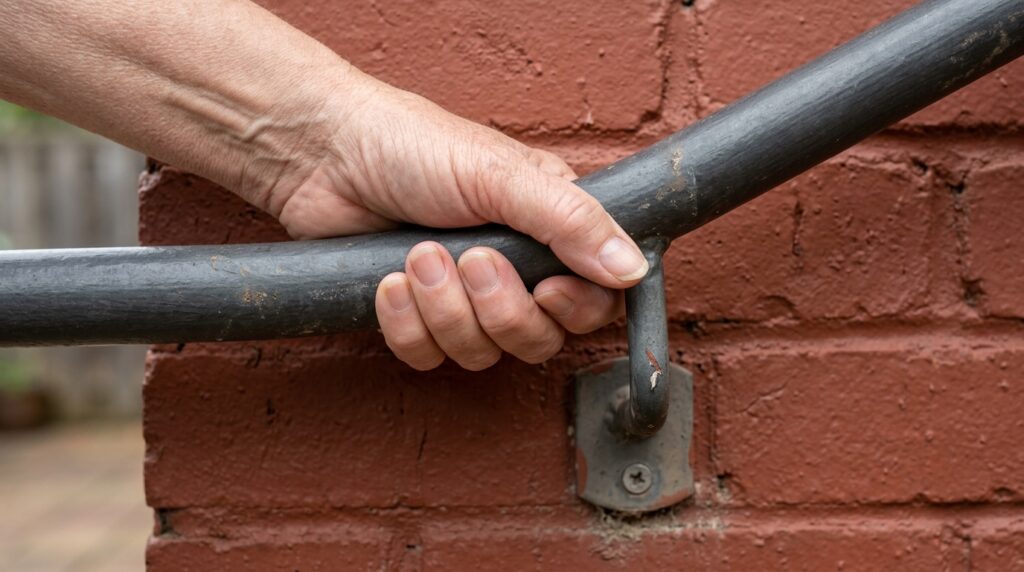
Wall clearance affects how easily the rail can be grasped. A commonly referenced minimum is 1½ inches between the handrail gripping surface and an adjacent wall. In practice, brackets, siding projections, downspouts, posts, and trim can still crowd the fingers even when one point measures correctly. Check the full gripping path, including the underside where fingers curl.
04Continuity, Extensions, and Safe End Points
The first and final step are often where usable support matters most. At the bottom, a person benefits from reaching the rail before committing weight to the first riser. At the top, support should continue through the transition onto the landing rather than disappearing while the body is still changing level.
A rail that begins after the first step asks the user to start unsupported. One that stops before the final riser creates the same problem in reverse. Posts, decorative panels, and bracket arrangements can also interrupt the hand path, forcing a release and re-grip at precisely the point where steady movement is preferable.
Code-required extensions vary by stair type and applicable standard. Where extensions are used, they must fit the landing and circulation route without becoming a projection hazard. Ends are commonly returned smoothly to a wall, post, guard, or walking surface so that sleeves, handbags, and straps are less likely to catch. A long, open-ended pipe is not automatically safer simply because it extends farther.
Turns at intermediate landings deserve separate attention. If the user must change hands, cross a gap, or rotate before the next rail becomes available, the system is continuous only in appearance. The practical question is whether support remains reachable through the change in direction.
05One Outdoor Handrail or Two?
Two rails often provide more options. The stronger or preferred hand may differ when ascending and descending. A bag, cane, mail bundle, or door key can occupy one hand. On wider steps, the opposite rail may be beyond comfortable reach, while rails on both sides give the user a choice without crossing the stair width.
The CDC and National Institute on Aging advise handrails on both sides of stairways as a general fall-prevention measure. That does not mean two rails are legally mandatory or physically appropriate at every private entrance. Narrow stairs may lose usable width. One side may lack sound structure for attachment. A second rail might conflict with a door, guard, or required clear route.
Observe the approach direction rather than choosing a side from a front-facing photograph. A rail on the “correct” side of the steps may be awkward from the driveway, or it may become inaccessible while a storm door swings outward. The final decision should reconcile user preference, stair width, structural conditions, and local requirements.
06Placement Around Steps, Landings, and Doors
A technically sound rail can still be poorly placed for the route. The user needs to find it from the walkway, approach the first step without sidestepping around a planter, and arrive on a landing with enough room to unlock and open the door.
Door swing is a frequent source of conflict. An outward-swinging storm door may require the resident to pull the door toward the body while stepping back. If the landing is shallow or the rail ends at the top riser, that backward movement can occur without support. An inward-swinging main door may be easier to clear outside, but a stiff closer, high threshold, or poorly placed lock can still make the person lean away from the rail.
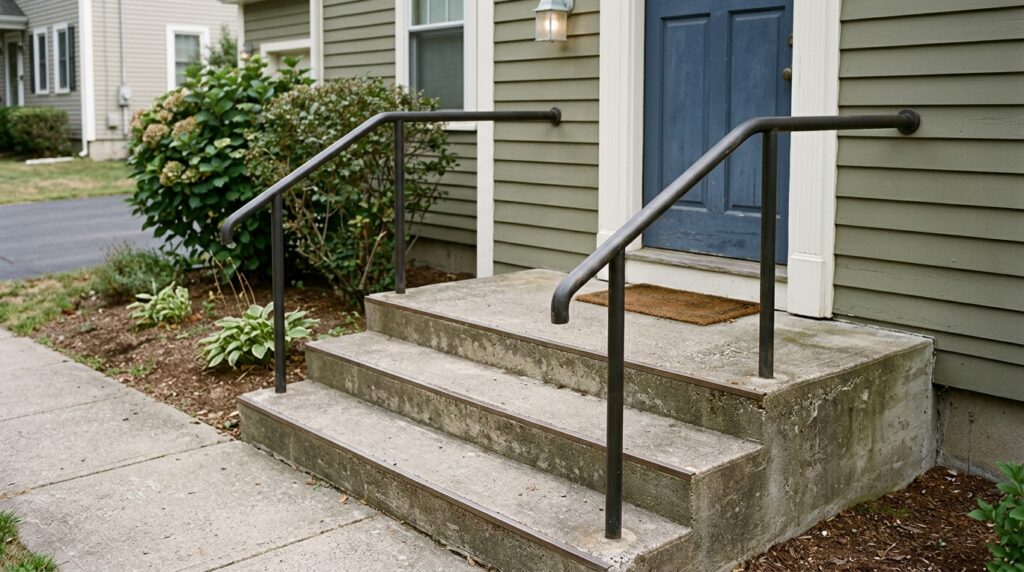
Mailbox posts, shrubs, downspouts, house numbers, and seasonal decorations can narrow the approach or block the gripping path. The hand should not need to weave around balusters, squeeze behind foliage, or release the rail to operate the door. For a closer look at the unlock–open–cross sequence, read Front Door Safety for Older Adults.
Visibility belongs in the placement discussion as well. A dark rail can disappear against dark siding, while a shadow from the rail can obscure the first nosing. The goal is not decorative contrast for its own sake; it is to make the support and the next level change easy to locate. The entryway lighting guide explains how fixture position, glare, shadows, and controls influence that route.
07Materials and Outdoor Conditions
No material is universally best outdoors. Suitability depends on exposure, maintenance, climate, grip profile, structural system, and the condition of the house or steps to which the rail connects.
- Powder-coated metal can offer a consistent profile and restrained maintenance when the coating remains intact. Chips at welds or fasteners may expose metal to corrosion, so connections deserve periodic inspection.
- Galvanized steel is valued for strength and corrosion protection, though cut edges, damaged coatings, incompatible hardware, and harsh exposure can still deteriorate. Its temperature can feel uncomfortable in very hot or cold weather.
- Aluminum resists rust and is lighter than steel, but system design, post spacing, connection quality, and alloy matter. Light weight should not be mistaken for either weakness or structural adequacy.
- Wood can match a porch naturally and feel less cold than metal, but the gripping surface needs monitoring for checks, splinters, rot, raised grain, peeling finish, and loose connections.
- Composite or integrated railing systems can reduce some finish maintenance, yet a broad top cap may function as a guard component rather than a graspable handrail. A separate code-compatible grip may be needed.
Weather changes use, not merely material life. Rain alters friction. Gloves reduce tactile feedback and make bulky profiles harder to wrap. Snow can conceal the bottom connection, while ice may form on both the steps and rail. Direct sun can make a dark metal surface unpleasant to hold. Evaluate the rail during the conditions that cause the resident to hesitate, not only on a dry afternoon.
08Structural Attachment and Exterior Installation
A handrail must resist real pulling, pushing, and leaning forces. Because it is a safety feature, slight movement under pressure is more than a cosmetic annoyance: it can cause a resident to distrust the rail and reach instead for a wall, doorframe, shrub, or another person.
Secure installation begins with sound supporting material. Wood framing, concrete, brick, concrete block, and stone require different connection strategies. Exterior siding and decorative trim are surface finishes, not proof of structure behind them. Likewise, an anchor installed into cracked mortar, spalled concrete, a loose brick, rotted framing, or a thin porch fascia may create false confidence.
The correct fasteners and anchors depend on the substrate, rail system, edge distances, loads, exposure, and manufacturer’s instructions. For that reason, this guide does not prescribe a universal screw or anchor. Alignment, post depth or base attachment, corrosion-resistant exterior hardware, and moisture management at penetrations all need to be resolved as one installation—not improvised one bracket at a time.
Sealing is also structural maintenance. Poorly detailed holes can admit water behind siding or into wood, accelerating damage that remains hidden until movement appears. On masonry, careless drilling can fracture already weakened units. If the support material is deteriorated or uncertain, repair and evaluation come before mounting the rail.
09Common Outdoor Handrail Problems
Some defects call for structural repair; others require repositioning or maintenance. Several may appear together:
- Posts or brackets move when the rail is used normally.
- Rust is concentrated at base plates, welds, anchors, or connections.
- Wood is split, splintered, soft, peeling, or cracked around fasteners.
- The rail begins above the second tread or stops before the top landing.
- A decorative section, post, or abrupt height change interrupts the grip.
- The profile is too wide to wrap the fingers around comfortably.
- Wall clearance is lost at trim, brackets, downspouts, or siding details.
- Vegetation, planters, packages, or seasonal objects block access.
- The gripping surface becomes unusually slippery when wet or catches gloves and clothing.
- Anchors enter cracked concrete, loose mortar, damaged brick, or deteriorated wood.
- Lighting leaves the first step, rail beginning, or final landing difficult to distinguish.
Visible movement, damaged support material, missing sections beside several steps, and advanced corrosion or decay generally deserve prompt professional attention. Refinishing can address a worn surface only when the underlying rail and connections remain sound. Paint should never be used to conceal uncertainty about structural condition.
10Outdoor Handrail Evaluation Guide
| Feature | What to Check | Why It Matters | Possible Next Step |
|---|---|---|---|
| Height | Consistent path above nosings | Supports predictable reach | Measure; verify locally |
| Grip shape | Fingers can wrap securely | A top-rest is not a full grip | Assess profile options |
| Wall clearance | Clear finger path throughout | May reduce finger obstruction | Remove conflict or reposition |
| Continuity | No gaps, posts, or height jumps | Avoids release mid-movement | Modify rail layout |
| Start and end | Reachable before and after steps | Supports level transitions | Review safe extension |
| Number of rails | Preferred hand and stair width | Improves usable choices | Evaluate second side |
| Movement | Visible looseness in normal use | Signals unreliable support | Stop relying; seek repair |
| Material | Rust, cracks, rot, splinters | Damage affects grip and strength | Repair or replace |
| Attachment | Sound substrate and connections | Surface mounting can mislead | Professional inspection |
| Door and landing | Swing, standing room, hand changes | Support may vanish during entry | Review full door sequence |
| Visibility | Rail and step edges are readable | Helps locate support early | Improve light or contrast |
| Weather | Wet, hot, cold, icy, or gloved use | Conditions change grip quality | Improve finish and maintenance |
11A Practical Home Evaluation
Begin by watching ordinary use rather than staging a strength test. From a safe position, note when the older person first reaches for the rail, whether the preferred hand is available, and whether support continues until both feet are securely on the landing. Look for hesitation, sideways stepping, heavy pulling, awkward hand changes, or reaching toward the wall or doorframe.
Repeat the observation when arriving and leaving, because the preferred side may change with direction. Consider a normal bag or mail bundle, but do not create a challenge merely for testing. Notice whether unlocking, opening a storm door, and crossing the threshold cause the person to release the rail or move backward toward a step.
Visually inspect posts, brackets, bases, welds, wood fibers, paint failure, corrosion, and the material receiving the anchors. Check the route for vegetation and objects. View the entrance in daylight and after dark, and observe it after normal rain if this can be done without exposing anyone to a hazardous condition.
A visual review does not replace structural evaluation. Do not ask a frail person to pull on, lean against, or deliberately test a rail that appears damaged or loose.
12How to Prioritize Improvements
Higher-priority concerns
Loose or visibly unstable support; attachment to damaged material; missing support beside multiple steps; no usable grip at the first or final step; severe corrosion, cracking, decay, or a dangerous interaction with uneven steps or an inadequate landing.
Maintenance and usability improvements
Refinishing a sound surface, clearing minor obstructions, improving contrast or lighting, controlling vegetation, and addressing early corrosion or coating damage before deterioration advances.
Priority depends on both the entrance and the person. A modest placement problem becomes more consequential when the resident relies heavily on the rail, has only one comfortable gripping hand, or must use the route daily in wet weather. Conversely, a cosmetic finish issue should not displace repair of a moving post or crumbling step.
13When to Consider Professional Evaluation
Professional input is particularly useful when mobility or balance has changed, the stair layout is unusual, the landing is small, the door interferes with movement, the rail moves, or the framing or masonry appears damaged. It is also sensible when adding a second rail could narrow the route, when a handrail must integrate with a guard, or when code and permit requirements are unclear.
- An occupational therapist can observe reach, hand use, movement sequence, and the fit between the person and the entrance.
- A Certified Aging-in-Place Specialist, accessibility specialist, or home safety assessor can help translate current and anticipated needs into a coordinated modification plan.
- A licensed or otherwise qualified home-modification contractor can evaluate installation feasibility, substrate, product instructions, exterior detailing, and construction scope.
- A structural, concrete, or masonry professional may be needed when posts, walls, steps, brick, mortar, or framing are deteriorated.
- The local building department can clarify adopted codes, local amendments, permits, inspections, and whether the planned work triggers other requirements.
The professions overlap but are not interchangeable. A therapist evaluates human use; a contractor evaluates buildability; a building official explains local compliance. Complex entrances often benefit from more than one perspective.
14How Handrails Fit Into Complete Entryway Safety
A strong handrail cannot correct a loose tread, ponding water, an invisible step edge, an undersized landing, or a threshold that catches a walker. It can provide support while those conditions continue to create difficulty, which is why upgrading the rail in isolation may leave the main movement problem unresolved.
Review the rail beside step dimensions and condition, slip resistance, drainage, lighting, landing space, door hardware, threshold height, and the route from the driveway or sidewalk. The practical sequence is explored in How to Make a Home Entrance Safer for Older Adults.
If steps are becoming unsuitable rather than merely under-supported, a ramp may be worth exploring. This is a route-planning decision—not an automatic replacement for stairs—and available slope, landing space, drainage, handrails, and local requirements all affect feasibility.
15Frequently Asked Questions
What is a common height for an outdoor handrail?
A widely referenced range is 34–38 inches to the top of the gripping surface. Local codes, stair configuration, property type, and individual needs still need to be checked.
How is handrail height measured on outdoor steps?
It is commonly measured vertically from the line connecting the front edges, or nosings, of the stair treads to the top of the gripping surface. The height should remain consistent along the run.
Is one outdoor handrail enough for an older adult?
It depends on the stair width, approach, preferred hand, mobility, structural options, and local requirements. Two rails often provide more choice, but they are not automatically required or feasible at every home.
What handrail shape is easiest to grip?
A rounded profile that allows the fingers and thumb to wrap around it is often easier to secure than a wide, flat cap. Circular and compliant non-circular shapes can both work when properly sized and unobstructed.
Should a handrail extend beyond the first and last step?
Support should be reachable before the first step and continue through the final transition. Whether a specific extension is required—and its permitted form—depends on the applicable code and available landing space.
Can an outdoor handrail be attached to brick?
Potentially, but the brick or masonry must be sound and the connection designed for that substrate and rail system. Loose brick, cracked units, and deteriorated mortar require evaluation before installation.
How can I tell whether an existing handrail is secure?
Look for movement during normal use, loose posts or brackets, rust near connections, split wood, cracked masonry, and pulled fasteners. Visual inspection cannot confirm hidden attachment strength, so uncertainty warrants professional assessment.
When should an outdoor handrail be professionally installed?
Professional installation is appropriate when the substrate is uncertain or damaged, the stair or landing is unusual, the rail integrates with a guard, local permits apply, or the user relies heavily on the rail for balance.
16Conclusion
An effective outdoor handrail is reachable before support is needed, graspable through the complete movement, continuous at critical transitions, stable under ordinary use, and positioned for the actual approach and door sequence. Height provides an important reference, but it cannot compensate for a blocked grip, early ending point, weak attachment, damaged step, or awkward landing.
Start with ordinary behavior, then examine the rail, structure, steps, landing, lighting, drainage, and door as one entrance system. The right improvement is the one that resolves the specific mismatch while respecting the home, the user, and applicable local requirements.
This content is for general educational purposes only and does not replace a professional home safety assessment, medical advice, or licensed contractor evaluation.
17Sources
- International Code Council — 2021 International Residential Code, Section R311.7.8: Handrails
- U.S. Access Board — Guide to the ADA Accessibility Standards: Stairways
- U.S. Access Board — ADA Accessibility Standards, Section 505: Handrails
- National Institute on Aging — Preventing Falls at Home: Room by Room
- National Institute on Aging — Home Safety Tips for Older Adults
- CDC STEADI — Check for Safety: A Home Fall Prevention Checklist for Older Adults
- Centers for Disease Control and Prevention — Information for Older Adults