
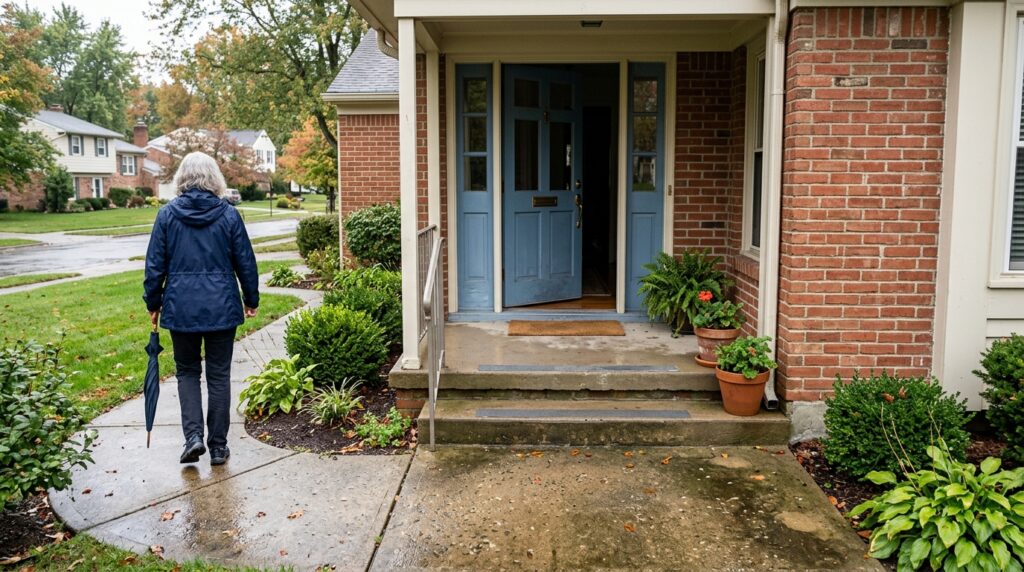
For a complete overview of safer home entrances, explore our Complete Entryway Safety Guide for Aging in Place .
Executive Summary
Safer entryway flooring combines dependable wet and dry traction, a stable surface, controlled moisture, secure low-profile mats, visible edges, and manageable transitions. The complete route—from the outdoor approach through the threshold to the interior floor—should be assessed together, particularly when reduced foot clearance, low vision, or mobility aids make small defects more significant.
A person entering a home may step from concrete onto a porch, cross a door threshold, place both feet on a mat, and then move onto tile, wood, vinyl, or carpet—all within a few seconds. Each surface may look acceptable on its own. The difficulty often appears in the way they meet.
A damp shoe can lose grip on sealed concrete. A thick mat can absorb that moisture but create an edge that catches a walker. A barely visible flooring strip can add another point where a shuffling foot hesitates. Several minor conditions can therefore combine into one demanding entry route.
Families frequently concentrate on steps and handrails while assuming the flat landing is uncomplicated. A useful assessment looks beyond the flooring material’s name. It considers traction, movement, wear, water, glare, mat behavior, footwear, and the way the person actually enters and leaves the home. Our broader Entryway Safety Guide for Aging in Place explains how this surface fits into the entrance as a complete safety system.
01What Makes Entryway Flooring Safer for Older Adults?
Entryway flooring is more supportive when it provides predictable traction, remains firmly in place, and allows a person to cross it without unexpected changes in height or resistance. These qualities matter under real conditions—not merely when the surface is new, clean, and dry.
- Reliable traction: The surface should provide reasonable grip with both dry and wet footwear.
- Structural stability: Flooring, pavers, boards, transition strips, and mats should not shift, rock, buckle, or compress unexpectedly.
- Manageable transitions: Changes in level and texture should be limited, firmly finished, and easy to recognize.
- Moisture control: Water should drain away rather than pool outside or spread across the first several feet indoors.
- Clear visibility: Lighting and contrast should reveal genuine edges without creating glare or confusing patterns.
- Practical compatibility: The route should work with the person’s footwear, gait, cane, walker, or wheelchair.
- Maintainability: A theoretically high-traction surface offers limited value if routine cleaning is so difficult that grit, algae, residue, or moisture remain on it.
“Non-slip” should not be interpreted as an absolute property. No residential floor remains reliably slip-proof under every contaminant, shoe type, weather condition, maintenance routine, and walking pattern. A textured tile can lose useful traction under cleaning residue, while a moderately textured floor that is well drained and maintained may behave more predictably.
Slip resistance is also only one part of the decision. A grippy surface that is loose, badly cracked, or interrupted by multiple raised edges can remain difficult to cross. The more useful question is: Does the entire entrance provide a stable and predictable walking route for the person who uses it?
02Slip Resistance: What the Label Does and Does Not Tell You
Slip-resistance ratings describe how a floor performed under defined test conditions. They can help compare products tested by the same method, but they do not reproduce every condition at a residential entrance. Water depth, shoe soles, walking speed, slope, wear, contamination, and maintenance can all change real-world performance.
Some manufacturers report a coefficient of friction, including measurements intended to represent a moving foot. The number is meaningful only when the reader knows the test method, whether the surface was wet or dry, and what footwear or testing material was used. A number from one method should not be casually compared with a number produced by another.
There is no single numerical label that can certify a floor as safe for every older adult. Public accessibility standards can offer useful design context, but they do not automatically govern every private residence. The U.S. Access Board, for example, explains that ADA accessibility standards apply principally to covered public, commercial, and government facilities.
Why dry traction can be misleading
A surface may feel secure on a sunny afternoon and change noticeably after rain. Water can form a lubricating layer on smooth tile, sealed concrete, stone, or finished wood. Fine sand may behave like small rolling particles underfoot, while leaves can become slick when crushed against a wet landing.
Cleaning can temporarily produce the same problem. Excess cleaner, wax, polish, or soap residue may reduce grip even after the floor appears dry. A family may respond by choosing a harsher texture, yet excessive texture can retain dirt and become harder for small wheelchair casters to cross. Traction and usability should therefore be balanced rather than maximized in isolation.
How traction changes over time
Wear can polish the center of a frequently used route. Exterior coatings can deteriorate unevenly, while sealers may change the surface feel. Moss, algae, grime, salt, and compacted dirt can fill a textured finish and reduce the benefit of that texture. The condition of an older installation is often more informative than the product description it carried when new.
03How Common Entryway Flooring Materials Perform
No material is the universal answer. Surface finish, installation quality, weather exposure, wear, drainage, and maintenance can matter as much as the material category itself.
Textured concrete
A restrained texture can provide useful outdoor traction and a firm route for mobility aids. Cracks, settlement, scaling, or a rough aggregate finish may create vibration or catch small wheels. Drainage remains essential.
Smooth or sealed concrete
It is firm and easy to roll across, but some smooth finishes and sealers become less predictable when wet. Worn coatings and ponding water deserve more attention than appearance alone suggests.
Brick and pavers
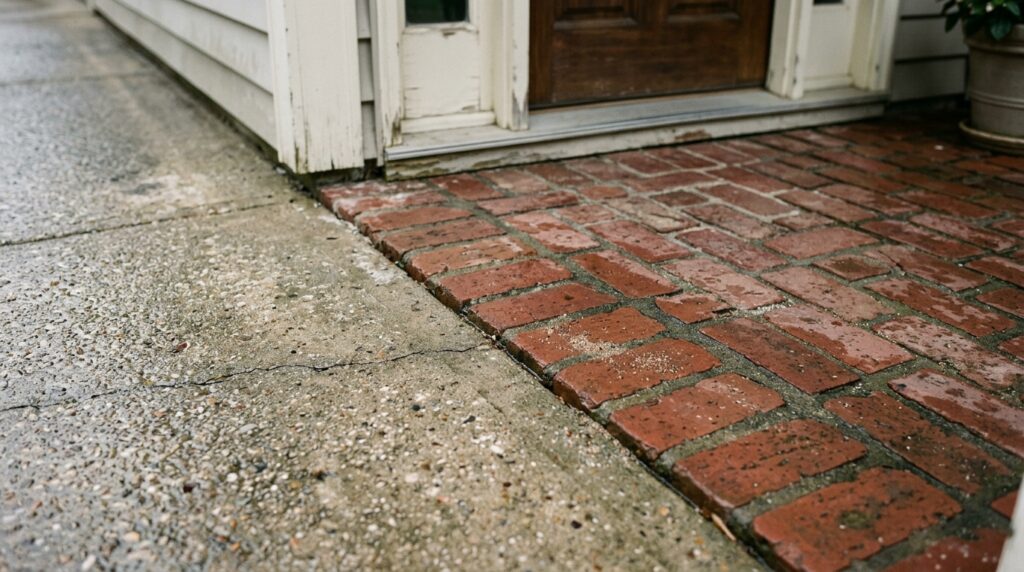
They may offer texture and allow localized repair, but settlement can create uneven joints. Sand loss, loose units, vegetation, and widening gaps can affect cane tips, walker wheels, and wheelchair casters.
Natural stone
Performance varies widely by stone and finish. A flamed or textured surface may behave differently from polished stone. Irregular edges, sealed finishes, weathering, and biological growth should be assessed directly.
Ceramic or porcelain tile
Tile can be durable and easy to clean, but glossy products may become difficult when wet. Grout joints can add traction yet also become uneven when tiles crack, loosen, or settle.
Wood or composite decking
Boards create a firm route when stable and properly maintained. Warping, loose fasteners, wide gaps, algae, worn finishes, and water retained in shaded areas can change performance.
Vinyl and laminate
These materials can create a relatively continuous interior surface. Water near seams, damaged edges, cleaning residue, and transitions to adjacent flooring may be more significant than the main field of the floor.
Hardwood
Hardwood is firm for walking and rolling, but polished finishes, wet footprints, loose boards, and curled edges near the door may affect stability. Moisture should be controlled before it damages the floor.
Low-pile carpet
Firmly secured, low-pile carpet can absorb some tracked-in moisture and reduce glare. It also adds rolling resistance and may conceal an uneven subfloor or transition edge. Deep, soft carpet is more demanding for many mobility aids.
The strongest candidate is usually not the floor with the most aggressive texture. It is the material and finish that remain stable under expected weather, can be maintained consistently, and connect cleanly with the surfaces on either side.
04Entryway Mats: When They Help and When They Create a Hazard
Mats perform a real safety function: they remove grit from shoe soles, capture water, and limit the spread of the first wet footprints onto a smoother interior floor. Removing every mat can solve a raised-edge problem while allowing moisture to travel farther into the home.
The question is therefore not simply whether a mat is present. It is whether the mat controls moisture without becoming an unstable surface.
Characteristics of a more manageable mat
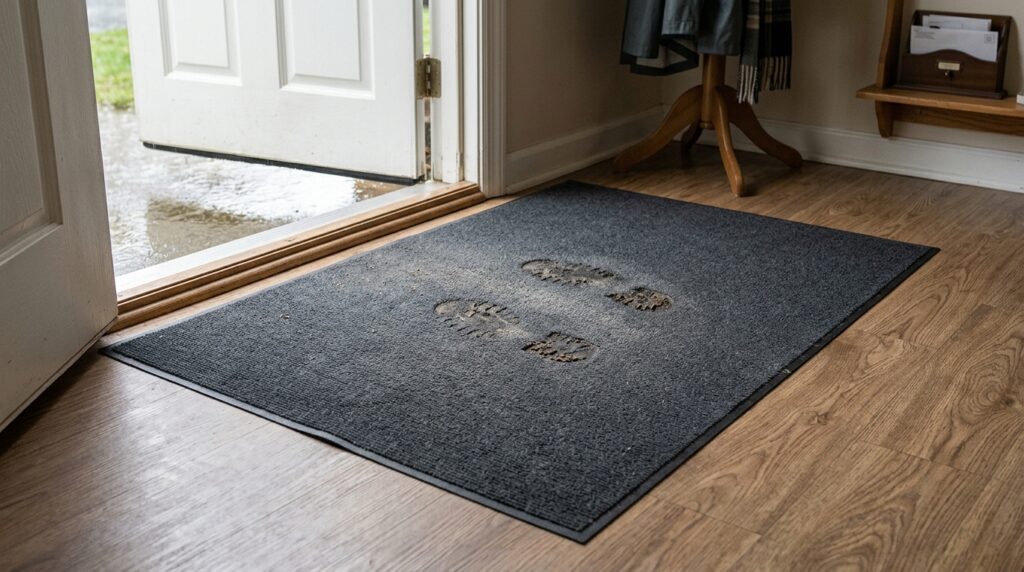
- A low profile that does not create an abrupt edge
- Firm construction rather than deep or highly compressible material
- Edges that remain flat instead of curling upward
- Backing or fixation appropriate for the underlying surface
- Enough area for natural foot placement rather than a narrow strip that requires precise stepping
- Clearance that allows the door to open without pushing or folding the mat
- A routine for drying, cleaning, and checking deterioration
A backing that performed well several years ago may harden, crack, shed, or lose grip. Families often inspect the top because that is where dirt appears, but the hidden underside may explain why the mat has begun to drift.
Absorbency also has a limit. A saturated mat may feel soft, release water when stepped on, and stop protecting the floor beyond it. In prolonged wet weather, a system for rotating or drying the mat may matter more than purchasing a thicker one.
Stacking mats should be avoided. The upper mat can shift independently, and the combined height and compression become harder to predict. A walker or wheelchair may cross the first edge but stall at the second.
Look Beyond the Entryway Floor
Plan your entryway flooring and threshold priorities, then compare the scope in written proposals.
05Surface Transitions, Thresholds, and Raised Edges
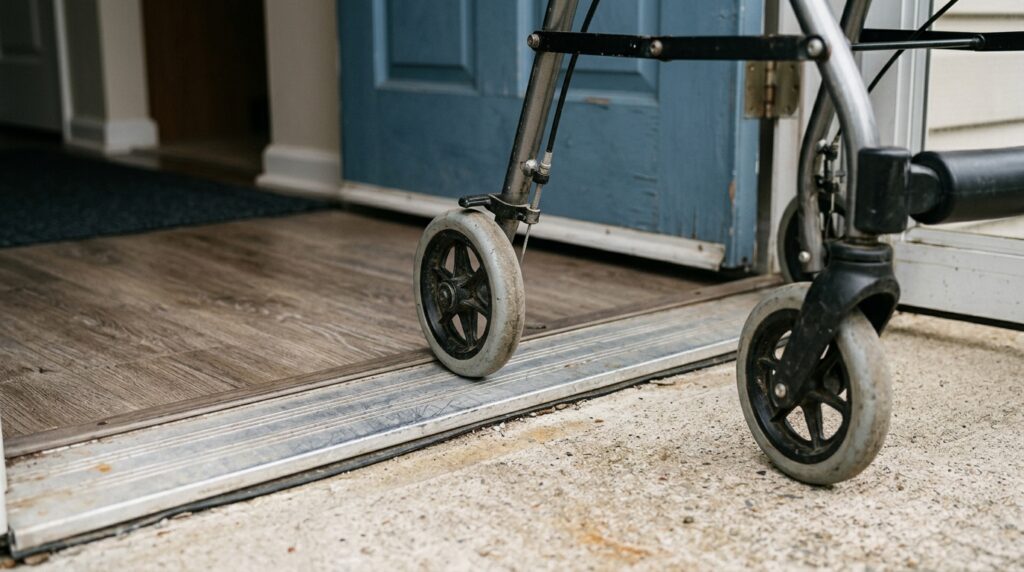
The most demanding point in an entryway may be the transition between two otherwise acceptable surfaces. A person can move securely across a concrete landing and a vinyl hallway yet catch a toe or walker wheel where the two routes meet.
Common transition problems include:
- A raised exterior door threshold
- A loose, bent, or poorly fitted transition strip
- Uneven tile or paver joints
- A lip created where new flooring was installed over an older floor
- A carpet edge that has lifted or separated
- A gap between the threshold and adjacent flooring
- Broken or crumbling material at the edge of a landing
- An abrupt change from a hard surface to deep carpet
The combined route matters more than any single measurement. A mat placed immediately beside a transition strip and door threshold may produce several changes in height and resistance within one step. Each may look small, but together they require repeated foot lifting and adjustment.
Reduced foot clearance or a shuffling gait increases the significance of a vertical lip. Low vision can make a same-colored transition difficult to recognize. A cane tip can land in a narrow gap, while a rolling walker may stop suddenly when its front wheels meet an edge. Small wheelchair casters are particularly sensitive to abrupt gaps and changes in level.
Contrast can help identify a genuine transition, but it should clarify rather than decorate. A distinct, restrained edge is usually easier to interpret than a busy pattern that makes the floor appear uneven. Thresholds should also be considered with the door itself; modifying one may affect weather sealing, drainage, and door operation. See our detailed analysis of front door thresholds, handles, locks, and visibility for the wider door-system context.
06Moisture, Weather, and Everyday Contamination
Flooring selection cannot compensate for an uncontrolled water problem. If a downspout discharges beside the approach, a landing slopes toward the door, or water enters beneath a failing seal, even an appropriate flooring surface may remain wet too long.
Where moisture commonly develops
- On an uncovered landing during rain
- At low points where drainage causes pooling
- Under exterior mats that do not dry fully
- Across the threshold through wind-driven rain
- On the first several feet of interior flooring from wet shoes
- Near door seals affected by condensation or leakage
- On shaded exterior surfaces where algae or moss can develop
- Where snow, ice, or de-icing material is tracked indoors in colder climates
A roof or canopy may reduce direct rainfall but does not guarantee a dry landing. Wind direction, roof runoff, and the position of the door can still expose part of the route. Likewise, an exterior mat may capture grit while retaining water against the floor beneath it.
Dust and fine sand deserve separate attention. They do not look like a wet-floor problem, yet they can reduce shoe-to-floor contact on smooth surfaces. Windblown leaves, mud, and gravel can also collect where the door swing makes routine cleaning inconvenient.
Water control should follow the source. This may involve cleaning drainage paths, redirecting discharge, repairing seals, improving coverage, drying mats, or correcting the landing—not repeatedly treating the visible floor while the source continues.
07Visual Contrast, Lighting, and Surface Perception
A person must be able to interpret the floor before safely crossing it. Polished tile can create glare that resembles water. Actual moisture can disappear within a strong reflection. A shadow cast across a threshold may make a flat surface appear raised—or conceal a real edge.
Similar colors between a threshold, mat, and adjoining floor can hide a change in level. At the opposite extreme, strong geometric patterns may resemble steps, holes, or changes in depth, especially for someone with reduced contrast sensitivity or cognitive changes.
Useful contrast identifies a genuine boundary without filling the route with visual noise. Lighting should reveal texture, edges, wet areas, and debris while limiting glare. Because flooring perception changes after dark, the entry should be viewed with the actual fixtures used at night, not only in daylight.
For guidance on fixture position, motion sensors, shadows, and glare control, see Entryway Lighting for Aging in Place.
08How Mobility Aids Interact With Entryway Flooring
Canes
A cane tip needs stable contact. Water, loose sand, smooth tile, wide paver gaps, and a mat that slides under load can make placement less predictable. The user may also place the cane farther to one side while reaching for the lock, where the flooring condition differs from the center of the route.
Standard walkers
A standard walker must be lifted and placed repeatedly. Thick mats and raised thresholds increase the height each walker leg must clear. If one side lands on a mat while the other remains on hard flooring, the frame may feel uneven during a moment when the person is also managing the door.
Rolling walkers
Front wheels can catch at a small lip or loose transition strip. Soft matting adds rolling resistance and may require extra force, followed by sudden forward movement when the wheels reach a smoother floor. The route should be considered in both directions because entering and exiting may produce different wheel angles.
Wheelchairs
Small front casters react strongly to gaps, uneven pavers, thick edges, and abrupt thresholds. Deep carpet and compressible mats increase effort. Space also matters: the user may need to stop on the landing, position the chair, operate the door, and cross the transition without rolling backward or becoming trapped by the door swing.
A surface that feels comfortable to a person walking unaided may therefore behave very differently under a mobility aid. Observing the actual route is more reliable than judging the floor from appearance alone.
If the entrance may eventually require a ramp or a more continuous wheeled route, our guide to making a home entrance safer for older adults can help place flooring decisions within the larger entrance plan.
Estimate a Possible Ramp Project
If thresholds, level changes, or approach conditions suggest that a ramp may be considered, use the calculator for an early planning estimate.
09Entryway Flooring Inspection Table
| Condition | What to Look For | Why It May Matter | Possible Response |
|---|---|---|---|
| Smooth floor that changes when wet | Wet footprints, pooling, a glossy finish, or hesitation after rain | Dry performance may not represent everyday entrance conditions | Control water, review cleaning products, and assess a compatible treatment or surface change |
| Loose or curling mat | Movement, lifted corners, waves, or edges contacted by the door | It can shift underfoot or catch a toe, cane, walker, or caster | Secure it appropriately or replace it with a firm low-profile alternative |
| Saturated absorbent mat | Persistent dampness, squishing, odor, or water released under pressure | The mat may stop containing moisture and become compressible | Dry or rotate it and address the volume or source of water |
| Cracked tile or concrete | Raised fragments, widening cracks, movement, or crumbling edges | Damage may create a catch point or indicate continued movement | Mark the area, arrange material-appropriate repair, and investigate ongoing movement |
| Uneven pavers | Rocking units, sunken sections, wide joints, or displaced edging | Foot placement and small wheels become less predictable | Have the base and affected pavers evaluated and reset where appropriate |
| Loose transition strip | Movement, exposed fasteners, bent metal, or separated edges | A small defect sits directly across the walking line | Restrict the damaged point if needed and arrange prompt repair |
| Raised threshold | Toe contact, walker catching, repeated stopping, or difficult caster movement | Reduced foot clearance or wheels can make a modest lip significant | Assess the threshold with the door, drainage, and weather seal as one system |
| Glossy floor with glare | Strong reflections, hidden wet spots, or uncertainty after dark | The surface can be visually misread even when physically level | Adjust lighting and evaluate the finish without creating visual clutter |
| Water pooling near the door | Standing water, tide marks, damp joints, or repeated indoor tracking | A recurring source can defeat flooring and mat improvements | Correct drainage, runoff, coverage, or door-seal problems first |
| Deep or compressible carpet | Feet sinking, wheels slowing, or instability at the carpet edge | Soft flooring raises effort and changes resistance abruptly | Consider a firm, low-pile, securely installed alternative |
| Abrupt surface change | A sudden shift in texture, firmness, height, or visual appearance | The user must adjust gait and force within a short distance | Improve the transition’s stability, profile, and visibility |
| Deteriorated mat backing | Cracking, shedding, stiffness, moisture retention, or loss of grip | The mat may appear sound from above while moving underneath | Replace the mat rather than relying on its original performance |
10A Practical Entryway Flooring Inspection
Start by tracing the entire route from the exterior approach to the interior hallway. Do not stop at the mat or threshold. The aim is to locate where traction, height, resistance, or visibility changes—and whether several changes occur close together.
- Inspect in daylight. Look for cracks, settlement, loose sections, curled edges, gaps, staining, wear, and drainage patterns.
- Inspect after dark. Use the normal entryway lights and view the route from both directions. Note glare, shadows, and hidden transitions.
- Check the dry route. Observe stability and surface continuity without deliberately sliding your feet.
- Recheck after ordinary rain or cleaning. Look for pooling, wet footprints, residue, saturated mats, and areas that dry slowly.
- Press and observe the mat safely. Check whether it shifts, curls, compresses, or interferes with the door.
- Examine every junction. Include paver joints, threshold edges, mat borders, transition strips, and changes between carpet and hard flooring.
- Observe the older adult’s routine—with permission. Notice shortened steps, foot dragging, repeated looking down, hesitation, furniture grabbing, or avoiding part of the route.
- Watch the mobility aid. Look for cane-tip movement, uneven walker placement, caster catching, or extra force needed to cross soft material.
- Check the interior reach of water. The first wet footprints may extend beyond the mat onto a smoother floor.
Behavior can reveal a problem before anyone describes it directly. Looking down at every step, shortening the stride, or approaching the door at an unusual angle may be a practical adaptation to a surface that no longer feels predictable.
11Prioritizing Practical Adjustments
Immediate corrections
Remove loose debris, dry pooled water, flatten or temporarily remove an unstable mat, and prevent use of a visibly broken or moving area until it can be repaired. These actions address conditions that can change from one entry to the next.
Routine maintenance
Use cleaning methods appropriate to the flooring, avoid leaving residue, inspect mat backing, dry saturated mats, clear drainage paths, and monitor cracks or joints for change. Maintenance is functional work, not merely cosmetic cleaning.
Minor modifications
Replace an unstable mat with a secure low-profile alternative, repair a loose transition strip, improve contrast at a genuine edge, or consider a compatible surface treatment after reviewing its wet traction and maintenance requirements.
Larger modifications
Regrading drainage, rebuilding an unstable landing, replacing widely deteriorated flooring, reducing a difficult threshold, or creating a more continuous wheelchair-accessible route may require professional design and construction.
Prioritize locations where conditions overlap. A slightly raised transition on a dry, well-lit, stable floor may be manageable for one person. The same transition beside a saturated mat, in shadow, at the point where a walker must turn can deserve earlier attention.
12Repair, Treatment, or Replacement?
Replacement is not automatically the first or most useful response. The correct level of work depends on what is causing the difficulty.
Cleaning may be enough when:
- The underlying surface is stable and intact
- Traction has declined because of grime, residue, algae, or compacted debris
- An appropriate cleaning method restores the original texture without leaving a film
A localized repair may be enough when:
- Damage is limited to a small number of tiles, boards, pavers, or edge sections
- A transition strip is loose but the adjoining floors remain stable
- A mat is the main unstable component and can be replaced independently
A coating or surface treatment may be considered when:
- The existing floor is structurally sound
- The treatment is compatible with the material and weather exposure
- Wet performance, curing, maintenance, appearance, and future wear have been evaluated
- The resulting texture will not create a new mobility-aid or cleaning problem
Larger replacement may be justified when:
- Cracking, settlement, movement, or deterioration is widespread
- Repeated repairs do not remain stable
- The route contains several difficult transitions that cannot be corrected separately
- The existing material is poorly suited to the entrance’s weather and mobility demands
Water control should usually come before new flooring. Replacing tile, wood, or concrete without correcting persistent pooling or leakage may damage the new work and recreate the same traction problem.
Cost should be considered alongside durability and maintenance. A less expensive finish that requires frequent specialized cleaning may not be the practical long-term choice. Conversely, a complete replacement may be unnecessary when drainage repair and one secure transition solve the actual problem.
13When to Consider Professional Evaluation
Professional input becomes more useful when the difficulty cannot be isolated to one loose mat or simple maintenance issue. Consider an evaluation when:
- The older adult has fallen or repeatedly trips near the entrance
- Gait, vision, strength, or mobility-aid use has changed
- A walker or wheelchair repeatedly catches at the threshold
- Several changes in height occur within a short distance
- The landing, floor, or subfloor moves under load
- Cracks, settlement, or uneven joints continue to worsen
- Drainage repeatedly wets the landing or interior floor
- A threshold change could affect the door, structure, drainage, or weatherproofing
- The household is considering resurfacing, coatings, or complete replacement
- Family members cannot tell whether the main difficulty comes from the floor, layout, footwear, or the person’s mobility
An occupational therapist can observe how the person performs the real entry routine and identify where the environment conflicts with current abilities. An aging-in-place or home safety specialist can evaluate the full route and help prioritize modifications.
An accessibility specialist may contribute detailed route and mobility-aid planning. A flooring professional can assess material condition, finish compatibility, and repair options. A qualified builder or licensed home modification contractor may be needed when drainage, structure, door framing, thresholds, or landing reconstruction are involved.
A flooring assessment does not replace medical evaluation when new foot dragging, dizziness, weakness, or balance changes appear. The physical surface and the person’s health can contribute at the same time.
Continue Planning With Practical Tools
Explore AgingAuthority calculators and planning resources for home modifications, mobility access, stairs, and bathroom safety.
14Common Entryway Flooring Mistakes to Avoid
- Choosing by appearance alone: Color and style do not reveal wet traction, edge stability, or maintenance demands.
- Assuming rougher is automatically safer: Aggressive texture may retain contamination and become difficult for small wheels or shuffling feet.
- Evaluating only when dry: The entrance’s most demanding condition may occur after rain, cleaning, or wet shoes.
- Placing a loose mat over a slippery floor: The mat can move with the foot and leave adjacent wet areas untreated.
- Stacking mats: Multiple layers add height, compression, and independent movement.
- Ignoring the underside: A clean-looking mat can have deteriorated backing that no longer grips the floor.
- Waxing or polishing without considering traction: A visually refreshed finish may behave differently under wet footwear.
- Replacing flooring before correcting drainage: New material will still face the same source of water.
- Treating the threshold separately: The threshold, mat, landing, transition, and door clearance interact.
- Assuming a small edge affects everyone equally: Foot clearance, vision, gait, and wheel size change its practical significance.
- Checking the floor without the mobility aid: A walker or wheelchair may expose problems that ordinary walking does not.
15Frequently Asked Questions
What type of entryway flooring is safest for older adults?
No single material is safest for everyone. A more supportive entryway floor is firm, stable, reasonably slip-resistant when dry and wet, easy to maintain, clearly visible, and connected through low, secure transitions. The person’s gait, footwear, weather exposure, and mobility aid should influence the choice.
Are entryway mats a fall hazard?
They can become a hazard when they slide, curl, bunch, saturate, or create a thick edge. A firm, low-profile mat with secure backing can help control water and debris. Its condition, door clearance, placement, and interaction with walkers or wheelchairs should be checked routinely.
How can I make an existing entrance floor less slippery?
First identify the cause. Remove debris and cleaning residue, control pooling and tracked-in water, dry saturated mats, and use cleaning methods appropriate to the material. A compatible surface treatment may be considered for a structurally sound floor, but its wet performance, maintenance, and effect on mobility aids should be evaluated.
Should an entryway mat be placed inside or outside the door?
The answer depends on weather exposure and the route. An exterior mat can remove coarse dirt before entry, while an interior mat can capture remaining moisture. Either mat should be low-profile, stable, properly sized, and able to dry. Two mats should not be stacked or positioned so closely that their edges create repeated obstacles.
When is a flooring transition too difficult for a walker or wheelchair?
A transition deserves attention when wheels or walker legs catch, the user must build momentum, the device tilts, or the person changes direction to avoid it. Gap width, edge shape, mat compression, available landing space, and the user’s strength may matter as much as the transition’s height.
Does slip-resistant flooring still become slippery when wet?
Yes. Slip-resistant flooring may provide better traction under defined conditions, but water, mud, leaves, sand, ice, cleaning residue, wear, or unsuitable footwear can still reduce grip. Wet performance and drainage should be considered rather than relying only on a product label.
16Conclusion
A safer entryway floor is not defined by one material or one “non-slip” label. It depends on traction, surface stability, moisture control, secure mats, manageable transitions, visibility, maintenance, and compatibility with the person who uses the entrance.
Inspect the complete route under the conditions in which it is actually used: daylight and darkness, dry weather and rain, ordinary footwear and mobility aids. Give priority to points where several difficulties overlap, such as a raised edge beside a wet mat or a loose transition hidden by glare. Correcting those combined conditions can often produce a more predictable entrance without rebuilding every surface.
17Sources and Further Reading
This content is for general educational purposes only and does not replace a professional home safety assessment, medical advice, or licensed contractor evaluation.