
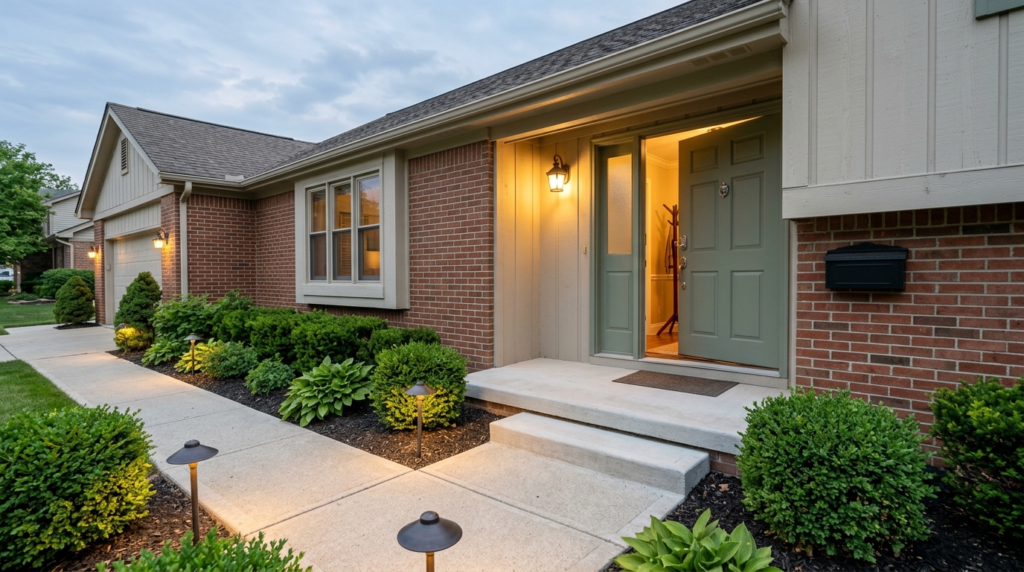
For a complete overview of safer home entrances, explore our Complete Entryway Safety Guide for Aging in Place .
Entryway Lighting for Aging in Place: Brightness, Placement, and Motion Sensors
A practical guide to creating clear, even, dependable light from the walkway to the interior—without replacing one visibility problem with glare, deep shadows, or unreliable automation.
Executive Summary
Safe entryway lighting should reveal the entire route before movement begins. Prioritize even illumination at walkways, steps, landings, locks, and thresholds; control glare; and use motion or dusk-to-dawn controls where switches are inconvenient. The right system depends on the entrance layout, weather exposure, visual needs, and how the resident actually arrives home.
This article was reviewed for clarity, safety logic, and real-world application in aging-in-place environments.
An entrance may seem adequately lit when viewed from inside the house. The experience can be very different for the person approaching from a dark driveway, searching for a key, judging a step edge, and opening a door while carrying a bag. A single porch fixture may illuminate the wall beautifully while leaving the walking surface and threshold difficult to read.
That is why entryway lighting for aging in place should be treated as a small system rather than a bulb replacement. The approach, steps, landing, lock, door swing, threshold, and first few feet inside all need usable light. If one segment disappears into shadow, the person may slow down, reach for unstable surfaces, or begin avoiding the entrance after dark.
Lighting is only one part of the route. Our guide on how to make a home entrance safer explains how visibility interacts with walkway condition, level changes, support, weather, and door operation.
1. Why Entryway Lighting Needs Change With Age
Age-related vision changes do not simply make everything darker. They can affect contrast sensitivity, depth judgment, glare tolerance, and the speed at which the eyes adjust between bright and dark environments. The National Institute on Aging notes that even small changes in sight can be associated with greater fall and injury risk.
At an entrance, these changes meet a particularly demanding sequence. A person may move from vehicle headlights to darkness, then toward a bright porch light, look down at steps, look up at a lock, and finally enter a brighter interior. Each transition asks the eyes to adapt while the body is still moving.
Families sometimes respond by installing the brightest available bulb. More light can help when an area is genuinely dim, but raw brightness is not the same as useful visibility. A very bright exposed source can produce discomfort, reflected glare, and sharper shadows. The practical goal is to make surfaces, edges, hardware, and obstacles easy to interpret without forcing the person to look directly into a harsh light.
2. What Makes an Entryway Well Lit for Aging in Place?
A well-lit entrance allows someone to understand the route early enough to plan movement. Ideally, the person should be able to see where the walkway begins, where the elevation changes, where support is available, where to stand while opening the door, and where the interior floor starts.
Four qualities matter together:
- Coverage: light reaches the entire route, not only the decorative area around the door.
- Uniformity: brightness does not change abruptly from one small zone to the next.
- Visual comfort: fixtures and reflections do not create disabling glare.
- Dependability: the light is already on when needed and remains on long enough to complete the entry sequence.
This systems view also prevents misplaced upgrades. A new sconce beside the lock may solve key visibility but leave the landing edge dark. A motion light above the garage may detect the driveway yet switch off while someone is still managing the door. An illuminated walkway can still end at a nearly invisible threshold.
For a broader inspection of how all entrance features work together, see the Complete Entryway Safety Guide for Aging in Place.
3. How Bright Should Entryway Lighting Be?
There is no single bulb wattage or lumen number that makes every entrance safe. A narrow covered porch, a long exposed walkway, dark brick, pale concrete, multiple steps, and a glass door all distribute and reflect light differently. Fixture design and placement may matter as much as lamp output.
The better question is whether the lighting makes the required information visible from the user’s normal position. Can the resident see changes in surface height? Are wet leaves or packages visible? Does the keyway remain clear when the person’s own hand and body block the fixture? Can the threshold be distinguished from both the exterior landing and the interior floor?
Use brightness in layers
Most entrances benefit from more than one lighting role:
- Approach lighting defines the walkway from the driveway, sidewalk, or parking area.
- Step and landing lighting reveals elevation changes and the stable standing area at the door.
- Door-task lighting supports finding the lock, operating the handle, and identifying visitors.
- Interior transition lighting prevents the doorway from becoming a sharp boundary between darkness and a bright hall.
Layering does not necessarily mean installing many conspicuous fixtures. A modest overhead fixture, shielded path lights, and a well-positioned wall light may produce better visibility than one high-output floodlight.
Do not judge lighting only during the day
Inspect the entrance after sunset and in the conditions in which it is actually used. If the resident comes home in the evening, evaluate it from the vehicle or sidewalk through the closed door. Daylight can conceal weak coverage, while a porch light viewed from indoors may appear more effective than it is from outside.
Check the Full Entrance, Not Just the Light
Plan entryway lighting, walking surfaces, level changes, and threshold work before comparing written proposals.
4. Where Entryway Lights Should Be Placed
Placement determines what the light reveals and what the user’s body hides. A fixture can be bright enough on paper and still fail at the moment it is needed because a column blocks it, a deep eave traps the light, or the resident casts a shadow over the lock.
Walkway and approach
Lighting should help the resident recognize the route before stepping onto it. Low path fixtures can define boundaries, but fixtures that are too widely spaced may create alternating bright and dark patches. Very low fixtures can also disappear behind shrubs, snow, parked vehicles, or seasonal growth. Position them to reveal the walking surface while keeping the light source out of the direct line of sight.
Where the approach changes direction, slopes, narrows, or meets a different material, additional light may be more valuable than perfectly symmetrical spacing. The visual decision point deserves priority.
Steps and ramps
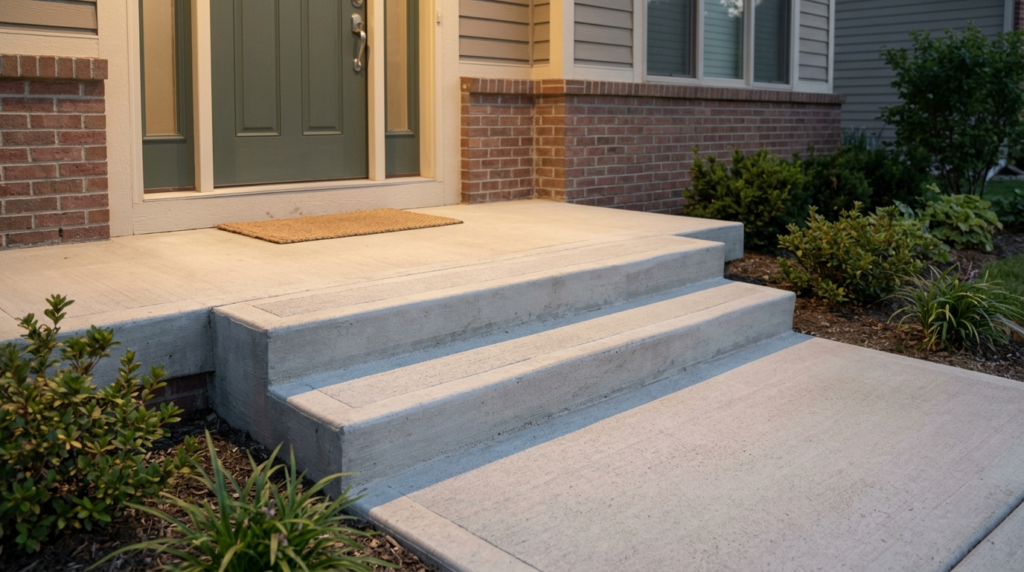
Light should show the leading edge of each step and the start and end of a ramp. A fixture placed only behind the user may project the person’s shadow forward across the very edges they need to see. Lighting from the side or from more than one direction can soften that effect.
Built-in step lights can be helpful when properly shielded, but bright points at ankle height can distract or cause glare. The goal is to illuminate the tread and edge, not to make the fixture itself the dominant visual feature.
The landing and door
The landing is a work area. A person may need to stop, turn, reach, unlock the door, pull it open, reposition a mobility aid, and cross the threshold. Light should cover the usable standing space rather than creating a small bright circle around the handle.
Door-task lighting is usually more effective when it reaches the lock and handle from the side or slightly forward. If the fixture sits directly above and behind the person, the head and shoulders may cast a shadow over the hardware. This matters more when fine hand movements already require extra attention. Our separate guide to front door safety, locks, handles, thresholds, and visibility examines that interaction in more detail.
Just inside the entrance
The route does not end when the door opens. An unlit interior hallway can appear like a dark void from a bright porch, while a very bright interior can make the exterior landing temporarily harder to read when someone is leaving. A nearby interior light can smooth the transition and keep the threshold, mat, and first steps visible in both directions.
5. Glare, Shadows, and Contrast: When More Light Works Against Visibility
Glare occurs when a bright source or reflection competes with the details the person is trying to see. Clear glass fixtures, unshielded bulbs, polished metal, wet pavement, glossy tile, and glass storm doors can all redirect light toward the eyes.
A useful test is to stand at the height and locations from which the resident normally approaches. If the bulb dominates the view, causes squinting, or makes surrounding details disappear, consider shielding, repositioning, or diffusing the source. This assessment should be repeated when the ground is wet, because reflections can change significantly.
Shadows can imitate level changes—or hide them
A hard shadow across a walkway may look like a raised edge. Conversely, a real step can disappear when the tread and riser receive the same uneven light. Multiple low-to-moderate sources often produce more interpretable surfaces than one intense source at a steep angle.
Contrast should identify the route, not create visual clutter
Lighting works best when it supports meaningful contrast: the edge of a step, the boundary of a landing, the door handle against the door, or the threshold against the floor. Highly patterned mats, strong moving shadows from plants, and numerous decorative light points can make the scene busier without making it clearer.
This is an important planning distinction. The safest-looking entrance in a photograph may not be the easiest one to interpret in motion.
6. Motion Sensors, Dusk-to-Dawn Controls, and Timers
Automatic lighting can reduce the need to search for a switch or cross a dark area before light is available. The National Institute on Aging specifically recommends considering motion-activated lights as part of home fall-prevention planning. Automation is most useful, however, when detection covers the full direction of travel and the timing matches the real task.
Motion sensors
A motion sensor should activate before the person reaches the first potential hazard. At an exterior entrance, that may mean detecting movement near the car, gate, or start of the walkway—not only when someone is already on the porch.
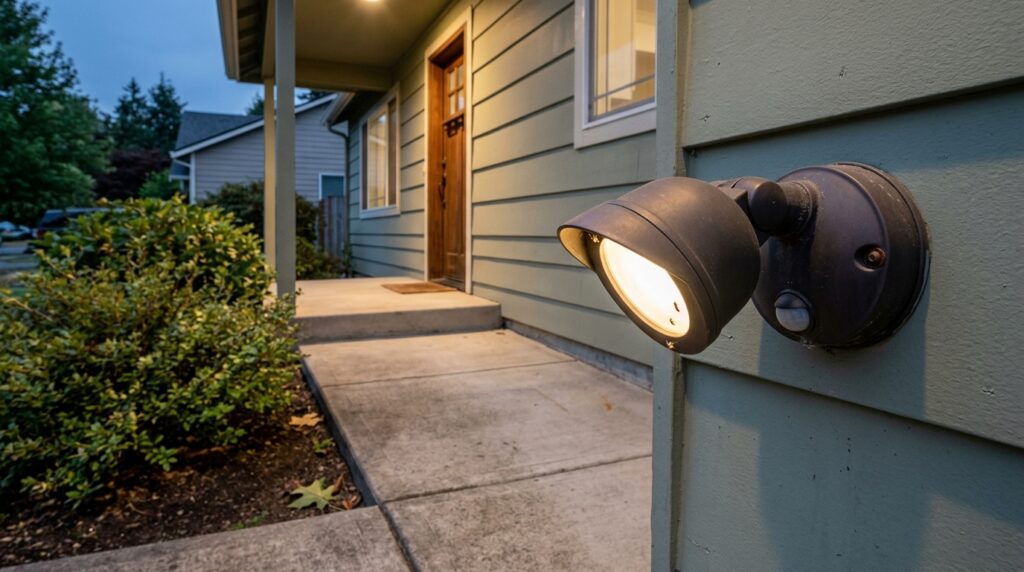
Check the sensor from every likely approach. Some devices detect side-to-side movement more reliably than someone walking directly toward them. A person moving slowly, using a walker, or pausing to retrieve keys may also interact differently with the detection pattern.
The shutoff delay should allow enough time to complete the whole sequence without waving or stepping backward to reactivate the light. Test it while carrying groceries and while unlocking the door slowly. A setting that feels generous during a quick test may be too short in ordinary use.
Dusk-to-dawn lighting
A photocell-controlled light turns on when ambient light falls below a set level and stays on through the night. It can provide predictable baseline illumination without requiring motion detection. This may be especially useful at the main approach, where knowing the route is visible before arrival can support confidence.
Continuous overnight lighting should still be shielded and directed carefully so it does not shine into bedroom windows or neighboring properties. Energy-efficient LEDs can reduce operating cost, but efficiency does not correct poor placement or excessive glare.
Timers and smart controls
Scheduled lighting may work well when routines are consistent. Smart controls can add remote activation and alerts, but they should not make basic entry dependent on a phone, internet connection, or complicated app. For a safety-critical route, a conventional wall control or reliable automatic fallback remains valuable.
7. Color Temperature, Color Rendering, and Fixture Quality
Color temperature describes whether white light appears warmer and more yellow or cooler and more blue. For a residential entrance, the choice should balance clarity, visual comfort, neighborhood context, and consistency with nearby interior lighting.
Very cool light can feel harsh at night, particularly when it is much bluer than the surrounding environment. Very warm, dim light may feel comfortable but may not make subtle surface differences easy to see. In many homes, a moderate warm-to-neutral white provides a practical compromise, but the fixture, output, and surface colors still influence the result.
Color rendering also matters. A lamp with good color rendering can make objects and surface changes look more natural, which may help someone distinguish the walkway, vegetation, packages, door hardware, and threshold. Avoid combining noticeably different light colors across a short route; the visual inconsistency can make an otherwise coordinated installation feel fragmented.
Choose exterior fixtures for the conditions
Outdoor fixtures and controls should be rated for their installation location, including exposure to rain or dampness. The fixture should also permit safe lamp replacement and maintenance. A theoretically ideal light that requires a resident to climb a ladder to clean or replace it creates a different problem.
8. Entryway Lighting Planning Table
| Entry Zone | What the Lighting Should Reveal | Common Failure | Practical Response |
|---|---|---|---|
| Driveway or gate | The beginning and direction of the safe route | Light activates only after the person reaches the walkway | Extend detection or provide low-level dusk-to-dawn illumination |
| Walkway | Surface condition, boundaries, turns, and obstacles | Alternating bright pools and dark gaps | Improve spacing and aim shielded light across the walking surface |
| Steps or ramp | Every level change, edge, and transition | The user’s shadow hides the next step | Add side lighting or a second direction of illumination |
| Landing | The full stable standing and turning area | Only the door face is bright | Widen coverage without exposing a glaring source |
| Lock and handle | Keyway, lever, controls, and hand position | Body blocks overhead light | Use side-positioned task lighting and contrasting hardware |
| Threshold | The height and boundary of the transition | Interior and exterior surfaces blend together | Coordinate porch and hall lighting; add meaningful contrast |
| Interior arrival area | Mat, floor, storage, and first direction of travel | A dark hall follows a bright porch | Provide an accessible interior light or coordinated automation |
9. How to Evaluate the Existing Entryway Lighting
A useful evaluation follows the resident’s real route rather than checking fixtures from a distance. Choose a safe time after dark, turn on the lighting as it would normally operate, and examine the entrance from both arrival and departure directions.
- Begin at the real starting point. Stand where the person exits a car, passes through a gate, or leaves the public sidewalk.
- Look ahead before moving. Can you identify the whole route, or does it disappear beyond the next pool of light?
- Check decision points. Examine turns, slopes, steps, rail starts, ramps, landings, and surface changes.
- Perform the door task. Use the key or keypad, operate the handle, open the door, and cross the threshold. Notice where your own body creates shadow.
- Repeat in reverse. Leaving the home can produce different glare and shadow conditions from entering it.
- Observe different weather. Rain, wet pavement, leaves, fog, and snow can alter reflectance and hide boundaries.
- Ask the resident what feels uncertain. A person may detect discomfort, delayed adaptation, or missing detail that another family member does not experience.
Do not ask someone to demonstrate a route that already feels unsafe. The purpose is to understand ordinary use, not to create a test of courage or balance.
10. Practical Improvements: What to Address First
The most useful priority is not necessarily the largest project. Begin where darkness, glare, or unreliable control intersects with a movement demand.
These improvements fit within a broader home-modification plan for aging in place. Lighting can make hazards easier to see, but it cannot correct a loose handrail, unstable surface, inadequate landing, or difficult door. The issue is rarely one feature acting alone.
11. When to Consider Professional Evaluation
Professional input may be appropriate when the entrance has several level changes, significant glare or shadow problems, complex electrical needs, repeated near-falls, or a resident whose vision or mobility has changed. It may also be useful when family members cannot agree on whether the problem is lighting, the physical route, or both.
- An occupational therapist can examine how the individual sees, reaches, balances, and completes the entry sequence in daily life.
- A home safety assessor or accessibility specialist can evaluate the entrance as a connected route and help identify priorities.
- A lighting professional can help with fixture selection, distribution, glare control, and more complex layouts.
- A licensed electrician should handle new wiring, exterior electrical work, relocated controls, and installations requiring code compliance.
- A home modification contractor may be needed when lighting improvements are coordinated with steps, railings, landings, ramps, or door changes.
If a person reports new difficulty seeing at night, unusual glare, or a recent change in vision, a vision evaluation may be relevant as well. Environmental improvements can support safer movement, but they should not be expected to explain every new visual symptom.
Could a Ramp Be the Better Long-Term Route?
Estimate a practical cost range based on ramp type, material, length, landing needs, and site conditions.
12. Frequently Asked Questions
How bright should an entryway be for aging in place?
There is no universal bulb output that suits every entrance. The lighting should make the walkway, level changes, landing, lock, and threshold clearly visible without uncomfortable glare or deep shadows. Fixture distribution, surface colors, and placement are as important as brightness.
Are motion-sensor lights good for older adults?
They can be helpful because they provide light without requiring someone to find a switch. The sensor should detect the person before the first hazard, work from every approach direction, and keep the light on long enough for slow or interrupted entry.
Is dusk-to-dawn lighting better than motion lighting?
Neither is automatically better. Dusk-to-dawn lighting offers predictable baseline visibility all night, while motion lighting limits operating time and may provide brighter task light when needed. Some entrances benefit from combining low-level continuous light with motion-activated supplemental light.
Where should a porch light be placed?
It should illuminate the landing, lock, handle, and threshold without shining directly into the user’s eyes. Side placement can reduce the chance that the resident’s head and shoulders will cast a shadow over the lock, although the best position depends on door swing and fixture design.
What color light is appropriate for an entryway?
A moderate warm-to-neutral white often balances comfort and clarity in residential settings. Avoid dramatic color differences between adjacent fixtures, and consider color rendering, glare control, and surface visibility rather than choosing by color temperature alone.
Can solar path lights provide enough entryway lighting?
Solar lights may help define a path, but performance depends on sun exposure, battery condition, weather, fixture output, and placement. They should not be the only lighting for critical steps, landings, locks, or thresholds unless their performance has been verified in the conditions in which the entrance is used.
When should entryway lighting be professionally assessed?
Consider professional input when there are repeated near-falls, significant vision or mobility changes, persistent glare or shadow problems, multiple level changes, or a need for new exterior wiring. A professional can help distinguish a lighting problem from a broader access problem.
Conclusion
Entryway lighting for aging in place should make movement predictable from the first approach to the first steps inside. The strongest systems do more than brighten the front door: they reveal the route, show level changes, support door tasks, limit glare, and activate before the resident enters a difficult zone.
Start by observing the entrance after dark from the resident’s point of view. Correct failed or blocked lighting, then address the places where movement and poor visibility overlap. If the route still requires hesitation, reaching, or guesswork, examine the entrance as a whole rather than assuming that a brighter bulb will solve it.
For families making decisions across the full home, our central guide to aging in place explains how the environment, changing abilities, daily routines, and long-term planning fit together.