
Created for families comparing bathroom safety costs, tradeoffs, and practical aging-in-place planning decisions. Learn about our editorial process.
Executive Summary
Bathroom safety modifications can range from relatively inexpensive upgrades costing under $100 to major accessibility renovations that exceed $20,000. The most appropriate solution depends on individual needs, existing bathroom conditions, and long-term plans rather than budget alone. Many families are surprised to discover that targeted improvements such as grab bars, better lighting, and shower seating may provide meaningful usability benefits without requiring a complete remodel. Understanding costs, tradeoffs, and future needs can help prioritize investments more effectively.
Introduction
For many households, the bathroom becomes one of the first rooms where aging-related changes begin to affect daily routines.
A space that once seemed simple and familiar can gradually become more demanding. Stepping over a bathtub edge, standing on a wet floor, turning in a narrow shower, or lowering onto a standard-height toilet may become more difficult over time.
When families begin discussing aging in place, conversations often focus on large projects. Walk-in showers, full renovations, and accessibility remodeling frequently receive the most attention. Yet many bathroom safety improvements involve much smaller investments.
The challenge is not simply determining how much modifications cost. The more important question is often which improvements provide the greatest practical benefit for the money being spent.
Understanding how bathroom safety modifications are priced—and why costs vary so dramatically—can help families make more informed decisions while avoiding unnecessary expenses.
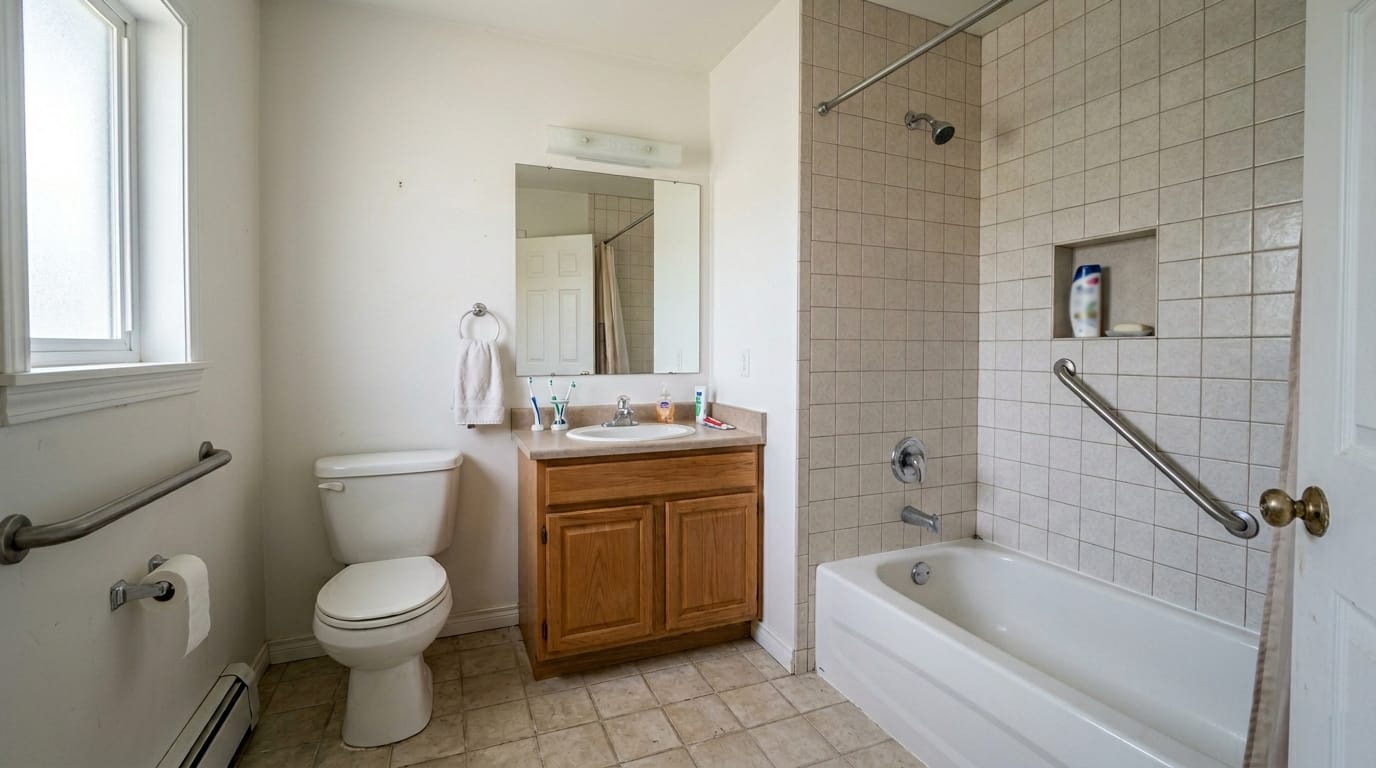
How Much Do Bathroom Safety Modifications Cost?
Bathroom safety modification costs vary widely.
At the lower end, a homeowner may spend less than $100 on basic safety equipment. At the higher end, a complete accessibility-focused bathroom remodel can exceed $25,000 depending on the home’s layout and construction requirements.
The broad range exists because bathroom modifications fall into several different categories:
- Simple equipment additions
- Fixture replacements
- Accessibility upgrades
- Structural modifications
- Full remodeling projects
A grab bar installation and a curbless shower conversion may both be considered bathroom safety improvements, but they involve entirely different levels of labor, materials, and construction complexity.
Families sometimes assume that improving bathroom safety automatically requires extensive renovation. In reality, many homes can become significantly easier to use through a combination of smaller modifications implemented over time.
Why Bathroom Modification Costs Vary So Much
Two homeowners can install what appears to be the same modification and receive dramatically different estimates.
Several factors influence pricing.
Existing Bathroom Layout
An accessible design is often easier and less expensive to achieve when the current layout already provides adequate space.
A larger bathroom may require fewer structural changes than a smaller one.
For example, installing a shower seat inside a spacious walk-in shower may be relatively straightforward. Creating sufficient maneuvering space in a compact bathroom may require moving walls, plumbing, or fixtures.
Labor Costs
Labor frequently represents a significant portion of project expenses.
Installation costs vary by:
- Region
- Contractor availability
- Permit requirements
- Project complexity
Many homeowners focus primarily on material prices while underestimating labor costs.
A $300 fixture may require several hundred dollars of installation work.
Plumbing and Electrical Changes
Projects become more expensive when plumbing or electrical systems must be relocated.
Replacing a toilet is generally simpler than moving a toilet location.
Similarly, upgrading bathroom lighting may involve minimal work in one home and extensive wiring changes in another.
Hidden Conditions
Bathrooms often conceal issues that become visible only after construction begins.
Contractors occasionally discover:
- Water damage
- Mold
- Rotting subfloors
- Plumbing deficiencies
- Improper previous renovations
These discoveries can increase costs unexpectedly.
One reason bathroom renovation budgets frequently exceed expectations is that some conditions cannot be fully evaluated until walls, flooring, or fixtures are removed.
Common Bathroom Safety Upgrades and Typical Cost Ranges
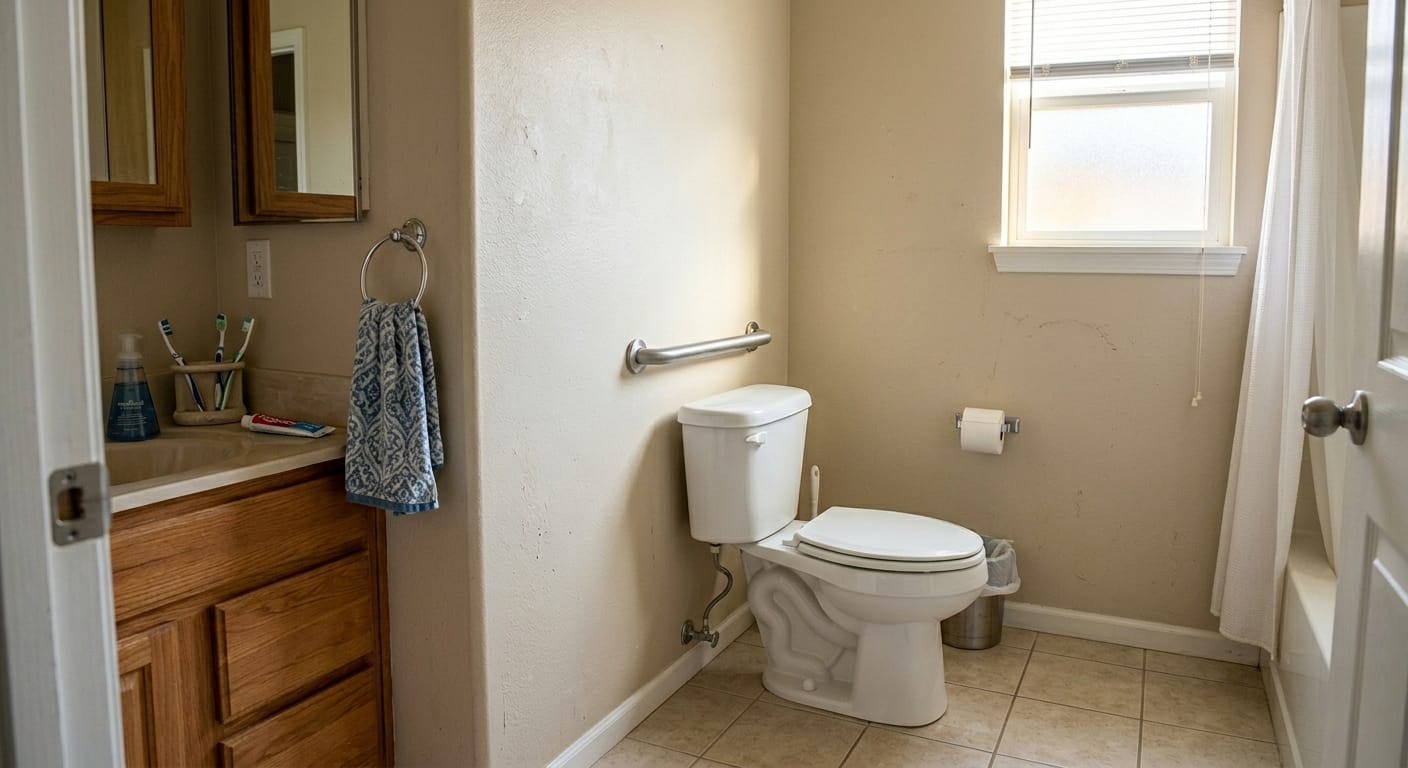
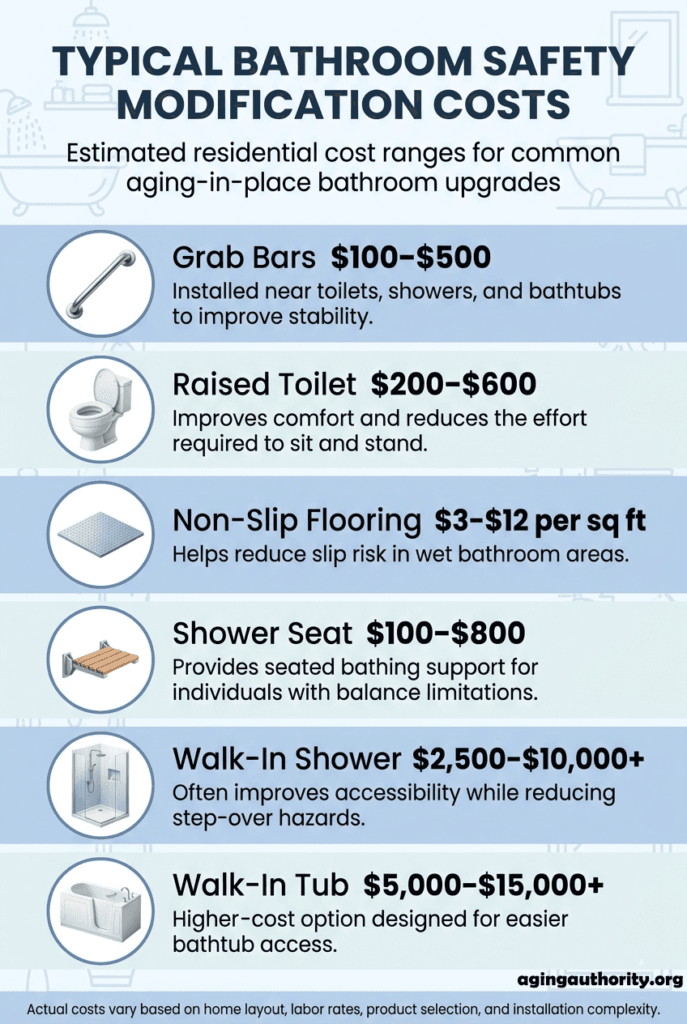
The following ranges are broad estimates intended for planning purposes only. Actual costs can vary substantially based on location, labor markets, materials, and project scope.
| Modification | Typical Cost Range |
|---|---|
| Grab bars | $50–$500+ |
| Raised toilet seat | $30–$200 |
| Handheld showerhead | $50–$300+ |
| Shower seat | $50–$1,000+ |
| Comfort-height toilet | $300–$1,500+ |
| Improved lighting | $100–$1,500+ |
| Slip-resistant flooring treatments | $200–$2,000+ |
| New slip-resistant flooring | $1,000–$5,000+ |
| Tub-to-shower conversion | $3,000–$12,000+ |
| Walk-in shower installation | $5,000–$15,000+ |
| Curbless shower installation | $8,000–$20,000+ |
| Doorway widening | $500–$5,000+ |
| Accessibility-focused bathroom remodel | $10,000–$30,000+ |
These figures should be viewed as planning estimates rather than guaranteed prices.
Bathroom Safety Cost Calculator
Want to Compare These Costs With Your Project?
Use the calculator at the top of this page to estimate whether your bathroom safety project is likely to be a small upgrade, a moderate modification, or a larger remodel.
Which Modifications Usually Provide the Most Value?
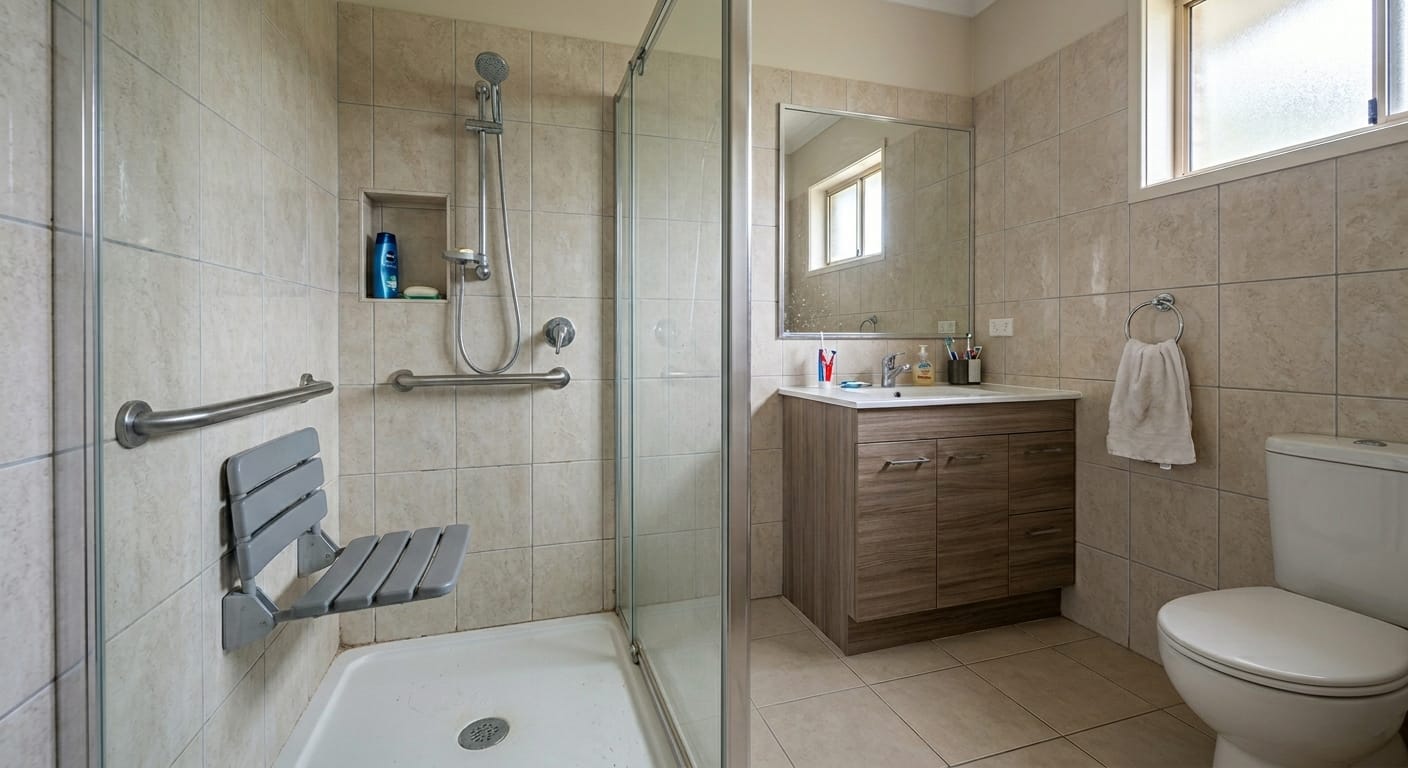
The highest-value modification is not necessarily the least expensive or the most expensive.
Value often comes from matching a solution to a specific challenge.
A household struggling with balance during shower entry may benefit more from grab bars and a shower seat than from replacing every fixture in the room.
Likewise, replacing a standard toilet with a comfort-height model may provide daily usability improvements at a relatively modest cost compared with major remodeling.
Families frequently discover that several targeted modifications can produce meaningful improvements while remaining within a manageable budget.
Another practical consideration is timing.
Installing certain features during a planned bathroom renovation may cost far less than adding them later.
For example, reinforcing walls for future grab bars during remodeling can be inexpensive. Opening finished walls years later to add reinforcement can be much more costly.
Small improvements implemented early may also delay the need for larger interventions.
Plan Your Bathroom Project
Organize bathroom priorities and questions before comparing written proposals.
Understanding Individual Bathroom Safety Modifications
Grab Bars
Grab bars are among the most commonly recommended bathroom safety upgrades.
Their relatively low cost often makes them attractive, but proper installation matters.
A professionally installed grab bar anchored into appropriate structural support generally provides greater reliability than temporary suction-based alternatives.
Many modern grab bars are designed to blend into residential décor and may not resemble institutional equipment.
The primary value of grab bars is not merely emergency support. They can also assist with routine movements such as entering a shower, stepping over a threshold, or standing from a seated position.
Raised Toilet Seats
Raised toilet seats typically represent one of the least expensive bathroom modifications.
They can reduce the distance required to sit down and stand up, which may help individuals experiencing reduced lower-body strength or joint discomfort.
However, they are not ideal for every situation.
Some households view them as temporary solutions while evaluating longer-term needs.
Others find that replacing the entire toilet with a comfort-height model provides a more stable and permanent option.
Comfort-Height Toilets
Comfort-height toilets are taller than standard models and often improve ease of use for many older adults.
Compared with extensive remodeling projects, replacing a toilet is usually a moderate-cost upgrade.
The benefit becomes more apparent when daily transfers begin requiring additional effort.
Because the toilet is used multiple times each day, even a modest usability improvement can have a meaningful cumulative impact.
Shower Seating
Standing for an entire shower may become more tiring as mobility, balance, endurance, or strength changes.
Shower seating options range from portable benches to permanently installed built-in seats.
Portable models are less expensive and easier to install.
Built-in seating generally costs more but may integrate better into a long-term accessibility strategy.
The choice often depends on expected future needs rather than current needs alone.
Handheld Showerheads
Handheld showerheads are often overlooked because they seem relatively simple.
Yet they may improve comfort and flexibility in several situations.
They can support seated bathing, reduce awkward movements, and make personal care easier for both users and caregivers.
Among lower-cost modifications, handheld showerheads frequently offer a favorable balance between cost and usability.
Slip-Resistant Flooring
Bathroom flooring decisions involve tradeoffs.
Some highly textured surfaces improve traction but may be harder to clean.
Others prioritize appearance while offering less slip resistance.
Homeowners sometimes focus exclusively on flooring materials while overlooking contributing factors such as:
- Soap residue
- Water accumulation
- Poor drainage
- Inadequate lighting
A safer flooring surface can be beneficial, but it works best as part of a broader safety strategy.
Walk-In Showers
Walk-in showers have become one of the most popular aging-in-place renovations.
The appeal is easy to understand.
Eliminating the need to step over a bathtub wall may improve accessibility and convenience.
However, costs can vary dramatically depending on:
- Plumbing changes
- Waterproofing requirements
- Shower size
- Material selection
- Existing bathroom layout
Not every household requires a luxury walk-in shower to improve bathroom safety.
The decision should be based on practical needs rather than renovation trends.
Curbless Showers
Curbless showers are often viewed as a long-term accessibility investment.
By eliminating threshold barriers, they can improve access for individuals using walkers, wheelchairs, or mobility aids.
Creating a true curbless design frequently requires substantial construction work.
Drainage systems, floor slopes, waterproofing layers, and structural considerations can significantly increase costs.
For some households, these expenses are justified by long-term accessibility goals.
For others, a standard walk-in shower may provide sufficient benefit at a lower cost.
Doorway Widening
Doorway widening is rarely the first modification families consider.
Yet it becomes increasingly important when mobility devices enter the picture.
A bathroom may contain accessible fixtures while remaining difficult to enter.
This illustrates an important planning lesson: accessibility is influenced by the entire user experience, not individual features alone.
Accessibility-Focused Remodeling
A full bathroom remodel may include:
- Walk-in shower
- Curbless entry
- Wider doorway
- Improved lighting
- Slip-resistant flooring
- Accessible fixtures
- Future-proof structural reinforcement
Such projects involve larger budgets but may create a more cohesive environment.
Still, the most expensive solution is not automatically the most appropriate one.
Some households genuinely need comprehensive remodeling.
Others achieve their goals through selective upgrades.
Cost Versus Usability: Interpreting the Tradeoffs
Bathroom safety decisions are rarely about cost alone.
A lower-cost modification may provide substantial benefit when it addresses a specific challenge.
Conversely, an expensive renovation may deliver limited practical value if it solves problems the user does not currently have.
Families often find it easier to discuss budgets than changing physical abilities.
Yet the latter usually drives the decision-making process.
Three planning approaches commonly emerge:
Reactive Planning
Modifications occur after significant difficulties appear.
This approach may lead to rushed decisions and higher costs.
Proactive Planning
Changes are made before major limitations develop.
This often allows greater flexibility and more competitive contractor selection.
Integrated Planning
Safety improvements are incorporated into scheduled renovations.
This strategy may reduce overall costs by combining projects and minimizing duplicate labor.
Practical Adjustment Strategies for Different Budgets
Under $500
Potential priorities may include:
- Grab bars
- Raised toilet seat
- Handheld showerhead
- Basic shower seating
- Improved task lighting
These modifications often provide meaningful usability improvements without construction work.
$500–$2,000
Possible upgrades may include:
- Comfort-height toilet
- Enhanced lighting
- Additional grab bars
- Better flooring treatments
- Professional installation services
This budget range often allows multiple targeted improvements.
$2,000–$10,000
Common projects include:
- Tub-to-shower conversion
- Slip-resistant flooring replacement
- Larger shower upgrades
- Moderate accessibility improvements
Many families begin considering long-term aging-in-place goals within this range.
Major Renovation Budgets
Projects exceeding $10,000 may involve:
- Walk-in showers
- Curbless showers
- Structural changes
- Doorway widening
- Complete accessibility remodeling
Larger budgets create more flexibility but also require more careful planning.
A poorly designed renovation can still create usability challenges despite significant expense.
Cost Comparison Table
| Modification | Typical Cost Range | Complexity | Potential Benefit |
|---|---|---|---|
| Grab Bars | Low | Low | Improved support during transfers |
| Raised Toilet Seat | Low | Very Low | Easier sitting and standing |
| Handheld Showerhead | Low | Low | Increased bathing flexibility |
| Shower Seat | Low–Moderate | Low | Reduced standing demands |
| Comfort-Height Toilet | Moderate | Moderate | Daily usability improvement |
| Lighting Upgrades | Moderate | Moderate | Better visibility |
| Slip-Resistant Flooring | Moderate–High | Moderate | Improved traction |
| Walk-In Shower | High | High | Easier shower access |
| Curbless Shower | Very High | Very High | Long-term accessibility potential |
| Full Remodel | Very High | Very High | Comprehensive accessibility improvements |
Related Bathroom Safety Planning Guides
Use these AgingAuthority guides to compare bathroom safety risks, layout issues, and lower-cost improvements before planning a larger project.
- Bathroom Safety for Seniors
- Bathroom Layout Fall Risks
- Safe Bathroom Storage and Fall Risks
- Bathroom Lighting for Seniors
- Best Non-Slip Bathroom Floor Solutions
- Hidden Bathroom Fall Risks
- Shower Chair Safety for Seniors
- Bathroom Grab Bar Placement
- Bathroom Project Planner
- Aging in Place Guide
- Home Modifications for Aging in Place
When to Consider Professional Evaluation
Professional input may be worthwhile when:
- Mobility limitations are increasing
- Transfers are becoming difficult
- A wheelchair may be needed in the future
- Multiple modifications are being considered simultaneously
- A significant renovation budget is involved
Professionals who may provide useful guidance include:
- Occupational therapists
- Certified Aging-in-Place Specialists (CAPS)
- Accessibility consultants
- Home modification contractors
- Home safety assessors
One advantage of a professional evaluation is that it focuses on how a specific individual uses a specific space.
Generic recommendations may not fully account for unique physical abilities, home layouts, or caregiving needs.
Should You Modify the Existing Bathroom or Remodel Completely?
There is no universal answer.
In some situations, a bathroom already has a functional layout and only requires targeted upgrades.
In others, multiple limitations combine to create ongoing usability challenges.
A homeowner may spend thousands of dollars adding individual modifications over several years, eventually approaching the cost of a comprehensive renovation.
On the other hand, a full remodel may be unnecessary when relatively simple improvements address the primary concerns.
The decision often depends on:
- Current abilities
- Anticipated future needs
- Length of time the homeowner expects to remain in the home
- Overall renovation plans
- Available budget
Thinking several years ahead can sometimes lead to more efficient investments.
Free Estimate Tool
Not Sure Which Bathroom Upgrade Fits Your Budget?
Answer a few questions and get a personalized planning range for common bathroom safety modifications.
Frequently Asked Questions
How much do bathroom safety modifications usually cost?
Bathroom safety modifications may cost less than $100 for simple equipment or more than $20,000 for major accessibility remodeling. The final price depends on the project type, labor, bathroom layout, materials, plumbing, electrical work, and hidden conditions such as water damage or subfloor problems.
What are the lowest-cost bathroom safety upgrades?
Lower-cost options often include grab bars, raised toilet seats, handheld showerheads, portable shower seats, and basic lighting improvements. These upgrades may not replace a full remodel, but they can address common usability concerns without major construction.
Is a full bathroom remodel always necessary for aging in place?
No. Many families can improve bathroom safety with targeted modifications rather than a complete remodel. A full remodel becomes more relevant when the existing layout, bathtub access, doorway width, flooring, or future mobility needs create ongoing limitations.
Which bathroom safety upgrade usually provides the best value?
The best value depends on the specific problem being solved. Grab bars may offer strong value for transfer support, while shower seating or a handheld showerhead may be more useful for someone who tires while bathing. Cost-effectiveness comes from matching the modification to the person’s daily routine.
When should families get a professional bathroom safety evaluation?
Professional input is especially useful when mobility is changing, transfers are becoming difficult, multiple modifications are being considered, or a major renovation budget is involved. Occupational therapists, CAPS professionals, accessibility consultants, and qualified contractors can help connect the home’s layout to the person’s actual needs.
Can bathroom safety modifications be done in stages?
Yes. Many families start with lower-cost improvements, then plan larger upgrades later if needs change. Staging projects can make costs easier to manage, although some work, such as wall reinforcement or plumbing changes, may be more efficient during a planned renovation.
Conclusion
Bathroom safety modifications can range from simple, low-cost upgrades to major accessibility renovations. The most effective approach is rarely determined by budget alone.
Families often achieve meaningful improvements through targeted modifications that address specific challenges rather than pursuing extensive remodeling immediately. Grab bars, shower seating, handheld showerheads, lighting improvements, and comfort-height toilets may provide substantial usability benefits while remaining relatively affordable.
Larger investments such as walk-in showers, curbless showers, and accessibility-focused remodels can be appropriate in certain circumstances, particularly when long-term mobility needs are expected to change.
The key is thoughtful prioritization. Understanding how an individual uses the bathroom today—and how those needs may evolve over time—can help families make more informed decisions about where to invest, when to renovate, and which modifications are likely to provide the greatest practical value.
Disclaimer
This content is for general educational purposes only and does not replace a professional home safety assessment, medical advice, or licensed contractor evaluation.