
Executive Summary
A shower chair can reduce bathing risk when fatigue, balance loss, or fear makes standing unsafe. But it is not a complete safety solution by itself. Its value depends on the full bathroom system: grab bars, entry design, floor traction, available space, and how safely the older adult sits, stands, turns, and exits the shower during real daily bathing routines.
1. Introduction
Bathing combines several of the highest-risk movements in the home into a single routine: stepping over thresholds, standing on a wet surface, turning, reaching, and transitioning between positions.
With age, these movements become less predictable. Strength declines, balance becomes less responsive, and endurance decreases. What once felt automatic can gradually require effort and attention.
The question is not simply whether an older adult can still stand in the shower.
The real question is whether they can complete the entire bathing process with enough stability, control, and endurance to remain safe.
For families building a complete safety plan, this article fits within our broader bathroom safety for seniors guide and the main aging in place hub.
This process includes:
- entering the shower
- maintaining balance while washing
- adjusting body position
- lowering into a seated position if needed
- standing back up safely
- exiting without slipping
A shower chair is often introduced as a solution. In practice, its value depends on whether it improves movement stability across this entire sequence—not just during standing. If you are also comparing full bathing layouts, see walk-in shower vs. walk-in tub for seniors.
Table of Contents
- Introduction
- What Is a Shower Chair for Seniors?
- When Is a Shower Chair Actually Needed?
- Deep Dive: Seated Shower Safety, Transfer Stability, and Fall-Risk Reduction
- Types of Shower Seating and Where Each Fits Best
- Shower Chair Safety in a Real Bathroom
- Pros, Limitations, and Common Mistakes
- Comparison Tables
- Cost and Practical Planning
- When to Hire a Professional
- Frequently Asked Questions
- Conclusion
- Sources
- Safety Disclaimer
- Editorial Note
Plan Your Bathroom Project
Organize bathroom project priorities and questions before comparing written proposals.
2. What Is a Shower Chair for Seniors?
A shower chair is a seating device designed to allow bathing while seated instead of standing.
It reduces the need to:
- maintain full-body balance continuously
- support body weight throughout the entire shower
- perform washing tasks while managing instability
However, not all shower seating serves the same purpose.
Common categories include:
- Shower chair (with back): Provides seated support and posture stability
- Shower stool: Compact and space-efficient, but offers minimal support
- Transfer bench: Designed to assist with entering and exiting over a tub edge
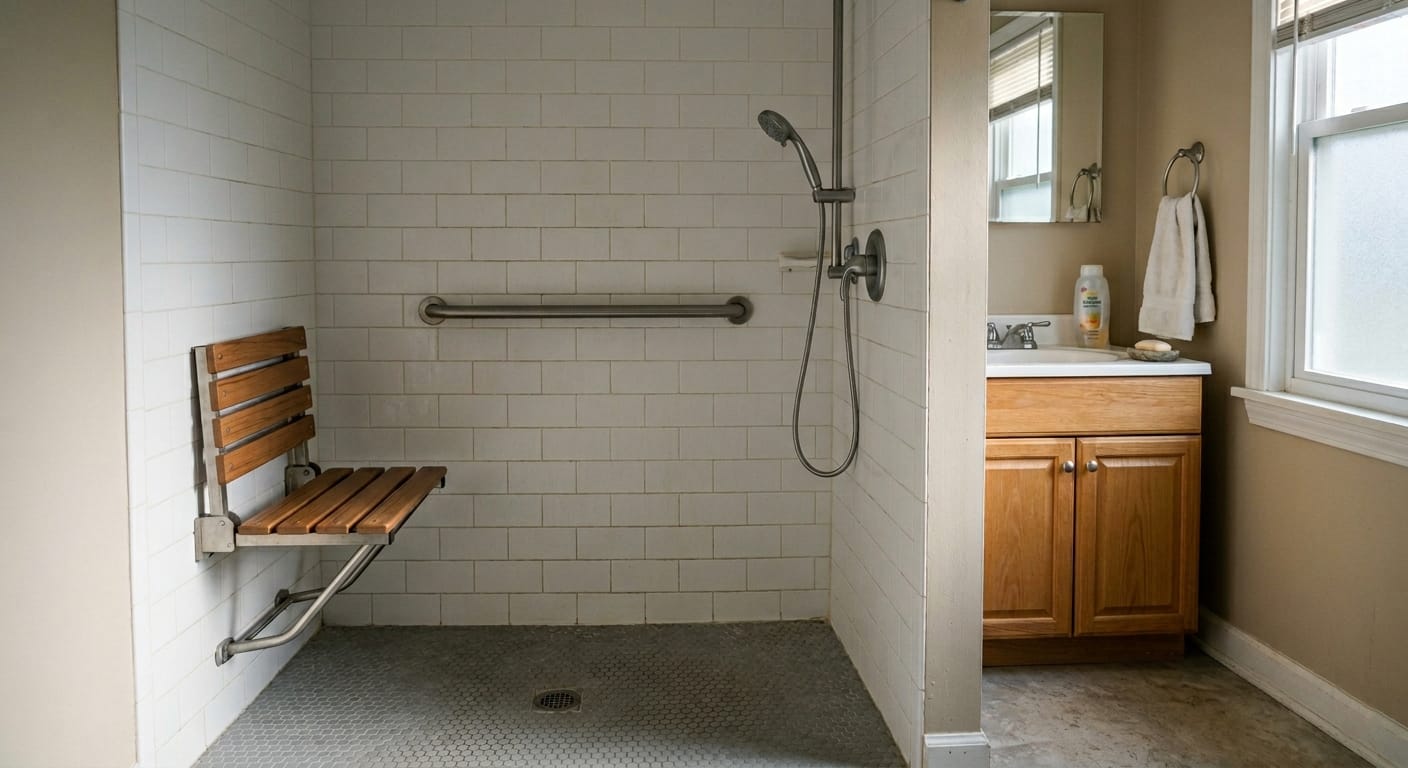
- Wall-mounted seat: Fixed, foldable seating integrated into the wall
- Built-in bench: Permanent seating in walk-in showers
These are not interchangeable. Each is designed to solve a different type of movement challenge within the bathing process. If toilet transfers are also becoming difficult, it is worth reviewing best toilet height for elderly safety as part of the same bathroom safety plan.
3. When Is a Shower Chair Actually Needed?
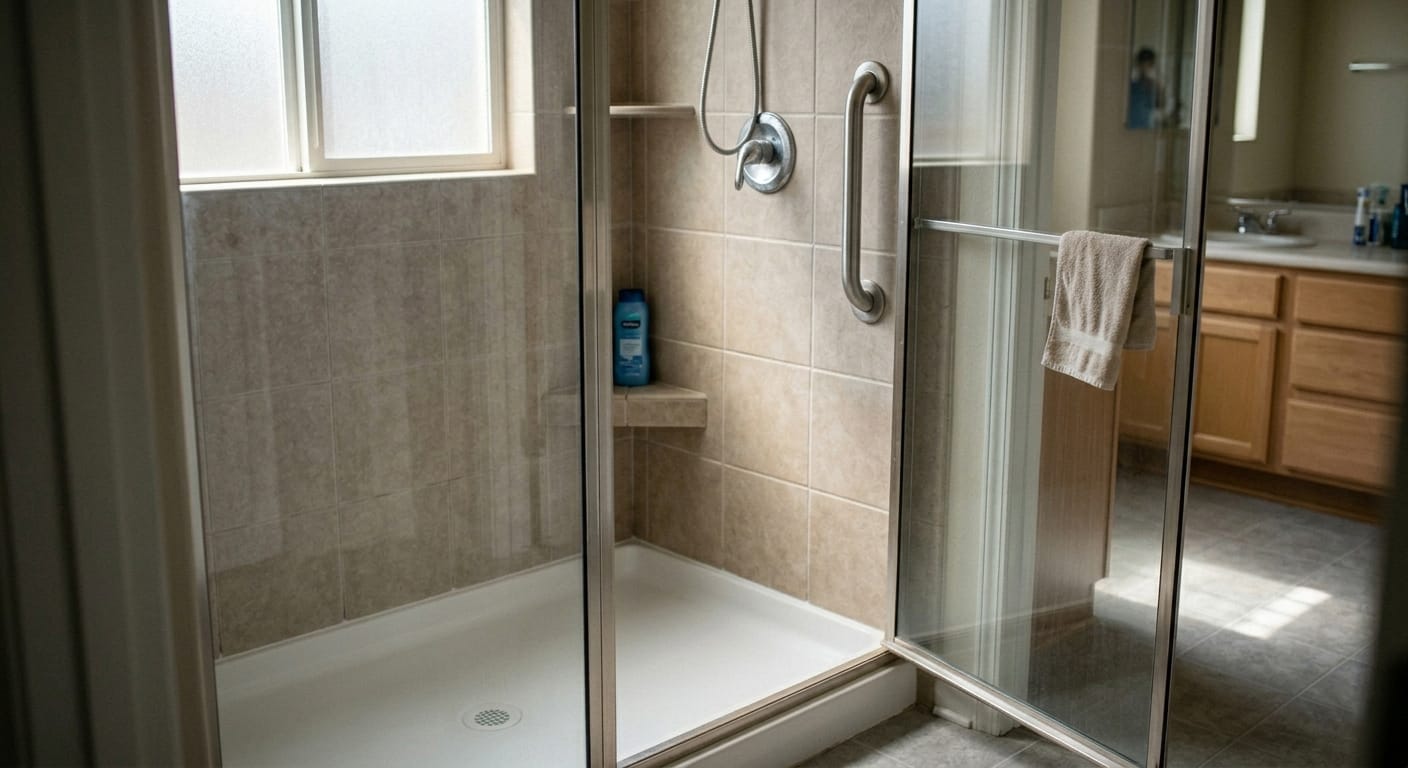
A shower chair becomes relevant when standing bathing begins to reduce safety margins.
In many homes, this change appears gradually. The older adult may still describe bathing as “manageable,” while movement patterns already indicate increasing risk.
Common indicators include:
- fatigue before finishing a shower
- leaning against walls or fixtures for support
- instability while turning or reaching
- fear of slipping, especially on wet surfaces
- recent fall or near-fall in the bathroom
- reduced strength after illness, surgery, or hospitalization
- difficulty lifting one leg while standing
- rushing through showers due to instability
These signals point to reduced movement capacity under wet and constrained conditions.
However, a shower chair may not be necessary when:
- balance remains stable
- endurance is sufficient for the full routine
- grab bars already provide strong support
- the shower layout minimizes risk
Movement Problem vs Solution
Understanding what is actually failing is critical.
| Movement Difficulty | What Is Actually Failing | Is a Shower Chair the Right Solution? | Better Alternative (If Not) |
|---|---|---|---|
| Difficulty standing for long periods | Reduced endurance | Yes, often helpful | — |
| Loss of balance while turning | Unstable balance control | Yes, with support | Add grab bars |
| Trouble stepping into shower | Entry/exit difficulty | No | Transfer bench |
| Difficulty sitting down safely | Poor descent control | Partially | Grab bars essential |
| Difficulty standing up | Leg strength weakness | Partially | Raised surfaces + grab bars |
| Slipping on wet floor | Poor traction | No | Non-slip flooring |
Not every problem requires a chair. Misidentifying the problem often leads to ineffective or incomplete solutions. In many bathrooms, the missing element is not the chair itself but the lack of properly placed support, which is why grab bar placement in the bathroom matters so much.
4. Deep Dive: Seated Shower Safety, Transfer Stability, and Fall-Risk Reduction
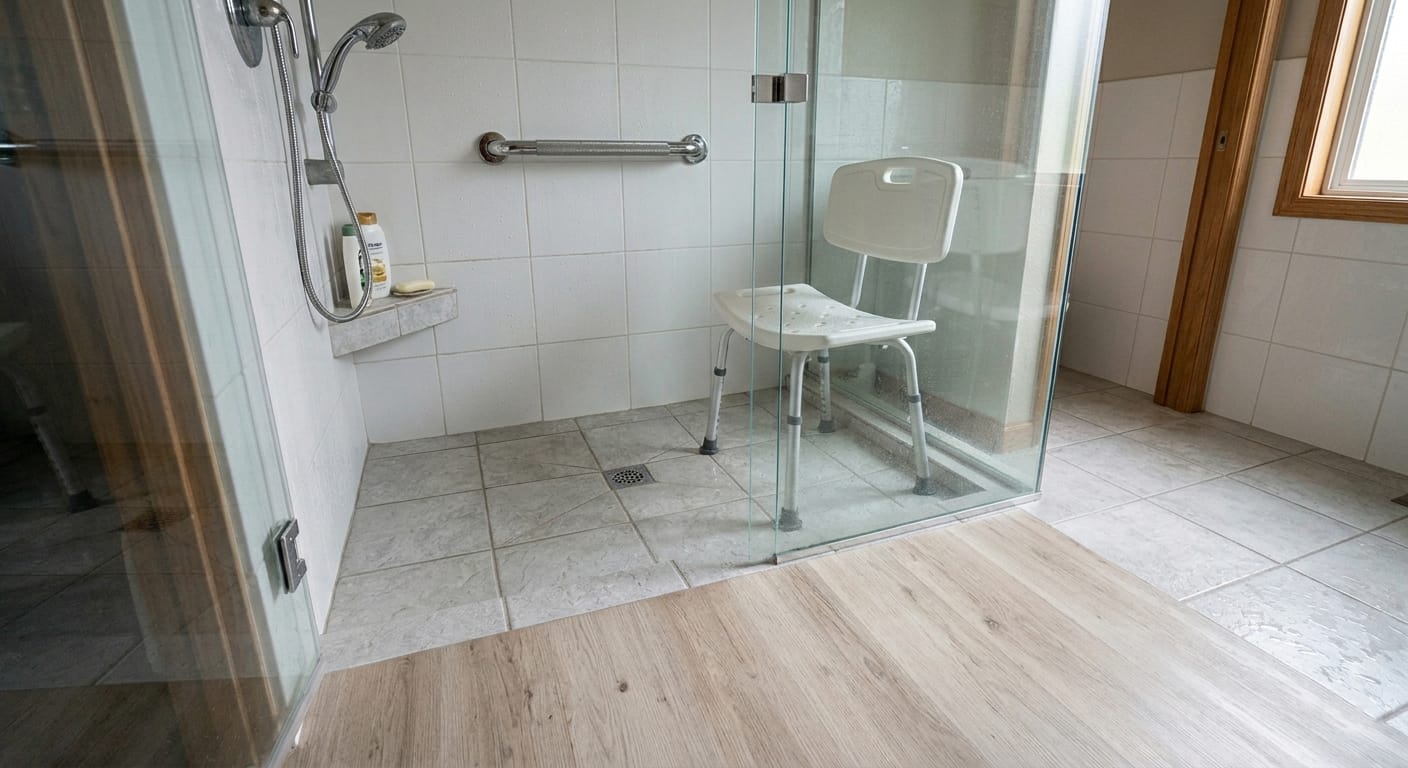
This is where real safety decisions are made.
Risk concentrates during transitions.
The most dangerous moments are:
- stepping into the shower
- lowering into position
- rising back to standing
- turning while wet
- reaching outside the base of support
Standing bathing requires continuous balance correction. Wet surfaces reduce friction, and fatigue reduces control.
How a Shower Chair Changes Risk
A shower chair reduces:
- continuous weight-bearing
- balance demands during washing
- fatigue accumulation over time
This improves:
- pacing
- stability
- movement predictability
Seating reduces demand. It does not remove danger.
The Critical Role of Transfers
Sitting down is not passive. It requires:
- controlled descent
- accurate alignment with the seat
- stable hand support
Standing up requires:
- leg strength
- coordination
- balance recovery
Without grab bars, these steps remain high-risk—even with a chair. For a deeper look at where support should actually be installed, see where to install grab bars safely in the bathroom.
Fatigue and Movement Breakdown
Fatigue changes how safely a person moves.
As fatigue increases:
- posture weakens
- movements become rushed
- balance reactions slow
In real environments, this often leads to:
- incomplete rinsing due to instability
- unsafe reaching
- reduced attention to footing
Seated bathing allows recovery between movements, reducing the likelihood of rushed or unstable actions.
Reaching and Rotational Stability
Bathing requires:
- forward bending
- side reaching
- washing lower body areas
- rotating toward fixtures or showerheads
These movements shift the center of gravity.
Even when seated, instability can occur if:
- the chair is too narrow
- feet are not firmly planted
- the surface is slippery
- no grab bars are available
A shower chair works best within a stable shower system.
5. Types of Shower Seating and Where Each Fits Best
Different seating types address different needs.
| Shower Seating Type | Best For | Main Safety Benefit | Key Limitation | Typical Setup |
|---|---|---|---|---|
| Shower Chair (with back) | Reduced endurance + mild balance issues | Stable seated support | Requires space | Walk-in shower |
| Shower Stool | Small showers | Space-saving | Limited support | Narrow shower |
| Transfer Bench | Difficult tub entry | Safer entry/exit | Bulky | Bathtub |
| Wall-Mounted Seat | Permanent setups | High stability | Requires installation | Renovated shower |
| Built-In Bench | Walk-in showers | Fixed stability | Not adjustable | Custom shower |
Choosing the wrong type can introduce new risks instead of reducing them. If the household is considering a full bathing upgrade instead of portable seating, compare permanent layouts in our guide to walk-in shower vs. walk-in tub safety.
6. Shower Chair Safety in a Real Bathroom
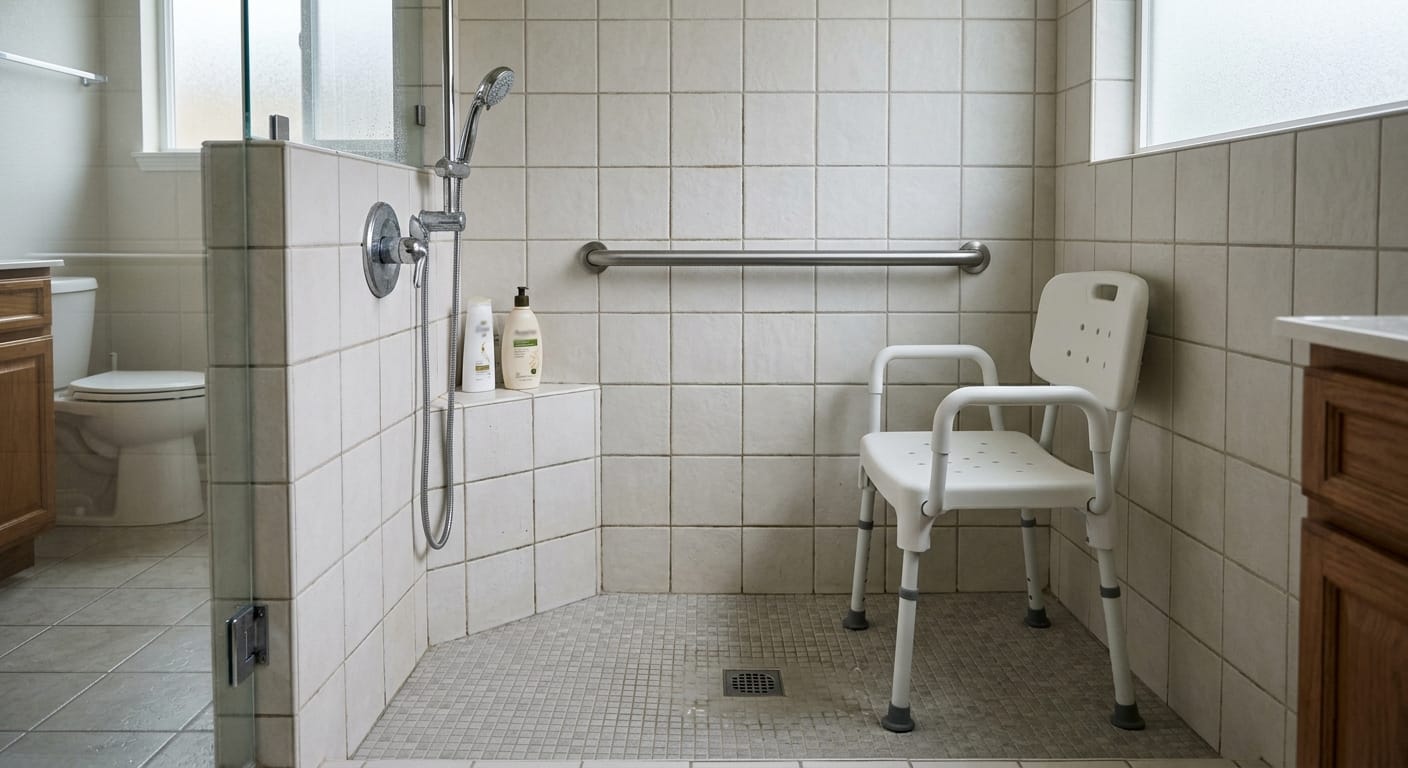
A shower chair does not operate in isolation.
In real homes, safety depends on how the chair interacts with the environment.
Common constraints include:
- narrow shower stalls that restrict positioning
- limited knee or leg space
- chairs placed too close to walls or fixtures
- water pooling under chair legs
- lack of space for stable hand placement
Key environmental factors:
- Grab bars: Essential for safe sitting and standing
- Entry design: High thresholds increase transfer risk
- Floor traction: Smooth surfaces increase slip risk
- Drainage: Standing water reduces stability
- Handheld showerhead: Reduces unsafe reaching
- Available space: Determines safe positioning
A poorly configured environment can make even a well-designed chair unsafe. Bathroom safety rarely depends on one upgrade alone, which is why this topic fits best within a broader home modifications for aging in place strategy.
7. Pros, Limitations, and Common Mistakes
Benefits
- Reduces standing demand: Helpful when endurance declines before the shower is complete
- Improves pacing: Allows movements to be controlled rather than rushed
- Supports recovery: Especially after illness or surgery
- Increases perceived stability: Can reduce fear and hesitation
Limitations
- Does not eliminate fall risk
- Requires proper setup and positioning
- May not fit smaller showers
- Does not replace the need for hand support
Common Mistakes
- using a chair without grab bars
- placing it on a slippery surface
- choosing the wrong size or type
- assuming sitting automatically makes the shower safe
- ignoring transfer-in and transfer-out risk
8. Comparison Tables
Situation-Based Safety Analysis
| Situation or Shower Condition | Why Risk Increases | How Shower Seating May Help |
|---|---|---|
| Poor standing endurance | Fatigue reduces control | Sitting reduces demand |
| Weak balance | Hard to correct slips | Seated stability improves control |
| High threshold | Entry is unsafe | Transfer bench may help |
| No grab bars | Transfers unstable | Chair alone insufficient |
9. Cost and Practical Planning
Typical cost ranges:
- Shower stool: $20–$50
- Shower chair: $40–$120
- Transfer bench: $80–$200
- Wall-mounted seat: $150–$400+
Additional costs may include:
- grab bars
- handheld showerhead
- non-slip flooring
- professional installation
The lowest-cost solution is not always the safest. Safety depends on how well all elements work together.
10. When to Hire a Professional
Professional input may be appropriate when:
- repeated near-falls occur
- transfers are unsafe or inconsistent
- recovery after surgery is ongoing
- multiple risks exist in the same bathroom
- the correct solution is unclear
Relevant professionals include:
- occupational therapists
- home safety specialists
- accessibility contractors
11. Frequently Asked Questions
Plan Your Bathroom Project
Organize bathroom project priorities and questions before comparing written proposals.
12. Conclusion
A shower chair is most useful when it improves control, reduces fatigue, and allows safer pacing during bathing.
But it is not a universal solution.
Its value depends on how well it integrates into a complete shower safety system that includes:
- stable hand support
- proper traction
- safe entry
- adequate space
The safest decision is not whether to add a chair, but whether it improves movement stability within the real environment. For readers building a safer bathroom step by step, related decisions around grab bar placement, toilet height, and walk-in bathing design should be evaluated together.
13. Sources
- Centers for Disease Control and Prevention (CDC) – Older Adult Fall Prevention
- National Institute on Aging (NIA) – Home Safety
- AARP – HomeFit Guide
- U.S. Access Board – ADA Accessibility Guidelines
Safety Disclaimer
Important: This article is for general educational purposes only and does not replace medical advice, occupational therapy assessment, or a professional home safety evaluation. If an older adult has fallen, feels unsafe bathing, or has new weakness after illness or surgery, consult a qualified healthcare or home safety professional before making major bathroom changes.
Editorial Note
Reviewed by AgingAuthority Editorial Team
This guide was reviewed using AgingAuthority’s research-informed residential safety framework, with attention to bathroom movement transitions, transfer stability, environmental risk factors, and practical aging-in-place planning. Learn more about our editorial process on our Editorial Process page.
Executive Summary
A shower chair can reduce bathing risk when fatigue, balance loss, or fear makes standing unsafe. But it is not a complete safety solution by itself. Its value depends on the full bathroom system: grab bars, entry design, floor traction, available space, and how safely the older adult sits, stands, turns, and exits the shower during real daily bathing routines.
1. Introduction
Bathing combines several of the highest-risk movements in the home into a single routine: stepping over thresholds, standing on a wet surface, turning, reaching, and transitioning between positions.
With age, these movements become less predictable. Strength declines, balance becomes less responsive, and endurance decreases. What once felt automatic can gradually require effort and attention.
The question is not simply whether an older adult can still stand in the shower.
The real question is whether they can complete the entire bathing process with enough stability, control, and endurance to remain safe.
For families building a complete safety plan, this article fits within our broader bathroom safety for seniors guide and the main aging in place hub.
This process includes:
- entering the shower
- maintaining balance while washing
- adjusting body position
- lowering into a seated position if needed
- standing back up safely
- exiting without slipping
A shower chair is often introduced as a solution. In practice, its value depends on whether it improves movement stability across this entire sequence—not just during standing. If you are also comparing full bathing layouts, see walk-in shower vs. walk-in tub for seniors.
Table of Contents
- Introduction
- What Is a Shower Chair for Seniors?
- When Is a Shower Chair Actually Needed?
- Deep Dive: Seated Shower Safety, Transfer Stability, and Fall-Risk Reduction
- Types of Shower Seating and Where Each Fits Best
- Shower Chair Safety in a Real Bathroom
- Pros, Limitations, and Common Mistakes
- Comparison Tables
- Cost and Practical Planning
- When to Hire a Professional
- Frequently Asked Questions
- Conclusion
- Sources
- Safety Disclaimer
- Editorial Note
Plan Your Bathroom Project
Organize bathroom project priorities and questions before comparing written proposals.
2. What Is a Shower Chair for Seniors?
A shower chair is a seating device designed to allow bathing while seated instead of standing.
It reduces the need to:
- maintain full-body balance continuously
- support body weight throughout the entire shower
- perform washing tasks while managing instability
However, not all shower seating serves the same purpose.
Common categories include:
- Shower chair (with back): Provides seated support and posture stability
- Shower stool: Compact and space-efficient, but offers minimal support
- Transfer bench: Designed to assist with entering and exiting over a tub edge
- Wall-mounted seat: Fixed, foldable seating integrated into the wall
- Built-in bench: Permanent seating in walk-in showers
These are not interchangeable. Each is designed to solve a different type of movement challenge within the bathing process. If toilet transfers are also becoming difficult, it is worth reviewing best toilet height for elderly safety as part of the same bathroom safety plan.
3. When Is a Shower Chair Actually Needed?
A shower chair becomes relevant when standing bathing begins to reduce safety margins.
In many homes, this change appears gradually. The older adult may still describe bathing as “manageable,” while movement patterns already indicate increasing risk.
Common indicators include:
- fatigue before finishing a shower
- leaning against walls or fixtures for support
- instability while turning or reaching
- fear of slipping, especially on wet surfaces
- recent fall or near-fall in the bathroom
- reduced strength after illness, surgery, or hospitalization
- difficulty lifting one leg while standing
- rushing through showers due to instability
These signals point to reduced movement capacity under wet and constrained conditions.
However, a shower chair may not be necessary when:
- balance remains stable
- endurance is sufficient for the full routine
- grab bars already provide strong support
- the shower layout minimizes risk
Movement Problem vs Solution
Understanding what is actually failing is critical.
| Movement Difficulty | What Is Actually Failing | Is a Shower Chair the Right Solution? | Better Alternative (If Not) |
|---|---|---|---|
| Difficulty standing for long periods | Reduced endurance | Yes, often helpful | — |
| Loss of balance while turning | Unstable balance control | Yes, with support | Add grab bars |
| Trouble stepping into shower | Entry/exit difficulty | No | Transfer bench |
| Difficulty sitting down safely | Poor descent control | Partially | Grab bars essential |
| Difficulty standing up | Leg strength weakness | Partially | Raised surfaces + grab bars |
| Slipping on wet floor | Poor traction | No | Non-slip flooring |
Not every problem requires a chair. Misidentifying the problem often leads to ineffective or incomplete solutions. In many bathrooms, the missing element is not the chair itself but the lack of properly placed support, which is why grab bar placement in the bathroom matters so much.
4. Deep Dive: Seated Shower Safety, Transfer Stability, and Fall-Risk Reduction
This is where real safety decisions are made.
Risk concentrates during transitions.
The most dangerous moments are:
- stepping into the shower
- lowering into position
- rising back to standing
- turning while wet
- reaching outside the base of support
Standing bathing requires continuous balance correction. Wet surfaces reduce friction, and fatigue reduces control.
How a Shower Chair Changes Risk
A shower chair reduces:
- continuous weight-bearing
- balance demands during washing
- fatigue accumulation over time
This improves:
- pacing
- stability
- movement predictability
Seating reduces demand. It does not remove danger.
The Critical Role of Transfers
Sitting down is not passive. It requires:
- controlled descent
- accurate alignment with the seat
- stable hand support
Standing up requires:
- leg strength
- coordination
- balance recovery
Without grab bars, these steps remain high-risk—even with a chair. For a deeper look at where support should actually be installed, see where to install grab bars safely in the bathroom.
Fatigue and Movement Breakdown
Fatigue changes how safely a person moves.
As fatigue increases:
- posture weakens
- movements become rushed
- balance reactions slow
In real environments, this often leads to:
- incomplete rinsing due to instability
- unsafe reaching
- reduced attention to footing
Seated bathing allows recovery between movements, reducing the likelihood of rushed or unstable actions.
Reaching and Rotational Stability
Bathing requires:
- forward bending
- side reaching
- washing lower body areas
- rotating toward fixtures or showerheads
These movements shift the center of gravity.
Even when seated, instability can occur if:
- the chair is too narrow
- feet are not firmly planted
- the surface is slippery
- no grab bars are available
A shower chair works best within a stable shower system.
5. Types of Shower Seating and Where Each Fits Best
Different seating types address different needs.
| Shower Seating Type | Best For | Main Safety Benefit | Key Limitation | Typical Setup |
|---|---|---|---|---|
| Shower Chair (with back) | Reduced endurance + mild balance issues | Stable seated support | Requires space | Walk-in shower |
| Shower Stool | Small showers | Space-saving | Limited support | Narrow shower |
| Transfer Bench | Difficult tub entry | Safer entry/exit | Bulky | Bathtub |
| Wall-Mounted Seat | Permanent setups | High stability | Requires installation | Renovated shower |
| Built-In Bench | Walk-in showers | Fixed stability | Not adjustable | Custom shower |
Choosing the wrong type can introduce new risks instead of reducing them. If the household is considering a full bathing upgrade instead of portable seating, compare permanent layouts in our guide to walk-in shower vs. walk-in tub safety.
6. Shower Chair Safety in a Real Bathroom
A shower chair does not operate in isolation.
In real homes, safety depends on how the chair interacts with the environment.
Common constraints include:
- narrow shower stalls that restrict positioning
- limited knee or leg space
- chairs placed too close to walls or fixtures
- water pooling under chair legs
- lack of space for stable hand placement
Key environmental factors:
- Grab bars: Essential for safe sitting and standing
- Entry design: High thresholds increase transfer risk
- Floor traction: Smooth surfaces increase slip risk
- Drainage: Standing water reduces stability
- Handheld showerhead: Reduces unsafe reaching
- Available space: Determines safe positioning
A poorly configured environment can make even a well-designed chair unsafe. Bathroom safety rarely depends on one upgrade alone, which is why this topic fits best within a broader home modifications for aging in place strategy.
7. Pros, Limitations, and Common Mistakes
Benefits
- Reduces standing demand: Helpful when endurance declines before the shower is complete
- Improves pacing: Allows movements to be controlled rather than rushed
- Supports recovery: Especially after illness or surgery
- Increases perceived stability: Can reduce fear and hesitation
Limitations
- Does not eliminate fall risk
- Requires proper setup and positioning
- May not fit smaller showers
- Does not replace the need for hand support
Common Mistakes
- using a chair without grab bars
- placing it on a slippery surface
- choosing the wrong size or type
- assuming sitting automatically makes the shower safe
- ignoring transfer-in and transfer-out risk
8. Comparison Tables
Situation-Based Safety Analysis
| Situation or Shower Condition | Why Risk Increases | How Shower Seating May Help |
|---|---|---|
| Poor standing endurance | Fatigue reduces control | Sitting reduces demand |
| Weak balance | Hard to correct slips | Seated stability improves control |
| High threshold | Entry is unsafe | Transfer bench may help |
| No grab bars | Transfers unstable | Chair alone insufficient |
9. Cost and Practical Planning
Typical cost ranges:
- Shower stool: $20–$50
- Shower chair: $40–$120
- Transfer bench: $80–$200
- Wall-mounted seat: $150–$400+
Additional costs may include:
- grab bars
- handheld showerhead
- non-slip flooring
- professional installation
The lowest-cost solution is not always the safest. Safety depends on how well all elements work together.
10. When to Hire a Professional
Professional input may be appropriate when:
- repeated near-falls occur
- transfers are unsafe or inconsistent
- recovery after surgery is ongoing
- multiple risks exist in the same bathroom
- the correct solution is unclear
Relevant professionals include:
- occupational therapists
- home safety specialists
- accessibility contractors
11. Frequently Asked Questions
Plan Your Bathroom Project
Organize bathroom project priorities and questions before comparing written proposals.
12. Conclusion
A shower chair is most useful when it improves control, reduces fatigue, and allows safer pacing during bathing.
But it is not a universal solution.
Its value depends on how well it integrates into a complete shower safety system that includes:
- stable hand support
- proper traction
- safe entry
- adequate space
The safest decision is not whether to add a chair, but whether it improves movement stability within the real environment. For readers building a safer bathroom step by step, related decisions around grab bar placement, toilet height, and walk-in bathing design should be evaluated together.
13. Sources
- Centers for Disease Control and Prevention (CDC) – Older Adult Fall Prevention
- National Institute on Aging (NIA) – Home Safety
- AARP – HomeFit Guide
- U.S. Access Board – ADA Accessibility Guidelines
Safety Disclaimer
Important: This article is for general educational purposes only and does not replace medical advice, occupational therapy assessment, or a professional home safety evaluation. If an older adult has fallen, feels unsafe bathing, or has new weakness after illness or surgery, consult a qualified healthcare or home safety professional before making major bathroom changes.
Editorial Note
Reviewed by AgingAuthority Editorial Team
This guide was reviewed using AgingAuthority’s research-informed residential safety framework, with attention to bathroom movement transitions, transfer stability, environmental risk factors, and practical aging-in-place planning. Learn more about our editorial process on our Editorial Process page.