
For a complete overview of safer stairs, explore our Complete Stair Safety Guide for Aging in Place .
Staircase Lighting for Seniors: Preventing Nighttime Falls
Executive Summary
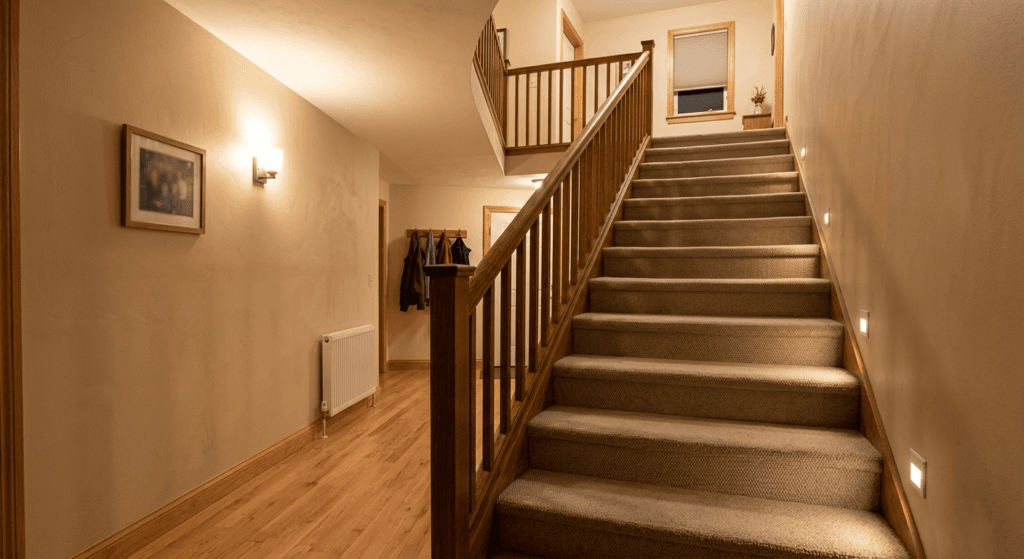
Many stair-related safety concerns are associated with visibility rather than the stairs themselves. A staircase that feels comfortable during the day may become challenging at night due to reduced contrast, shadows, glare, and age-related vision changes. Thoughtful lighting improvements—including motion-activated lighting, dual-location switches, and smart lighting controls—can improve visibility, confidence, and consistency while supporting safer aging in place.
1. Why Stairs Often Feel Different at Night
Many families focus on stair surfaces, handrails, and flooring materials while overlooking visibility conditions.
Yet for many older adults, nighttime visibility becomes one of the first signs that stair use is becoming more difficult.
Several factors contribute:
- Reduced contrast sensitivity with age
- Difficulty distinguishing stair edges
- Increased sensitivity to shadows
- Slower visual adaptation between bright and dark areas
- Fatigue during nighttime bathroom trips or bedtime routines
A staircase that feels completely safe at 2 p.m. may feel very different at 2 a.m.
In some homes, older adults quietly begin avoiding stairs at night long before family members recognize a problem. They may wait until daylight, avoid retrieving items from another floor, or limit movement after dark because the stairs no longer feel predictable.
These changes often appear alongside many of the issues discussed in Why Stairs Become More Dangerous With Age Before Falls Occur, where age-related changes affect balance, vision, reaction time, and confidence simultaneously.
Not Sure Whether Your Stairs Are Safe at Night?
Use the stair safety assessment to identify visibility, handrail, surface, and layout concerns that may be easy to miss during daytime use.
2. How Lighting Affects Stair Safety
Good stair lighting does more than make stairs visible.
Effective lighting helps people:
- Identify stair edges
- Judge depth more accurately
- Detect obstacles
- Maintain visual orientation
- Move with greater confidence
When visibility is poor, even healthy adults may hesitate while descending stairs.
For older adults, uncertainty about where the next step begins or ends can increase caution, disrupt natural walking patterns, and contribute to loss of confidence.
Lighting upgrades often provide benefits beyond visibility itself. Many families report that older adults become more willing to use stairs consistently when lighting feels predictable and reliable.
This improvement in confidence can be just as valuable as the increase in illumination.
4. Comparing Common Stair Lighting Options
| Lighting Option | Installation Difficulty | Typical Benefit | Limitations |
|---|---|---|---|
| Motion-Activated LED Strips | Low to Moderate | Illuminates stair edges automatically | Requires battery changes or power source |
| Plug-In Night Lights | Low | Simple visibility improvement | Limited coverage |
| Two-Way Switches | Moderate | Control lighting from both stair ends | May require electrical work |
| Smart Bulbs | Low | Scheduling and remote control | Requires setup and familiarity |
| Smart Motion Sensors | Moderate | Automated activation without manual switches | Technology maintenance required |
| Under-Step Lighting | Moderate to High | Excellent stair-edge visibility | Higher installation complexity |
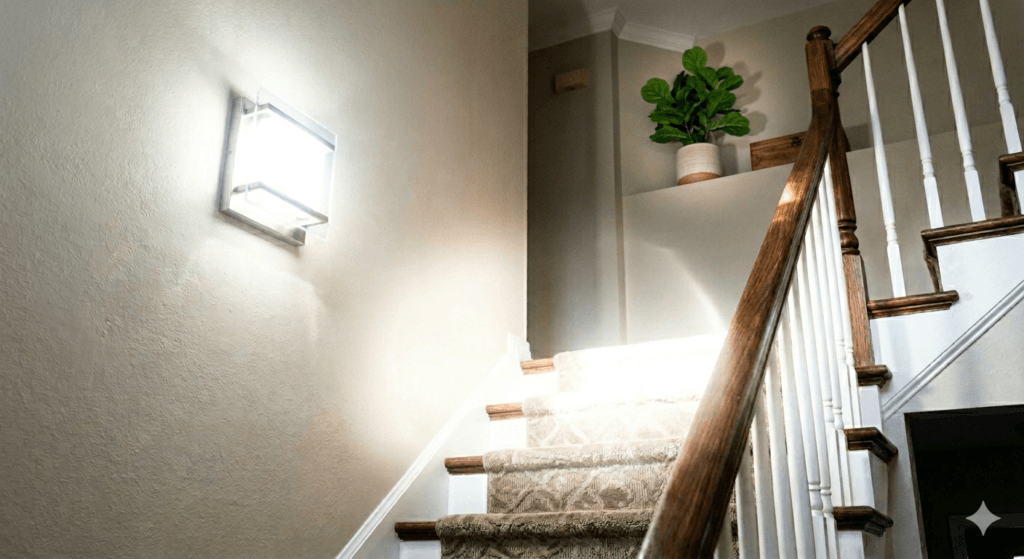
| Wall-Mounted Accent Lighting | Moderate | Reduces shadows and improves contrast | Fixture placement matters |
5. Motion-Activated Stair Lighting
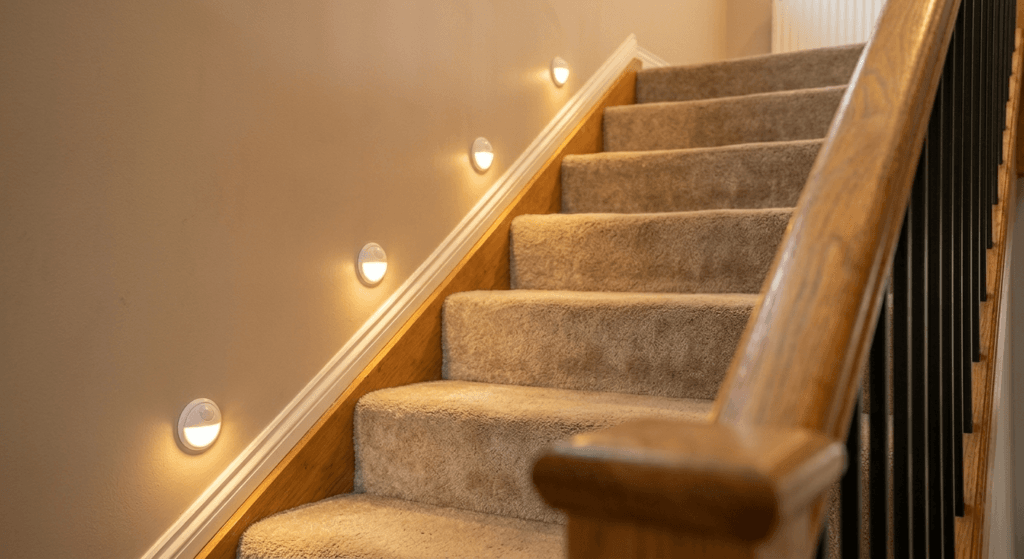
Motion-activated lighting has become increasingly popular for aging-in-place projects because it addresses a common problem:
The need to find a light switch before using the stairs.
Common Options
LED Strip Lighting
LED strips can be installed:
- Along stair treads
- Beneath stair nosing
- Along handrails
- Near baseboards
They create visual definition without producing excessive brightness.
Under-Step Lighting
Under-step lighting highlights each individual tread.
This can improve stair-edge recognition and reduce visual uncertainty during nighttime use.
Battery-Powered Lighting
Advantages:
- No wiring required
- Relatively easy installation
- Useful in rental properties
Limitations:
- Batteries require replacement
- Brightness may decrease over time
Plug-In Solutions
Advantages:
- Simple installation
- Low cost
- No battery maintenance
Limitations:
- Outlet location may limit placement
- Cord management may be necessary
When Motion Lighting Works Best
Motion-activated lighting may be particularly useful when:
- Nighttime bathroom trips are common
- Switches are inconveniently located
- Stair users frequently forget to turn lights on
- Additional visibility is needed without leaving lights on overnight
Check More Than the Lighting
Lighting can improve visibility, but stair safety also depends on handrails, tread condition, contrast, clutter, and how the stairs are used during daily routines.
6. Why Two-Way Light Switches Matter
Sometimes the lighting itself is not the problem.
The switch location is.
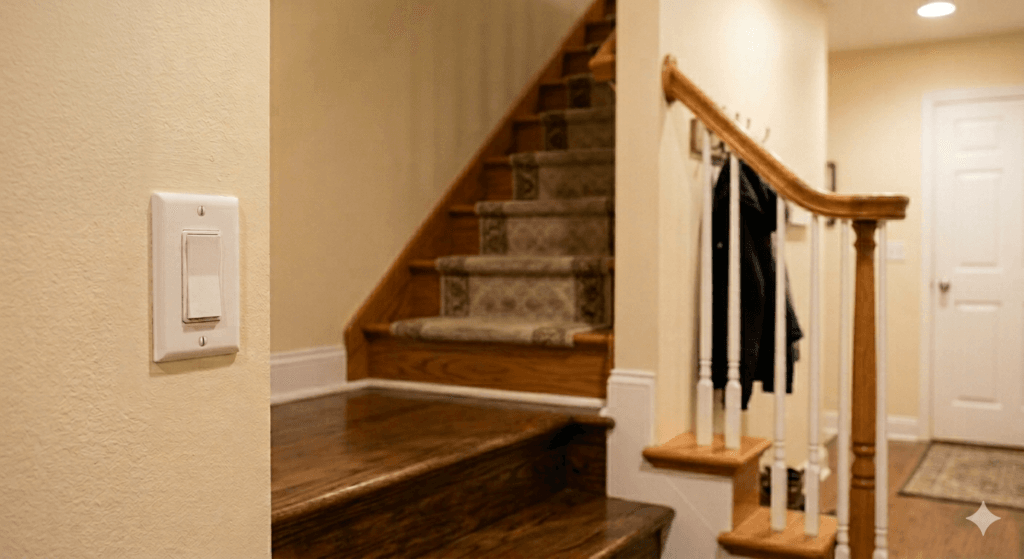
Many stair incidents begin before a person steps onto the stairs because they must navigate part of the staircase before reaching a switch.
A two-way switch system allows stair lighting to be controlled from:
- The top of the stairs
- The bottom of the stairs
This arrangement allows users to illuminate the staircase before beginning ascent or descent.
Benefits
- Can reduce the need to walk in darkness to reach a switch
- Improves convenience
- Encourages consistent light use
- Supports safer nighttime navigation
Retrofit Considerations
In some homes, installing two-way switches is relatively straightforward.
In others, additional wiring may be required.
Depending on the home’s electrical layout, installation may require a licensed electrician.
7. Smart Lighting Options for Aging in Place
Smart lighting technologies offer several ways to improve convenience and consistency.
Smart Bulbs
Smart bulbs can:
- Turn on automatically
- Follow schedules
- Adjust brightness levels
- Operate remotely
Voice-Controlled Lighting
Voice control may be helpful for individuals who:
- Have mobility limitations
- Frequently carry items on stairs
- Find switches difficult to reach
However, voice systems may not be practical for everyone and can introduce complexity that some users prefer to avoid.
Scheduled Lighting
Scheduled lighting can automatically illuminate stairways:
- During evening hours
- Overnight
- Before typical wake-up times
This creates a predictable environment without requiring user action.
Occupancy Sensors
Occupancy sensors can activate lighting when movement is detected and turn lights off afterward.
These systems reduce reliance on memory and daily routines.
Balancing Convenience and Complexity
Smart lighting offers substantial flexibility.
However, families should consider:
- Comfort with technology
- Reliability of internet-connected devices
- Ease of troubleshooting
- Long-term maintenance
The most advanced solution is not always the best solution.
For many households, a simple motion-activated light may provide greater practical value than a complex smart-home system.
8. When Lighting Alone Is Not Enough
Lighting improvements can address visibility problems.
They cannot correct every stair-related risk.
Additional concerns may include:
- Narrow stair dimensions
- Inconsistent step heights
- Missing handrails
- Poor stair geometry
- Significant visual impairment
- Balance disorders
- Strength limitations
- Neurological conditions
If stair use continues to feel difficult despite lighting improvements, broader interventions may be necessary.
In some cases, families may eventually evaluate options discussed in Stairlift vs First-Floor Living: Which Option Makes More Sense? when mobility limitations become more significant.
Similarly, lighting upgrades should be viewed as one component of overall stair safety rather than a complete solution.
Many households also discover additional environmental hazards identified in 5 Signs Stairs Are Becoming Dangerous in Your Home and The Most Dangerous Staircase Mistakes Families Often Miss.
Planning Beyond Lighting?
If stairs are becoming difficult even with better visibility, compare possible stairlift cost factors before speaking with installers.
9. Nighttime Stair Safety Checklist
Use this quick checklist during the evening, not during bright daytime conditions. The goal is to notice how the staircase actually feels when someone uses it at night.
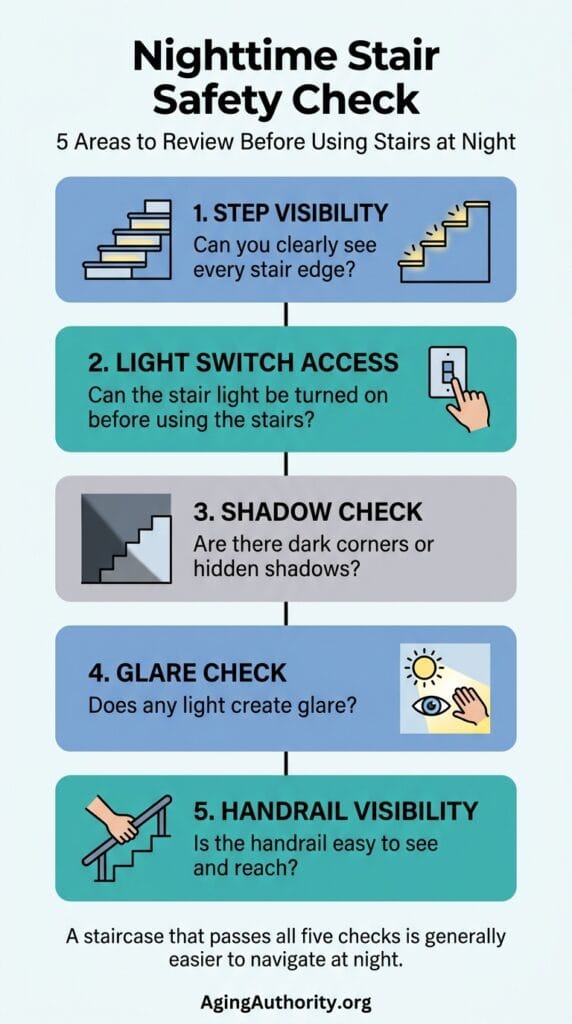
10. How to Check Nighttime Stair Safety in Your Own Home
Families can perform a simple evening assessment.
Step 1: Turn Off Daytime Lighting
Evaluate the staircase under conditions that resemble actual nighttime use.
Step 2: Observe Shadow Patterns
Look for:
- Dark corners
- Uneven illumination
- Areas where stair edges disappear
Step 3: Check Stair-Edge Visibility
Ask:
- Can each tread be clearly identified?
- Are transitions between steps obvious?
Step 4: Evaluate Switch Placement
Determine whether lights can be activated before reaching the staircase.
Step 5: Look for Glare
Notice:
- Bright spots
- Reflections
- Discomfort when looking toward fixtures
Step 6: Walk the Route Carefully
Observe whether hesitation occurs during:
- Ascending
- Descending
- Turning onto landings
This type of assessment often reveals issues that remain unnoticed during daylight hours.
11. When to Consider Professional Evaluation
Families may benefit from professional guidance when:
- Nighttime stair avoidance is increasing
- Lighting changes do not improve confidence
- Vision limitations are affecting navigation
- Multiple stair hazards exist
- Falls or near-falls have occurred
Professionals who may assist include:
Occupational Therapists
Can evaluate functional mobility and environmental barriers.
Home Safety Assessors
Can identify hazards throughout the home.
Accessibility Specialists
Can recommend modifications that support long-term independence.
Licensed Electricians
Can evaluate wiring, switch placement, and lighting upgrades safely.
Aging-in-Place Professionals
Can help prioritize improvements based on current and future needs.
A professional assessment may identify risks that are difficult for families to recognize independently.
Review Your Staircase Before Problems Escalate
A short stair safety review can help families notice lighting, handrail, visibility, and layout risks before they become part of a daily pattern.
12. Frequently Asked Questions
Are motion-sensor lights good for stairs?
Yes. Motion-sensor lighting can improve convenience and visibility by automatically illuminating stairs when movement is detected. They are often most useful for nighttime use.
Can brighter lights reduce fall risk?
Not necessarily. Adequate lighting is important, but excessive brightness can create glare. The goal is comfortable, even illumination that improves visibility without causing visual discomfort.
What color temperature is best for stair lighting?
Many homeowners prefer warm to neutral lighting because it provides comfortable visibility while reducing the harsh appearance sometimes associated with cooler light temperatures.
Do smart lights work well for older adults?
They can. However, effectiveness depends on the individual’s comfort with technology. Simpler systems may sometimes provide greater long-term usability.
When should staircase lighting be professionally evaluated?
Professional evaluation may be beneficial when nighttime stair avoidance increases, visibility concerns persist despite upgrades, or mobility and vision limitations are becoming more noticeable.
Published by AgingAuthority. AgingAuthority publishes practical, safety-focused aging-in-place guidance for families planning safer homes. Learn more about our editorial standards on the AgingAuthority Editorial Team page.
13. Sources
This article is informed by publicly available guidance, educational materials, and aging-in-place resources related to home safety, fall prevention, accessibility, environmental design, vision changes associated with aging, and residential lighting considerations.
- Centers for Disease Control and Prevention (CDC) – Older Adult Fall Prevention
- National Institute on Aging (NIA) – Falls and Falls Prevention
- MedlinePlus – Fall Prevention
- National Institute on Aging – Aging and Your Eyes
- American Occupational Therapy Association (AOTA) – Home Modifications
- Electrical Safety Foundation International (ESFI) – Electrical Safety Resources
- National Association of Home Builders (NAHB) – Certified Aging-in-Place Specialist Resources
- Illuminating Engineering Society (IES) – Lighting Guidance