
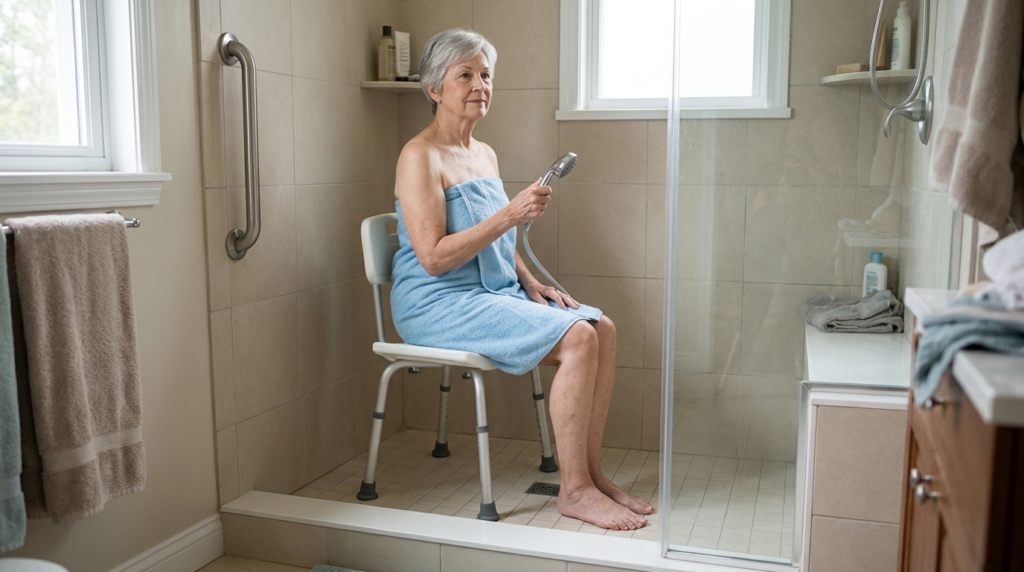
Can an Older Adult Safely Shower While Sitting Down?
Executive Summary
Showering while seated may reduce fatigue and the time an older adult spends balancing on a wet floor. But the most demanding moments may be getting onto the seat, reaching for supplies, and standing again. A shower chair, transfer bench, or built-in seat must suit both the person and the bathroom.
If someone has recent falls, fainting, significant transfer difficulty, or confusion, seating alone is not enough to establish that showering independently is safe.
A shower chair seems like a simple way to make bathing easier. But when is sitting actually safer, which type of seat makes sense, and what risks remain? This guide looks at the entire bathing routine rather than treating any one product as a complete solution.
1Is Showering While Sitting Down Safer for an Older Adult?
It can be safer for some people, but sitting is not a guarantee against falls or injury. A suitable shower chair or bench may reduce fatigue and the amount of time spent standing on a wet surface. It can also make washing easier for someone who struggles to reach their feet or maintain balance. But getting onto the seat, staying stable, reaching for supplies, and standing back up can introduce their own risks.
The practical question is not simply whether a person can sit. It is whether they can enter the bathing area, transfer onto a stable seat, wash without unsafe leaning, and exit safely. Someone who can sit comfortably in a dining chair may still have trouble transferring in a small, wet shower.
A person with new dizziness, repeated falls, severe weakness, or confusion needs individualized assessment rather than an assumption that a chair makes solo showering safe. Until the concern has been evaluated, a different bathing arrangement or appropriate assistance may be necessary.
2Why Sitting May Help: What It Does Not Fix
Less time balancing on a wet floor
For someone who tires while standing, sitting can reduce the period spent supporting their body weight on slippery flooring. It may allow them to wash at a slower pace without repeatedly shifting their feet.
Less bending and awkward reaching
A handheld showerhead and supplies positioned within comfortable reach may reduce twisting or bending. Sitting does not remove the need to reach, however. Leaning far forward or sideways can cause a lightweight seat to shift or tip.
The transfer remains the critical moment
Many problems occur before or after washing: stepping over a threshold, turning to sit, lowering onto the seat, standing again, and walking onto the bathroom floor. A chair cannot make these transitions safe by itself.
Medical symptoms still matter
Sitting may ease fatigue, but it does not treat fainting, sudden weakness, or medication-related lightheadedness. A person who loses consciousness can fall from a seat or be injured by hot water. New fainting or unexplained dizziness calls for medical assessment; sudden or severe symptoms may require emergency care.
3Shower Chair, Shower Bench, and Transfer Bench: What Is the Difference?
These products serve different layouts and abilities. Names vary by manufacturer, so look at the actual design and instructions rather than relying on a label.
| Equipment | Typical use | Important limitation |
|---|---|---|
| Shower chair | Freestanding seat placed inside a shower | Must fit the floor and enclosure; can shift if used incorrectly |
| Shower bench | A wider seat, sometimes built in or wall-mounted | Mounting and support requirements vary; not all benches are designed for transfers |
| Transfer bench | Seat that extends across a bathtub edge to support seated entry | Needs sufficient space and a suitable tub layout; transfers can still require assistance |
| Built-in shower seat | Permanent or folding seating integrated with the shower | Requires correct structural support and placement; may not suit every user |
A transfer bench is generally associated with getting across a bathtub wall, not automatically the best option for a low-threshold walk-in shower. For a person with significant transfer difficulty, an occupational therapist can help identify the right equipment and method.
4A Practical Safety Check Before Using a Shower Seat
Rather than asking someone to test a difficult movement in a wet bathroom, review these questions together. An uncertain answer calls for further assessment before relying on the setup for independent showering. Do not treat this checklist as proof of safety.
| Question | Why it matters | Possible next step |
|---|---|---|
| Can the person approach the seat without losing balance? | The entry and turn may be harder than sitting | Review entry design and support points |
| Can they lower themselves and rise without pulling on a towel rack or glass door? | Unrated fixtures can break or move | Assess transfers and grab-bar placement |
| Does the seat fit securely on the shower floor? | Uneven floors and poor fit can cause rocking | Check manufacturer instructions and floor compatibility; seek help with fitting if needed |
| Can they reach the water controls and soap without leaning far? | Reaching can destabilize the user or seat | Reposition controls and supplies |
| Can they manage the exit after becoming tired or warm? | End-of-shower fatigue can increase difficulty | Consider supervision or a revised routine |
| Can they reliably call for help if something goes wrong? | A seat does not solve emergency access | Create an appropriate assistance plan |
This checklist is a conversation aid, not a clinical clearance test. Do not encourage someone to demonstrate a movement that already feels unsafe.
5What to Look for in a Shower Chair
- Correct fit: the seat and legs must fit within the actual shower without blocking safe entry or drainage.
- Stable construction and load rating: use a shower-specific seat, follow the manufacturer’s weight capacity and assembly instructions, and never improvise supports or exceed its rating.
- Suitable non-slip feet: check that all feet make secure contact with the actual shower surface, including any slope, and inspect regularly for wear. Do not use a chair that rocks or slips.
- Appropriate seat height: when seated, the person should be able to maintain stable foot support as intended by the equipment; a very low seat may make rising difficult. Individual transfer needs may require professional assessment.
- Backrest and armrests when appropriate: these can be helpful for some users, but can also interfere with certain transfers.
- Accessible water controls: a handheld showerhead and reachable controls can reduce awkward movements.
- Easy cleaning: soap residue, mildew, loose components, and worn feet can change how securely the chair sits.
Not every feature is helpful for every person. An armrest that provides leverage for one user might obstruct a lateral transfer for another. The right choice depends on the person, the space, and how the equipment will be used. A chair should not be used as a step stool, climbing aid, or unsupported transfer device. If the person needs physical assistance to sit or rise, a caregiver should not attempt unsafe lifting without appropriate instruction.
6Do You Still Need Grab Bars With a Shower Chair?
Possibly, yes. A seat can reduce standing time, while a correctly positioned grab bar may provide a dedicated support point during entry, turning, sitting, and rising. The two address different parts of the bathing routine.
The placement matters more than simply having a bar somewhere on the wall. A bar that requires twisting or stretching may be less useful than one located along the natural path of movement. Bars must be installed according to product instructions and appropriate structural requirements; a towel rail, faucet, or glass door is not a safe substitute.
For a closer look at when handholds are needed, read Can an Older Adult Safely Use a Walk-In Shower Without Grab Bars?. If you are considering adding permanent support, see How Much Does Professional Grab Bar Installation Cost? for installation planning.
Request a Bathroom Quote in Your Area
Answer a few quick questions to request a quote. A bathroom provider serving your area may contact you to discuss your project.
Thank you!
Your bathroom quote request has been received.
If a provider is available for your project and area, they may contact you using the details you supplied.

7The Risks of Sitting Down and Standing Up
A seat can move
A freestanding chair may rock or slide if its feet are poorly adjusted, if the floor is uneven, or if the person pushes sideways against it. Confirm that the seat is compatible with the actual shower surface and follow the manufacturer’s instructions. If the chair rocks, slides, has damaged feet, or cannot sit securely on the slope, do not use it until the problem is resolved.
The person may not have enough strength to stand
Lowering onto a seat is not the same as getting up from it. Knee pain, weakness, fatigue, and a low seat height can make standing unexpectedly difficult, especially after a warm shower.
Leaning can cause a fall
Washing the lower legs, reaching for dropped soap, or grabbing a towel outside the enclosure can shift the person’s center of gravity. Keep commonly used items within easy reach and avoid asking the person to retrieve objects from the floor.
A transfer bench needs a matching technique
For a bathtub, a transfer bench may help a person move across the tub wall while seated, but it must fit the tub and the user. Someone with significant transfer limitations should receive individualized guidance and, where needed, hands-on assistance before using it. Avoid attempting an unassessed transfer on a wet floor.
8Three Real-Life Scenarios
1. Tired after a few minutes of standing
An older adult walks independently but finds that standing through an entire shower is exhausting. A properly fitted seat and handheld showerhead may make washing more manageable. The family should still consider how the person sits down and gets up, particularly at the end of the shower.
2. Can sit comfortably but struggles to rise
Another person sits without difficulty yet needs to pull on the shower door to stand. Buying a chair alone does not address the dangerous transfer. This situation calls for reassessment of seat height, support points, and whether assistance or a professional evaluation is needed.
3. Sometimes becomes dizzy
A person who feels faint in warm showers may prefer sitting, but dizziness is not solved by a chair. Medical evaluation and a safer temporary bathing arrangement should come first. If fainting occurs, the person may be unable to protect themselves even while seated.
9When Sitting Alone Is Not Enough
A shower seat should not be used as a reason to ignore warning signs. Repeated near-falls, inability to transfer without substantial help, confusion about the bathing sequence, unpredictable dizziness, or a recent change in mobility may mean that showering alone is not currently appropriate.
An occupational therapist can assess the complete task, including the approach to the shower, transfers, reaching, and the ability to exit. A healthcare professional can evaluate possible medical contributors such as dizziness or weakness. A contractor can advise on the feasibility of grab-bar installation and layout changes; this is a different role from assessing functional ability.
Call emergency services immediately for sudden one-sided weakness or facial drooping, difficulty speaking, new severe confusion, severe chest pain, or loss of consciousness. Do not attempt to solve these symptoms with a chair or bathroom renovation. After a fall, do not forcibly lift someone who may have a head, neck, back, or other serious injury; seek urgent help and follow emergency guidance.
10How Bathroom Layout Changes the Decision
A seat that works in a spacious curbless shower may not fit a compact enclosure with a hinged door. The location of the drain, slope of the floor, shower controls, and distance to the dry area all influence safe use.
- Entry width: is there room to approach and turn without bumping the door or walls?
- Threshold: does the user have to lift a foot or navigate a track before reaching the seat?
- Floor slope: can the seat stand as intended without rocking or slipping?
- Water reach: can the user control temperature and spray without leaning or standing?
- Exit route: is there a clear, well-lit path to a dry surface, towel, and clothing?
- Caregiver access: if help is needed, does the enclosure allow it without awkward lifting or reaching?
A full remodel is not always necessary, but sometimes a cramped or poorly arranged shower makes accessory-only solutions impractical. Compare the specific problems and costs before deciding. For a broader look at bathroom layouts, access, and modification priorities, see our Bathroom Modifications for Aging in Place guide.
11How to Choose a Safer Bathing Setup
Start with the task that is difficult rather than the product that looks convenient. If the challenge is standing endurance, seating may help. If it is stepping into the enclosure, entry design and a support point may be more important. If it is transferring from a wheelchair or managing severe weakness, specialized guidance may be necessary.
- Identify when the person feels unstable: entry, standing, washing, sitting, rising, or exit.
- Ask about near-falls and changes in health, rather than relying only on whether a fall has occurred.
- Choose equipment for the actual dimensions and surfaces of the bathroom.
- Check installation, weight limits, and maintenance instructions for every product.
- Plan for privacy and independence while matching the amount of assistance to real needs.
- Reassess after illness, a fall, medication changes, or a noticeable decline in mobility.
If the main question is whether someone should bathe independently at all, read Is It Safe for an Older Adult to Shower Alone?. For the wider decisions around remaining safely at home, explore our Aging in Place guide.
12Preserving Privacy and Independence
Some people avoid shower seats because they associate them with losing independence. A more useful framing is that the right equipment can make a familiar routine less tiring and more comfortable. The person should be involved in decisions about the seat, assistance, and bathroom changes whenever possible.
At the same time, privacy should not become a reason to overlook clear hazards. Someone who needs hands-on help to transfer may not be safe simply because another person is somewhere in the house. The arrangement should be based on the ability to complete each step and obtain timely help if needed.
The goal is a workable routine, not a universal rule that every older adult should sit, or that sitting automatically makes solo showering safe.
Bathroom Modification Planner
Compare shower seating, support options, and accessibility changes with the Bathroom Modification Planner before speaking with a contractor.
Explore the Bathroom Planner →Planning resource only; not a clinical safety assessment.
13Frequently Asked Questions
Is it safer for older adults to shower sitting down?
It may reduce standing-related fatigue for some people, but transfers, reaching, seat stability, and medical conditions still matter. A seat does not guarantee fall prevention or make independent bathing safe for everyone.
Can an older adult use a shower chair without grab bars?
Some may be able to, but a chair does not provide a secure handhold for transfers. If the person pulls on a towel rack, shower door, or other unsuitable fixture to sit or rise, pause that unsafe arrangement and seek an assessment of appropriate support.
What is the difference between a shower chair and a transfer bench?
A shower chair typically sits inside a shower. A transfer bench usually spans a bathtub edge so a person can move across the wall while seated. The appropriate option depends on the layout and the person’s abilities.
Should a shower chair have a back and arms?
A backrest or armrests may help some people but can interfere with certain transfers. A compatible seat height, weight rating, stable footing, and an individually appropriate transfer method matter more than choosing every feature.
Can someone with dizziness shower safely while sitting?
Sitting does not prevent fainting or a fall from the seat. Unexplained or recurring dizziness needs medical evaluation; avoid showering alone while the risk remains unresolved. Sudden severe symptoms may require emergency services.
When should a family ask an occupational therapist about shower seating?
Consider an assessment after a fall or near-fall, when sitting or standing transfers are difficult, when mobility changes, or when the household is unsure which seating, grab bars, and assistance fit the person and bathroom.
14Sources and Further Reading
- MedlinePlus: Bathroom Safety for Adults: guidance on shower chairs, grab bars, dry floors, and occupational therapy referrals.
- National Institute on Aging: Preventing Falls at Home: Room by Room: bathroom traction and handhold recommendations.
- CDC: Older Adult Falls: risk factors and fall-prevention information.
- National Institute on Aging: Falls and Fractures in Older Adults: prevention and warning signs.
- MedlinePlus: Falls: overview and additional health resources.
- U.S. Access Board: Accessibility Standards: technical reference for accessible design; private homes and individual needs may differ.
These sources provide general principles, not a specific product endorsement or a substitute for personalized medical and installation advice.
15The Bottom Line
Showering while sitting down can be a practical safety improvement for an older adult who tires or struggles to stand. The benefit depends on whether the person can reach the seat, transfer onto it, wash without unsafe leaning, and exit the bathroom safely.
A correctly chosen shower chair, appropriate grab bars, reachable controls, and a suitable layout may work together. When falls, dizziness, severe weakness, or cognitive difficulties are involved, seek individualized guidance instead of assuming a seat is enough. Never ask someone to test an unsafe transfer just to see whether the chair works.
Editorial note: Prepared by the AgingAuthority Editorial Team using public fall-prevention and bathroom-safety guidance. This article has not been represented as individually medically reviewed. The cited sources describe general safety principles, not a clinical clearance test for any one person.
Safety note: General educational information only. This article does not replace individualized medical advice, occupational therapy assessment, or product-specific installation guidance. Call emergency services for urgent symptoms.