
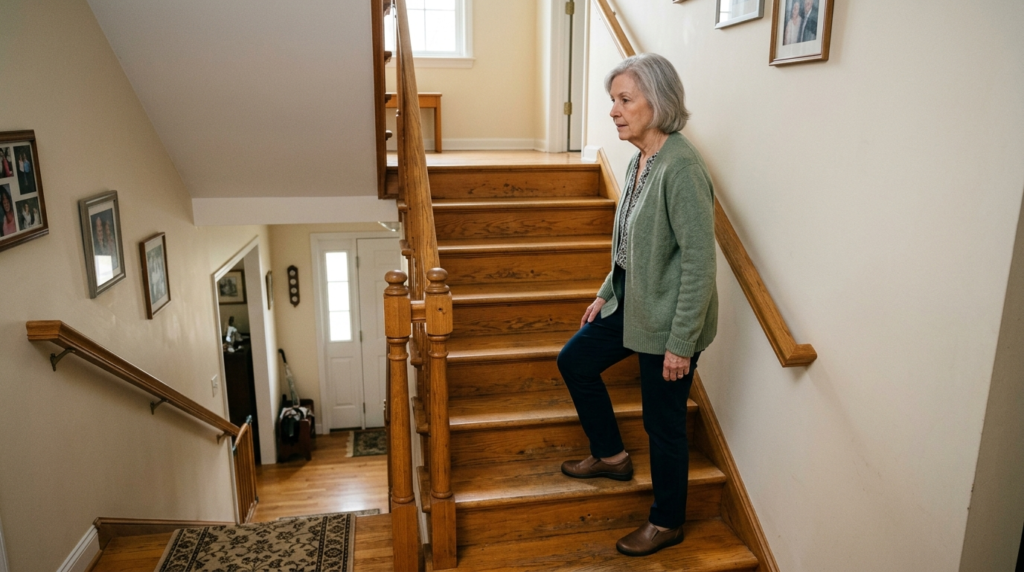
For a complete overview of safer stairs, explore our Complete Stair Safety Guide for Aging in Place .
Is It Safe for an Older Adult to Use Stairs Alone?
The right answer depends on how reliably a person manages the full staircase, not simply their age. Here are the warning signs, environmental hazards, and decisions that matter.
Executive Summary
Some older adults can use stairs alone safely; others need assistance or changes to the home. Look at balance, strength, step visibility, handrails, recent falls, dizziness, and whether the person can manage both ascent and descent consistently.
A handrail or stairlift may help with particular problems, but neither guarantees safety or replaces medical assessment when symptoms are involved.
1 Is It Safe for an Older Adult to Use Stairs Alone?
Sometimes, but the answer depends on the person and the staircase, not age alone. Some older adults climb stairs independently with good control, while others may be at significant risk even on a familiar flight. The key questions are whether they can manage every step, turn, landing, and handrail consistently, and what happens if they become tired, dizzy, or distracted.
A staircase can feel manageable on a good day but become difficult when carrying something, rushing to answer the door, wearing unsuitable footwear, or returning downstairs after a long day. Descending can be particularly demanding because the person must control their weight while judging the next step.
This guide helps families recognize warning signs, assess the home environment, and decide when a professional evaluation or modification is warranted. It is not a test that certifies someone safe to use stairs alone.
2 Warning Signs That Solo Stair Use May Be Unsafe
Observe everyday patterns without asking someone to demonstrate a risky maneuver. One incident may not establish the cause, but repeated difficulty is a reason to act.
| What you notice | Why it matters | Practical response |
|---|---|---|
| Holding the rail with both hands or pulling hard | May indicate reduced strength, balance, or confidence | Discuss functional assessment and reliable handrail support |
| Pausing frequently or becoming breathless | Fatigue or a medical issue may reduce control | Seek clinical advice, particularly if symptoms are new |
| Missing a step, tripping, or nearly falling | Foot clearance or step judgment may be unreliable | Review lighting, treads, footwear, and mobility |
| Avoiding the stairs or moving sideways | May signal pain, fear, or difficulty with the layout | Ask what movement feels difficult; consider evaluation |
| Carrying items while needing the rail | Hands may not be available for secure support | Change how items are transported |
| New confusion, dizziness, or faintness | A health problem may be contributing | Seek medical assessment before relying on solo stair use |
After a fall or near-fall: do not assume the person is safe simply because they reached the top or bottom without injury. Reassess the circumstances and whether assistance is needed.
3 Why Stairs Become More Difficult
Balance and strength can vary from day to day
Climbing requires leg strength and coordination; descending requires controlled lowering and accurate foot placement. Arthritis, reduced sensation, weakness, vision changes, and medication effects can alter how reliably a person manages these tasks. Not everyone experiences these changes, and a diagnosis alone does not tell you whether solo use is safe.
The environment can create avoidable hazards
Poor lighting, inconsistent step edges, worn carpet, loose runners, clutter on landings, and missing or difficult-to-grip handrails can increase the challenge. A narrow or winding staircase may require a different strategy from a broad straight flight.
The task matters as much as the stairs
Carrying laundry, holding a phone, using a walking aid, or rushing can change a familiar trip. A person who manages the stairs with one hand on a secure rail may struggle when that hand is occupied.
4 Going Upstairs vs. Coming Downstairs
| Situation | Going up | Coming down |
|---|---|---|
| Leg demands | Requires lifting body weight to the next step | Requires controlled lowering and balance |
| Vision and foot placement | Must clear the front edge of each tread | Must judge the edge and placement of the lower step |
| Fatigue | Can build toward the top | May be present before descent begins |
| Loss of balance | Can occur while pushing upward | Can occur while shifting weight downward |
Neither direction is universally safer. A person may find ascent painful because of knee or hip weakness, while descent feels less secure because of balance or depth perception. Ask which direction causes difficulty rather than treating stair use as a single ability.
If someone cannot safely descend, the fact that they can climb up is not enough to support independent access to an upper floor. Consider the entire round trip and the possibility of an urgent need to leave the home.
5 How Much Difference Do Handrails Make?
A secure, graspable handrail provides a consistent support point, but its usefulness depends on continuity, location, the person’s grip, and whether it is properly installed. A decorative banister or unstable railing should not be assumed to provide reliable support.
- Continuity: assess whether a person can maintain support across the flight and at the top and bottom transitions.
- Reach and grip: the rail should be usable by the person, not merely present on the wall.
- Condition: loose rails, brackets, or damaged treads need professional attention.
- Both sides: a second rail may help some people, but it is not a substitute for an individualized assessment.
Do not advise someone to attempt a difficult staircase simply because a handrail has been added. A rail cannot prevent fainting or compensate for every balance or mobility limitation.
The National Institute on Aging recommends secure handrails on both sides of stairs, along with good lighting and keeping the steps clear. A qualified professional should evaluate installation and local building requirements. A second rail can improve the environment without establishing that independent stair use is appropriate for every person.
6 A Staircase Safety Review Families Can Do
This is a visual and planning checklist, not a physical performance test. Do not ask an older adult to climb stairs specifically to prove they can do so.
| Area | What to look for | What to discuss |
|---|---|---|
| Lighting | Dark steps, shadows, difficult-to-find switches | Better lighting at both ends and along the route |
| Handrails | Loose, interrupted, or hard-to-grasp support | Professional inspection or suitable upgrades |
| Step surfaces | Loose carpet, curled runner edges, slick finishes | Repair and appropriate traction |
| Edges and geometry | Hard-to-see nosings or irregular step heights | Visibility and professional assessment |
| Landings | Shoes, baskets, cords, or furniture in the path | Clear, usable turning space |
| Daily routine | Carrying loads, rushing, fatigue, nighttime trips | Alternative storage and assistance plans |
Small improvements can address environmental hazards, but they do not automatically make independent stair use safe for someone with significant physical or medical limitations.
Also check whether a person can reach light switches at both ends of the staircase and whether the rail remains usable through the first and last steps. Ask a qualified contractor to review loose treads, rail fixings, or unusual stair geometry rather than attempting a structural repair without suitable expertise.
Compare Stairlift Quotes in Your Area
Answer a few quick questions to find stairlift providers serving your area and compare your options.
Thank you!
Your stairlift quote request has been received.
7 When a Health Concern Changes the Decision
New dizziness, fainting, sudden weakness, marked shortness of breath, or a change in walking ability should not be treated only as a staircase problem. Ask a healthcare professional to assess possible causes and whether stair use should be restricted temporarily.
Emergency warning signs: sudden one-sided weakness, difficulty speaking, chest pain, loss of consciousness, or severe new breathing difficulty require emergency medical help. Do not attempt to manage these symptoms by installing equipment or practicing stairs.
A physical therapist may assess strength, gait, balance, and stair negotiation. An occupational therapist may assess the home routine, task demands, and practical alternatives. An appropriate assessment is especially valuable after hospitalization, a fall, or a meaningful change in mobility.
8 Three Realistic Stair Safety Scenarios
1. Steady on the stairs, but carries laundry
A person climbs and descends steadily while holding the handrail, yet routinely carries a full laundry basket with both hands. The immediate improvement may be changing how laundry moves between floors. The household should not assume the ability observed with a free hand applies while carrying a load.
2. Comfortable climbing, hesitant descending
Another person reaches the upper floor without difficulty but pauses at every step on the way down. The family should take the difficulty seriously, review visibility and support, and consider a mobility assessment before continuing to rely on unsupervised trips.
3. Recent fall and new dizziness
A person has recently fallen and now reports unpredictable dizzy spells. Better lighting or a second rail may help the environment, but these changes do not resolve the medical concern. Independent stair use may need to be paused while a clinician evaluates the symptoms and an appropriate assistance plan is made.
9 Options When Independent Stair Use Is No Longer Reliable
The appropriate response depends on the source of difficulty and whether the change is temporary or ongoing. There is no single product that works for every staircase or every person.
| Option | Potential benefit | Important limitation |
|---|---|---|
| Repair lighting, treads, or handrails | Addresses identifiable environmental hazards | Does not treat balance or medical problems |
| Move essential activities to one floor | Reduces the number of necessary stair trips | May require bathroom or bedroom changes |
| Arrange assistance with stair trips | Provides support when the person needs help | Requires reliable availability and a safe assistance method |
| Professional mobility or home assessment | Clarifies which tasks and modifications are appropriate | Recommendations must be matched to the home |
| Stairlift assessment | May reduce the need to climb a flight | Safe transfers, landing space, and emergency arrangements still matter |
A stairlift is not automatically the right solution. A person must be able to get on and off the seat safely, use the controls appropriately, and manage the top and bottom landings. Ask a qualified provider to assess the staircase and the intended user; seek clinical input if transfer ability is uncertain.
Do not improvise assisted lifting on stairs. A family member holding someone by the arm, or two people attempting to carry a person, can put both the older adult and helpers at risk. Ask a clinician or rehabilitation professional about an appropriate assistance and transfer plan. If stairs cannot be used reliably, consider temporarily arranging essential activities on an accessible level.
10 When to Consider a Stairlift Assessment
If stairs have become a recurring barrier and the household wants to continue using both floors, a stairlift assessment may be worth discussing. The decision should consider the whole journey, not only the rail: boarding, seat position, parking, transfers, doors, and other household members who use the stairs.
Request a written proposal that identifies the model, rail route, installation scope, service arrangements, and any work required before fitting. Compare proposals based on the same household needs and assumptions.
Related AgingAuthority guides include Aging in Place and Bathroom Modifications for Aging in Place. The latter can help when moving essential activities to one level involves bathroom changes.
Important stairlift limits: Safe boarding and exiting, seat-belt use, controls, footrest clearance, and the user’s ability to remain seated must be assessed. A stairlift is not a substitute for an emergency evacuation plan. Discuss power outages, battery operation where available, maintenance, and how other occupants can use or pass the staircase with the provider. Never assume someone who cannot transfer safely can use a stairlift independently.
11 How to Discuss Stair Safety Without Taking Away Independence
Start with a specific observation: “I noticed the last few steps seem difficult,” rather than “You are too old for stairs.” Ask what the person experiences, including pain, fear, fatigue, or trouble seeing step edges. Their perspective matters, and a conversation is more useful than an argument over whether they are “allowed” to climb.
Agree on practical boundaries when needed, such as avoiding carrying loads or arranging help for certain trips, while professional assessment is pending. The aim is to preserve choice where it is reasonably safe and respond early when conditions change.
Revisit the plan after illness, medication changes, falls, or a change in strength. Stair safety is not a permanent yes-or-no label.
12 Frequently Asked Questions
Can a healthy older adult use stairs alone?
Yes, some older adults can use stairs independently. The decision depends on their actual balance, strength, health, and the condition of the staircase, not age alone.
Is going downstairs more dangerous than going upstairs?
Descending can be especially demanding because it requires controlled lowering and accurate step placement, but the harder direction varies by person. Assess both directions.
Does adding a second handrail make stairs safe?
A properly installed second rail may improve support for some people, but it does not address every risk, including dizziness, severe weakness, or inability to negotiate steps.
Should an older adult use stairs after a fall?
A recent fall or near-fall warrants reassessment before another unsupervised stair trip. If there may be a head, neck, back, or hip injury, do not force the person to stand or move; seek urgent medical help. Whether independent stair use can resume depends on the cause, injuries, current function, and guidance from appropriate professionals.
Can a stairlift replace the need to use stairs?
A stairlift may reduce the need to climb steps, but it still requires safe boarding, transfers, landings, and appropriate operation. It does not replace an evacuation plan, and the provider should explain what happens during a power outage or equipment fault.
When should families seek a physical or occupational therapy assessment?
Seek guidance when there are repeated near-falls, new difficulty climbing or descending, uncertainty about assistance, or changes in mobility after illness or hospitalization.
13 Sources and Further Reading
- National Institute on Aging: Preventing Falls at Home, Room by Room Specific guidance on stair handrails, lighting, and clear routes.
- CDC: Preventing Falls and Hip Fractures Fall-prevention actions including railings on both sides of stairs.
- CDC STEADI Clinical resources for assessing fall risks.
- MedlinePlus: Falls Patient-focused information on risk factors and prevention.
These references support general safety principles. They do not certify any specific person or staircase as safe.
14 The Bottom Line
Using stairs alone can be reasonable for an older adult who can consistently manage the complete route. The warning signs are not a particular birthday but near-falls, difficulty descending, reliance on unsuitable fixtures, new symptoms, and a staircase that no longer supports safe movement.
Address visible hazards, change risky routines, and seek an individualized assessment when the person’s ability is uncertain. If climbing stairs is no longer reliable, compare assistance, one-level living arrangements, and professionally assessed equipment options rather than waiting for a serious fall.