
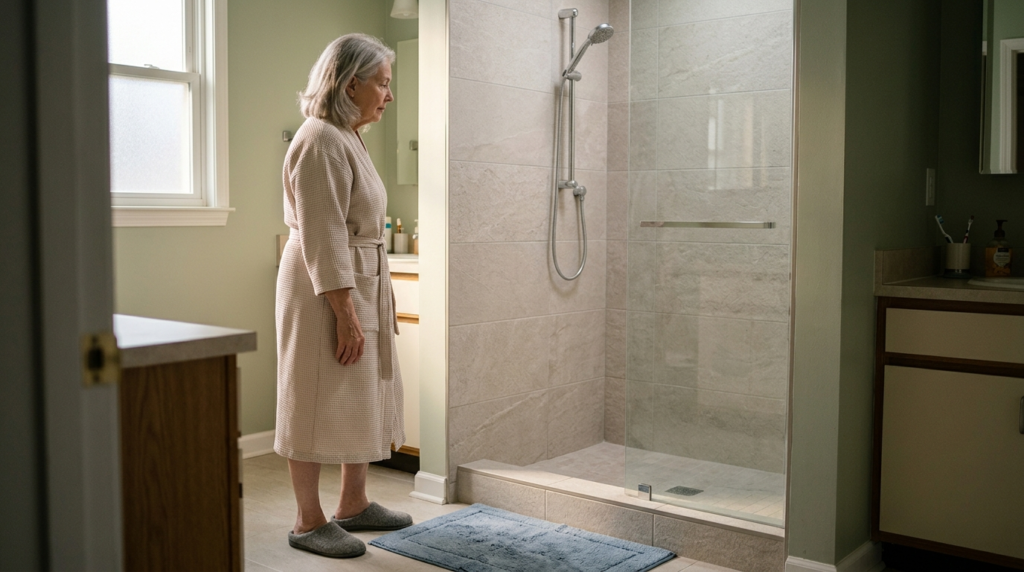
Can an Older Adult Safely Use a Walk-In Shower Without Grab Bars?
Executive Summary
Some older adults may manage a walk-in shower without grab bars, but this cannot be assumed safe based on age, a low entry, or the absence of previous falls alone. Balance, recent falls, dizziness, transfers, and the ability to turn and exit matter. Properly installed grab bars can offer support at critical moments, while a shower seat, suitable flooring, and medical or occupational therapy evaluation may address other risks.
If someone is grabbing a shower door or towel rack, experiencing dizziness, or struggling to move safely, reassess the routine before relying on independent showering.
A walk-in shower looks easier to access than a bathtub. But does removing the tub wall mean grab bars are optional? Here is how to evaluate the real risks, recognize warning signs, and choose practical changes without sacrificing independence.
1Is a Walk-In Shower Safe Without Grab Bars?
Sometimes, but not for everyone. A walk-in shower can reduce the need to climb over a bathtub wall, although some walk-in designs still have a raised threshold. It does not remove the risk of slipping, losing balance, or needing support while turning, washing, and stepping back out. Whether someone can use one without grab bars depends on their abilities, the bathroom layout, and what happens during the entire routine.
An older adult who moves confidently, has no recent falls or dizziness, and can enter and exit without reaching for nearby fixtures may have a different risk profile from someone who uses the wall or shower door to steady themselves. Age alone is not a reliable test.
The important distinction is between not currently needing to hold a bar and having a reliable support point if balance changes. A person may manage today’s shower without help but still benefit from a well-placed, securely installed grab bar.
2Why a Low-Entry Shower Can Still Be Risky
Wet surfaces and changing traction
Soap, shampoo, water, and a smooth floor can make footing less predictable. A low threshold reduces one obstacle, but it does not guarantee slip resistance or prevent a fall. Flooring, drainage, cleaning products, and footwear all influence traction.
Turning, bending, and closing the eyes
Showering involves movements that are easy to underestimate: reaching behind the body, looking upward to rinse hair, bending toward the feet, and briefly closing the eyes. Each can challenge balance even when ordinary walking feels comfortable.
The step out may be harder than the step in
After a warm shower, some people may feel tired or lightheaded; new or recurring lightheadedness deserves medical assessment, not just a change in bathroom equipment. They must then turn, manage a wet threshold, reach for a towel, and move onto a different floor surface. The transition between wet and dry areas deserves as much attention as the shower interior.
A shower door is not a handhold
Glass doors, towel racks, faucets, and shelves are not substitutes for grab bars designed and installed to take a person’s weight. Grabbing an unsuitable fixture during a slip can create an additional hazard.
3Signs Grab Bars Deserve Serious Consideration
Look at what the person actually does, not only what they say they can do. These signs suggest that the current arrangement needs review:
| Situation | What it means | Safer response |
|---|---|---|
| Reaches for the wall, tap, or door | Support is already being sought during movement | Discuss grab-bar placement and have the shower assessed |
| Has slipped, nearly fallen, or fallen recently | Balance or traction may be unreliable | Reassess independent showering and seek appropriate clinical guidance |
| Struggles to turn or wash the lower body | The routine involves unstable movements | Consider seating, handheld controls, and support points |
| Has arthritis, weakness, or uses a walking aid | Transfers may demand more stability than walking | Request an individualized occupational therapy assessment |
| Reports dizziness or faintness | A medical issue may be involved | Avoid showering alone while unresolved and seek medical evaluation |
| Has trouble following the sequence of bathing | Judgment or ability to summon help may be affected | Discuss supervision and medical evaluation |
A single observation is not a diagnosis. New problems, repeated near-falls, and sudden changes in function call for prompt reassessment. After a fall or near-fall that makes transfers uncertain, pause showering without appropriate help until the situation has been evaluated. Do not ask someone to demonstrate a movement that already looks unsafe.
4Walk-In Shower With vs. Without Grab Bars
The main difference is not appearance. It is whether a purpose-built, securely anchored support point is available where the person needs it.
| Consideration | Without grab bars | With properly installed grab bars |
|---|---|---|
| Entering and exiting | No dedicated handhold | A support point may assist with the transition |
| Turning or changing position | Relies on balance alone or unsafe fixtures | May offer a stable handhold in selected locations |
| Slippery flooring | Slip hazard remains | Slip hazard still remains; bars do not make flooring slip-proof |
| Dizziness or fainting | Not addressed | Not prevented by bars |
| Installation and layout | Fewer fixtures | Requires correct positioning and secure anchoring |
Grab bars are one layer of protection, not a promise that a person can shower independently. The right combination may also involve a shower seat, a handheld showerhead, better lighting, or another person’s assistance.
5Where Grab Bars May Be Most Useful
At the shower entrance
A support point near the entrance may help someone manage a small threshold or change of floor surface. Its location should match the direction of entry and the person’s natural hand movement.
Inside the shower
A bar near the area used for washing may help with turning or changing position. Vertical, horizontal, and angled configurations serve different movement patterns; there is no single placement that works for every person.
Near a shower seat
If a person uses a seat, they may need support while sitting down and standing up. The seat, bar, floor, and reachable controls should be considered together. A bar placed too far away can encourage unsafe reaching.
Installation matters: A grab bar must be appropriate for the intended weight-bearing use, with its fasteners and wall construction evaluated and installed according to the manufacturer’s instructions and applicable building requirements. A qualified installer should confirm that the mounting surface can support the intended loads; do not assume tile or drywall alone is sufficient. Decorative towel bars and suction-cup handles should not be treated as equivalent to securely installed grab bars.
6What Else Makes a Walk-In Shower Safer?
Grab bars work best when the rest of the environment supports safe movement. Prioritize changes based on the problem observed rather than buying every accessory available.
- Floor traction: choose a shower floor designed for wet use, maintain it appropriately, and address standing water.
- Shower seating: use a stable, appropriately rated and correctly sized chair or built-in seat only as directed by its manufacturer. The feet must suit the shower surface, the seat must fit the space, and the person must be able to sit and rise safely; some people need trained assistance for transfers. Seating does not prevent fainting or eliminate transfer risks.
- Handheld showerhead: reduce the need to turn, stretch, or tilt the head.
- Reachable controls and supplies: keep essentials within easy reach without encouraging twisting or bending.
- Lighting and clear pathways: make the transition from shower to dry floor visible and free of clutter.
- Water temperature: consider professionally assessed temperature-limiting controls, particularly when sensation, reaction time, or judgment is reduced. Do not assume a specific setting suits every household or local plumbing system.
If the person needs to pull hard on a fixture to stand, cannot safely transfer to a seat, or has unpredictable loss of balance, accessories alone may not be sufficient. A professional assessment can identify a more suitable plan.
Request a Bathroom Quote in Your Area
Answer a few quick questions to request a quote. A bathroom provider serving your area may contact you to discuss your project.
Thank you!
Your bathroom quote request has been received.
If a provider is available for your project and area, they may contact you using the details you supplied.

7When Grab Bars Are Not Enough
A grab bar cannot prevent fainting, treat dizziness, reverse severe weakness, or make confusion harmless. These issues change the decision from a bathroom-design question into a health and support question.
For persistent dizziness, medication-related lightheadedness, significant fatigue, or repeated falls, ask a healthcare professional to evaluate the cause. An occupational therapist can assess transfers, bathing movements, and the environment; a physical therapist may help evaluate mobility and balance.
Urgent warning signs: sudden one-sided weakness or numbness, facial drooping, trouble speaking, sudden confusion, chest pain, loss of consciousness, or severe breathing difficulty may be emergencies. Call local emergency services immediately; do not wait to see whether the symptoms resolve. If someone has fallen and a head, neck, back, or hip injury is possible, do not force them to stand or move them unnecessarily; follow emergency-dispatch guidance. Do not treat these symptoms as problems to solve with a bathroom modification.
Until an unresolved risk is evaluated, the safer arrangement may include supervision or hands-on help rather than independent showering.
8Three Realistic Household Scenarios
1. Independent and steady, but the shower has no handholds
An older adult walks independently, has no recent falls, and enters a low-threshold shower comfortably. This situation does not by itself establish that showering alone is unsafe, but it also cannot establish that showering without support will remain safe. Still, discussing preventive installation may be sensible, particularly if the bathroom is being renovated.
2. Uses the shower door to turn around
The person says they do not need help, yet regularly grabs the glass door when changing direction. That behavior is an important warning sign. The family should avoid treating the door as support and arrange an assessment of safe handhold placement and the overall bathing routine.
3. Has occasional dizzy spells
Even with well-installed grab bars, a person who becomes suddenly lightheaded may not be able to react in time. Medical evaluation and a temporary change to the showering arrangement are more important than assuming a bar solves the problem.
9When to Ask for an Occupational Therapy Assessment
An occupational therapist can observe or discuss the sequence of bathing tasks and recommend changes that match the person’s strength, reach, balance, cognition, and bathroom layout. Consider this when:
- There has been a recent fall, near-fall, hospitalization, or major change in mobility.
- A person needs help entering, turning, sitting, or standing.
- The family disagrees about whether independent showering is safe.
- A remodel is being planned and bar placement, seating, or entry design is uncertain.
- Equipment has been purchased but does not seem to fit the person or space.
A contractor can advise on structural feasibility and installation; that is different from evaluating a person’s functional ability. For complex cases, the two perspectives should inform the same plan.
10How to Decide What to Change First
Start with the highest-risk moment. If the person reaches for a towel rack at the entrance, address safe support there. If standing causes fatigue, evaluate seating and transfers. If dizziness occurs, prioritize medical assessment before assuming a renovation will solve it.
- Observe the entire routine only with the person’s consent and without asking them to demonstrate a risky movement.
- Record specific difficulties: entry, turning, reaching, standing, exit, or getting help.
- Discuss privacy and what level of assistance feels acceptable.
- Match equipment to the individual and have structural supports installed correctly.
- Reassess after illness, a fall, medication changes, or changes in mobility.
For related planning, see How Much Does Professional Grab Bar Installation Cost? and Is It Safe for an Older Adult to Shower Alone?. If either URL differs on your site, update the link before publishing.
11Supporting Independence Without Making Promises
Many older adults understandably want privacy. A practical conversation focuses on the exact task that has become difficult rather than making a broad judgment about age or independence.
Someone may be comfortable washing independently but want help getting in and out. Another person may prefer someone within calling distance. When balance, cognition, or health problems make a fall or emergency difficult to manage, nearby availability may not be enough. The level of support should match the actual risk.
The goal is not to install the most equipment or remove every independent task. It is to create a bathing routine that is workable, respectful, and responsive to changing abilities.
Bathroom Modification Planner
The Bathroom Modification Planner helps families document bathing concerns, compare modification options, and prepare questions before speaking with a contractor.
Get the Bathroom Planner →Digital planning resource; not a substitute for clinical advice or a professional safety assessment.
12Frequently Asked Questions
Are grab bars required in every walk-in shower for an older adult?
Not in every private home as a universal rule. Applicable accessibility standards, building codes, and project requirements vary. Needs also differ by mobility, balance, and bathroom design. The National Institute on Aging recommends bathroom grab bars for fall prevention, and a qualified assessor can advise on placement.
Can a walk-in shower be safe without grab bars if it has a non-slip floor?
A floor designed for wet traction may reduce slipping risk, but it cannot prevent all falls or provide support during a loss of balance. Entry, turning, reaching, and exit still need consideration.
Is a shower chair enough without grab bars?
Not always. A chair may reduce standing demands, but it does not eliminate the risk of falling while sitting down, getting up, or entering and exiting. Use only an appropriately rated and stable seat according to the manufacturer’s instructions; some people need transfer assistance or professional assessment.
Can suction grab bars replace permanently installed bars?
No. Do not rely on suction-cup handles as an equivalent substitute for a correctly installed, weight-bearing grab bar. Suction can fail, and device limitations vary. Follow the manufacturer’s warnings and arrange a secure, professionally assessed mounting solution when dependable support is needed.
Where should grab bars go in a walk-in shower?
Placement depends on the entry, washing area, seating, wall construction, and how the person moves. A qualified professional can help determine locations and appropriate installation.
When should an older adult stop showering alone?
A recent fall, repeated near-falls, fainting, unresolved dizziness, significant transfer difficulty, or new confusion are reasons to pause showering without appropriate assistance and obtain an individualized assessment. Sudden confusion or stroke-like symptoms require emergency care.
13Sources and Further Guidance
- National Institute on Aging — Preventing Falls at Home: Room by Room: bathroom grab-bar and slip-prevention recommendations.
- CDC — Older Adult Falls: fall risks and prevention guidance.
- National Institute on Aging — Falls and Fractures in Older Adults: risk factors and prevention.
- MedlinePlus — Falls: patient-oriented information and related resources.
- U.S. Access Board — ADA Accessibility Standards: technical accessibility reference; residential needs and local codes may differ.
These references support general fall-prevention and accessibility principles. The ADA standards do not automatically apply to every private residential bathroom. They do not replace an individualized clinical assessment or a site-specific installation plan.
14Final Considerations
A walk-in shower without grab bars is not automatically unsafe, but a low threshold alone does not make it safe. Look for the moments when support is needed: entering, turning, reaching, sitting, standing, and exiting. A properly installed grab bar can help with some of those movements, but it cannot solve medical causes of falls or replace assistance when assistance is necessary.
The most useful decision is based on the person’s real abilities, the actual bathroom, and whether the setup remains safe when conditions change.
Editorial note: Prepared by the AgingAuthority Editorial Team using publicly available U.S. fall-prevention and accessibility guidance. No individualized clinical examination or medical professional review is claimed. Reviewed for editorial clarity October 23, 2026.
Safety note: This article is for general educational purposes and is not medical, occupational therapy, or installation advice. Individual risks vary. Seek qualified professional guidance for health concerns, transfers, and grab-bar installation; call emergency services for urgent symptoms.