
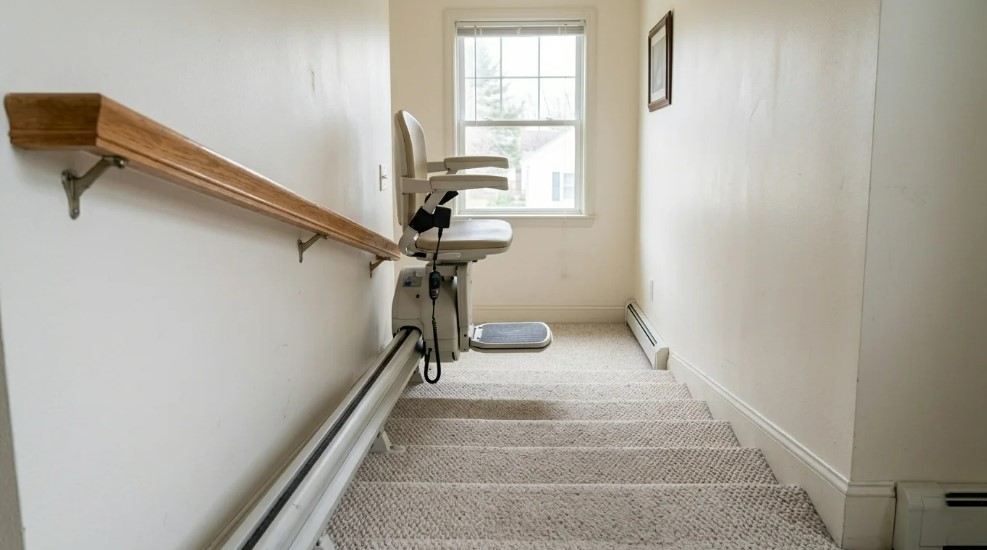
For a complete overview of safer stairs, explore our Complete Stair Safety Guide for Aging in Place .
Can a Stairlift Be Installed on Stairs With a Landing?
Compare a continuous curved stairlift with separate straight lifts, and understand what the landing changes before requesting installation quotes.
Executive Summary
Yes, a stairlift can often be installed on stairs with a landing. An intermediate landing usually calls for a curved rail when the rider needs one continuous journey between flights. Two separate straight lifts may be an alternative on suitable straight flights, but the rider must get off one chair and move to the other at the landing. Bruno identifies this distinction in its installation planning guidance. [1]
A landing at the top of an otherwise straight staircase does not automatically require a curved lift. The important questions are where the landing sits in the route, whether the rail must change direction or slope, and how the intended rider will use the installation.
A staircase with two straight flights can look like a straightforward equipment purchase until the landing enters the conversation. That flat area may connect the flights, provide access to a bedroom, or serve as the point where two chairs would meet.
Choose the journey first: one continuous ride, or two rides with a transfer. Then compare the feasible layouts and their complete installed costs.
1 Which Kind of Landing Does Your Staircase Have?
When contacting a dealer, distinguish the flat space where a flight ends from a landing that interrupts the route to the next floor. Those arrangements lead to different rail questions.
Top or bottom landing
If the staircase is one uninterrupted straight flight, the endpoint landing does not by itself make the route curved. The provider still needs to confirm boarding, seat rotation, and parking space. Stannah describes straight lifts as serving straight flights with suitable landings at their ends. [2]
Quarter landing
The flights meet at a right angle, forming an L-shaped route. A continuous ride needs a rail designed for that change in direction. Stannah includes quarter landings among its curved-stairlift layouts. [2]
Half landing
The next flight reverses direction, creating a U-shaped route. The turn, space between flights, and proposed rail position need to be shown together. Stannah also identifies this layout as a curved application. [2]
Intermediate landing without a sideways turn
Even when both flights point in the same direction, the rail must accommodate the transition from slope to level and back to slope. Ask for a continuous-route design rather than assuming one standard straight rail can span the interruption. Stannah’s rail guidance identifies intermediate landings as likely curved-rail applications. [3]
Useful description for a quote request: “We have two straight flights with a landing between them. The second flight turns left, turns back, or continues in the same direction. We want to know whether one chair can serve the complete route.”
A dealer needs the whole journey, not only the number of steps. Include whether the landing provides access to another room and whether the rider needs to stop there.
2 One Curved Lift vs. Two Straight Lifts
One curved stairlift: a continuous journey
A curved system follows the complete route with one chair. The rider can remain seated while the rail carries the chair between flights. For example, Bruno’s Elite curved model uses a rail made for the particular staircase and offers different parking-position options. [4]
This configuration deserves consideration when avoiding an intermediate chair change is a central requirement. Make sure the quote includes the entire route; a curved-lift label does not establish its start, finish, or intermediate stops.
Two straight stairlifts: a transfer at the landing
Separate lifts can serve the individual straight flights where the layout and user permit. The rider gets off the first chair, moves across the available landing space, and boards the second. Bruno notes that this may be more economical than a continuous curved system, with that transfer as the central tradeoff. [1]
Resolve the transfer before treating this as a budget alternative. Ask where each chair stops, how it rotates, and what space remains between the chairs and any doors. If the rider needs help, include the helper’s position in the discussion.
What does the transfer actually involve?
Have the dealer describe the complete sequence: rotate the first seat into its exit position, stand on the landing, move to the second chair, sit down, and prepare for the next ride. Ask whether the rider’s usual walking aid can be kept within reach without blocking the second chair or a door.
Do not assume that the two seats will align for a direct seated transfer. If standing, turning, walking a short distance, or waiting on the landing is difficult for the intended rider, resolve that requirement before ordering two lifts.
| Decision point | One continuous curved lift | Two separate straight lifts |
|---|---|---|
| Travel between flights | One chair follows the complete designed route. | Two rides, with a chair change between them. |
| Landing space | Confirm the turning rail and chair’s travel envelope. | Confirm both chairs’ stopping positions and transfer space. |
| Budget comparison | Quote the full rail, chair, options, and installation. | Quote both complete units and all required options together. |
| Access to an intermediate room | Ask whether a suitable intermediate stop is included. | Determine whether the transfer arrangement also leaves room access usable. |
| Daily operation | Confirm controls and charging for the single system. | Confirm operation and charging for each unit. |
| Service planning | One system’s written warranty and service terms. | Terms covering both units; ask how visits are billed. |
On smaller screens, swipe horizontally to read the full table.
Neither arrangement wins on price alone. A less expensive pair of lifts is useful only if its transfer is workable for the intended rider. A continuous lift earns its additional cost when the continuous journey addresses a real requirement.
3 What the Site Survey Needs to Establish
The survey should produce a proposed layout that a family can understand. Ask the dealer to show the rail route, chair positions, and remaining circulation space rather than relying on a verbal “it will fit.”
Turning and occupied clearance
The equipment outline is only part of the question. Confirm clearance for the seated rider’s knees and feet through the turn, along with head clearance where the next flight or ceiling projects above. Stannah’s dimensions guidance describes assessing turns, landings, bulkhead clearance, and the overall route during its curved-stair survey. [5]
Doors, handrails, and shared use
Identify doors that open onto the landing and passages used by people walking on the stairs. Request the narrowest remaining passage for the proposed arrangement. Tell the dealer if retaining an existing handrail is a household requirement.
For more detail on shared stair access, see how much stair width remains after stairlift installation. For a nearby doorway, use the stairlift and door clearance guide.
For two lifts, have the drawing show both chairs in the positions used for a transfer. A generous empty landing can become a different space once the chair, footrest, and person are included.
Stopping, parking, and charging positions
A place where the chair can travel is not necessarily an approved place to stop, board, or charge. Ask which positions the exact system supports and whether an intermediate landing stop is included in the order.
Stannah describes alternative curved-rail starts and finishes, including extensions onto a landing or around a corner. Those options depend on the proposed home layout. Ask whether the quoted parking position occupies an area needed for another purpose. [3]
Record three different uses of the same space
Ask the surveyor to show the landing in three conditions: while the occupied chair travels through it, while the rider boards or changes chairs, and while the equipment is parked. A layout can leave a clear passage when folded yet occupy that passage during a transfer.
Request this on the drawing: the narrowest clear passage, each chair’s swivel position, the open footrests, door swings, and any space required by a helper. Label the proposed charging and parking points separately from boarding stops.
How much landing space is enough?
There is no single landing measurement that establishes suitability for every stairlift. A measurement that works for one chair, turn, and user may not apply to another configuration. Request the model-specific requirements and the dealer’s measured clearance for your proposed layout.
Professional input should answer a specific question: The equipment dealer resolves rail geometry and installed clearances. If the two-lift option depends on a transfer the household is unsure about, an occupational therapist can help assess that functional requirement before a purchase decision.
Compare Stairlift Quotes in Your Area
Answer a few quick questions to find stairlift providers serving your area and compare your options.
Thank you!
Your stairlift quote request has been received.
4 Compare Costs After Confirming the Layout
A landing can change the rail route, the number of chairs, and the options needed to board or exit. First establish which arrangements work for the rider and the available space. Then compare complete installed proposals for the same start, destination, and required landing access.
For price ranges, quote examples, and the difference between two straight lifts and one continuous system, read How Much Does a Stairlift Cost for Stairs With a Landing?
- One continuous lift: include the full rail route, every required stop, parking extensions, seating options, and installation.
- Two straight lifts: request one combined total covering both chairs, both rails, and the options needed for the agreed transfer arrangement.
- Related work: identify any outlet, handrail changes, permit, or site preparation and who pays for it.
A cheaper arrangement is useful only when the rider can use it. If a transfer is unsuitable, compare continuous-route proposals that meet the same access requirements.
5 Installation Timing and Ownership Planning
Separate installation day from the complete lead time
Bruno publishes installation-day guidance of approximately 2–4 hours for a straight lift and 4–8 hours for a curved lift. Those figures do not establish the order-to-installation schedule or the duration of a two-unit project. Ask the dealer for the timing of your full installation. [1]
A custom rail adds a design and supply stage. Confirm when the survey occurs, when you approve the final layout, when the order is committed, and when installation can be scheduled. If access is needed by a particular date, raise that requirement before choosing the configuration.
Confirm what must happen first
The provider should identify prerequisites and who handles them. If electrical work is required, obtain a licensed electrician’s scope and price. Where permit or inspection questions apply, clarify who checks with the local authority and who arranges approval.
Ask how long the stairs will be unavailable during work and what access the installers need. Keep the discussion at project scope and household scheduling; the installer should determine the installation method.
Two units mean two sets of equipment to support
Ask whether a service plan covers both chairs and how a visit involving both units is charged. Do not assume maintenance costs simply double, or that one advertised plan automatically covers the entire installation.
For longer-term budgeting, see stairlift maintenance costs. Keep service planning separate from deciding whether the landing layout is workable.
For a curved system, request warranty and labor terms for the actual rail and equipment package. For either arrangement, identify who supplies local service, the basis for travel or call-out charges, and coverage for batteries and other excluded items.
6 Questions to Ask Before Accepting a Quote
Use the following questions to make the proposed journey and installation scope clear on paper.
- Does the quote cover the complete route? Identify the starting floor, landing, final floor, and every required stopping point.
- Can the rider remain seated between flights? If a transfer is required, request the exact chair positions and movement involved.
- Which arrangements are actually feasible? Ask whether one continuous lift and two separate lifts have both been evaluated.
- What is the remaining passage at the landing? Include doors, handrails, parked chairs, and the occupied travel or transfer space.
- Is intermediate room access included? Confirm the supported stop, boarding position, and any additional option.
- Where does each chair park and charge? Establish normal daily positions and the effect on other routes.
- What is the installed cash total? Specify rails, chairs, options, delivery, labor, taxes, and exclusions.
- What related work or approvals are required? Assign responsibility and obtain costs before committing.
- When will the complete system be usable? Include survey, layout approval, equipment supply, and installation.
- What warranty and service terms cover the full proposal? For two units, confirm both are covered.
If the layout changes after the survey, require the revised route and total before approving the order. For a custom rail, also confirm the deposit and cancellation terms and when design changes become chargeable.
7 Frequently Asked Questions
Does every staircase with a landing need a curved stairlift?
No. An endpoint landing on an uninterrupted straight flight does not by itself require one. An intermediate landing usually requires a curved-route system for a continuous ride; separate lifts may be an alternative if the flights, transfer space, and user requirements permit.
Can a straight stairlift rail bend around the landing?
A standard straight rail is not a curved-route solution. Ask the provider for a rail system designed and supported for the full change in direction or slope. Do not plan on adapting a straight rail yourself.
Can the stairlift stop at a room on the intermediate landing?
Ask for that function specifically. Passing the landing does not establish a suitable boarding or exit point there. The dealer must confirm the exact model’s stopping capability, seat position, available space, and quoted scope.
Can a landing stop also be the normal parking position?
Only if the provider confirms it for the proposed system, including its charging arrangement. A programmed stop and a charging or parking location are different questions. Include both in the layout request.
Could we install a lift on one flight now and add the other later?
Ask the dealer what the first phase actually serves and whether it remains compatible with the final plan. A lift on only one flight does not complete access to the next floor. Obtain the future configuration and additional scope before using phasing as a budget strategy.
Should we compare an inside and outside rail route?
Ask whether both are feasible for your staircase. Stannah describes curved installations on either side, subject to the layout. Compare measured clearance, door access, stopping positions, and the quoted total rather than assuming one side is always better. [3]
8 What to Do Next
Identify whether the landing is an endpoint or part of the route between flights. Then ask a stairlift provider for a drawing of the complete proposed journey, with stopping points and available passage marked.
If two straight lifts are proposed, resolve the transfer requirement before comparing their price with a continuous curved system. Choose between configurations that meet the intended rider’s needs, then assess installed scope, timing, and ownership support.
For preliminary budgeting, use the Home Remodeling Cost & Project Planner and select Stairs. A planner estimate does not replace a provider’s site-specific quote.
9 Sources
Manufacturer information supports its own equipment and published guidance. Confirm model-specific dimensions, supported stops, and rail options with the provider for the proposed installation.
- Bruno: Stair Lift CostLanding configurations, continuous curved travel vs. two-lift transfers, quote scope, and installation-day timing.
- Stannah U.S.: Types of StairliftsEndpoint landings, quarter landings, half landings, and rail-type distinctions.
- Stannah U.S.: Stairlift Rail Types and Configuration OptionsIntermediate landings, rail sides, and alternative starts and finishes.
- Bruno: Elite Curved Indoor StairliftSite-specific curved rail and parking-position options.
- Stannah U.S.: Stairlift DimensionsSurvey considerations for turns, landings, occupied space, and head clearance.