
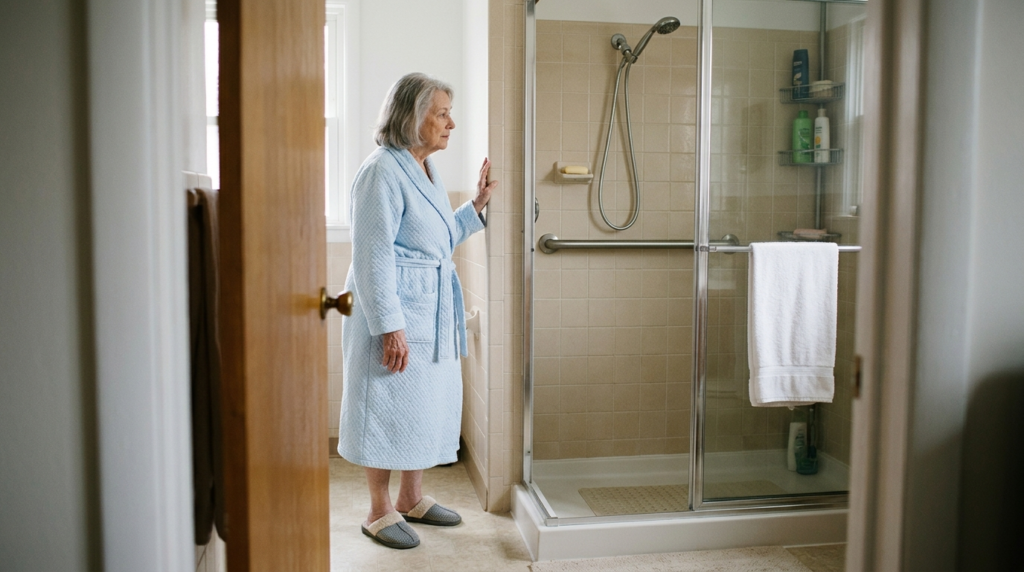
Is It Safe for an Older Adult to Shower Alone?
Executive Summary
Some older adults can shower independently, but the answer depends on safe entry and exit, balance during washing, stamina, judgment, and the ability to get help. A recent fall, new dizziness, confusion, or difficulty transferring calls for reassessment. Begin with the exact step that is difficult; a remodel is not necessarily the first or only solution.
For many families, concern starts with a small observation: a parent grips the shower door when stepping out, skips showers because they are tiring, or asks someone to stay nearby. None of these automatically means independence must end. They do suggest that the bathing routine deserves a closer look.
1Can an Older Adult Safely Shower Alone?
Yes, some older adults can shower alone safely enough to maintain their usual routine. Age by itself does not determine whether supervision is necessary. The more useful question is whether the person can complete the entire process—getting ready, entering, washing, exiting, and recovering from an unexpected problem—without a level of risk that calls for additional support.
Someone who walks comfortably through the house may still struggle to step over a bathtub wall. Another person may use a shower chair successfully but need someone nearby because dizziness occasionally develops after standing. These situations call for different responses.
Safety is not a permanent yes-or-no label. It can change after illness, medication adjustments, surgery, or a fall. A decision that worked six months ago may deserve a fresh look today.
2What Makes Showering Alone More Difficult?
The transition in and out
For many households, the difficult part is not washing. It is shifting weight over a raised edge while the floor is wet and there is little stable support. A person may be able to stand under running water yet hesitate at the threshold, especially when lifting one leg requires balancing on the other.
A low-entry shower may reduce that particular obstacle, but the surrounding floor, door clearance, drainage, and available handholds still matter. A remodel does not automatically resolve a balance problem.
Standing, turning, and reaching
Washing hair can involve closing the eyes and tilting the head. Reaching for soap or turning toward a towel may briefly change balance. When strength or joint movement is limited, these ordinary movements can become the most demanding parts of the routine.
Water, temperature, and visibility
Wet floors, loose mats, glare, poor lighting, and hard-to-read controls add friction to a task that already requires coordination. Water that becomes unexpectedly hot can prompt a quick movement. Good lighting and accessible controls matter as much as the shower’s appearance.
Health and medication changes
Dizziness, faintness, fatigue, pain, reduced sensation, and some medication effects can change the risk. Symptoms deserve medical review rather than being treated solely as a bathroom-design problem. The National Institute on Aging’s room-by-room fall-prevention guidance includes bathroom changes as part of a broader home-safety approach.
3Evaluate the Entire Shower Routine
Rather than asking, “Can you stand in the shower?”, observe or discuss the specific steps that have become difficult. Respect privacy: a conversation and a demonstration of the entry movement while fully dressed may be enough to identify an obstacle. Do not ask someone to attempt a maneuver that already seems unsafe.
Before entering
Can the person gather towels and toiletries without repeated bending or carrying items while using a mobility aid? Is the bathroom warm enough to avoid rushing? Can they identify and adjust the water controls?
At the entrance
Does stepping over the tub wall require holding a towel rail, faucet, or sliding door? Those fixtures are not substitutes for properly installed grab bars. A person who pulls on a door frame to get in is revealing a support need, even if they have not fallen.
During washing
Can they turn, reach, and rinse without losing balance or becoming exhausted? Would sitting allow them to complete the same task with less strain? Consider whether the shower seat fits the enclosure and can be used as intended.
After the water stops
Exiting while tired can be harder than entering. Where is the towel? Is there a dry, clear place to stand or sit while drying and dressing? A plan that ends when the water turns off misses a substantial part of the task.
If something goes wrong
Can the person call for help from inside the bathroom, and can another person actually hear or respond? A phone left in another room is not an emergency plan. An accessible communication device may help, but it does not replace appropriate supervision when a person cannot reliably summon assistance.
4Signs the Current Arrangement Needs Reconsideration
| What you notice | What it may suggest | Reasonable next step |
|---|---|---|
| Holding a towel bar or shower door for balance | Reliable support is missing at a critical movement | Assess entry and exit; consider professionally installed grab bars |
| A recent slip, near-fall, or new fear of bathing | The current routine may have little room for error | Pause unsupervised showering until the concern is assessed |
| Breathlessness or marked exhaustion during bathing | The task may exceed current endurance | Seek medical guidance; assess seated bathing and assistance |
| Confusion about controls or forgetting water is running | Judgment or sequencing may be unreliable | Discuss supervision and clinical evaluation |
| Dizziness or fainting symptoms | A medical issue may be contributing | Seek prompt medical advice; avoid showering alone while unresolved |
| Difficulty lifting a leg over the tub edge | Entry geometry may be the main barrier | Evaluate transfer equipment or a lower-entry configuration |
A single sign does not diagnose a condition. But repeated near-misses, sudden changes, or a need to grab unsuitable fixtures are reasons to act before a serious incident occurs.
5Alone, Nearby, or Hands-On Help: Choosing a Level of Support
Families sometimes frame the choice as complete independence versus someone physically washing the person. There are intermediate arrangements, and the least intrusive option that addresses the actual difficulty may preserve more dignity.
| Arrangement | May fit when | Important limitation |
|---|---|---|
| Showering independently | All steps are manageable, judgment is reliable, and help can be summoned | Reassess after a health or mobility change |
| Someone available in the home | The person manages bathing but wants backup for a possible problem | Being in the house does not guarantee immediate response |
| Standby assistance at entry or exit | The threshold is difficult but washing itself is manageable | The helper needs a safe, agreed role |
| Hands-on bathing assistance | Transfers, balance, cognition, or endurance make independent bathing unreliable | Safe assistance may require caregiver training or professional input |
The level of support should follow function, not age or family preference alone. When a person has new confusion, faints, or cannot transfer safely, simply having someone in the next room may not be adequate.
6Practical Bathroom Changes That Address Specific Problems
Start with the movement that creates the greatest difficulty. Buying several accessories without identifying that movement can leave the main hazard untouched.
When standing is the limiting factor
A properly sized, stable shower chair and a handheld showerhead may reduce prolonged standing and reaching. Check the seat’s compatibility with the shower floor, the user’s needs, its weight rating, and the manufacturer’s instructions. Do not improvise how the chair is positioned or used. Some people need assistance not only while washing but also when sitting down and standing up. A chair is not a substitute for a safe transfer.
When the tub wall is the barrier
A transfer bench may allow a seated movement across a tub edge for some users, provided the layout and the person’s abilities make it suitable. A walk-in shower conversion may address a persistent high threshold, but it introduces design decisions about slope, drainage, splash control, and floor traction.
When support is missing
Grab bars need to be placed for the actual movements and anchored appropriately. A towel rack, suction accessory, or shower door should not be assumed capable of bearing body weight. An occupational therapist or qualified installer can help determine placement and suitability.
When the environment adds avoidable difficulty
Consider non-slip surfaces, uncluttered access, lighting, reachable storage, and easy-to-use water controls. The NIA home fall-prevention checklist provides a useful starting point, though individual needs still require evaluation.
7When Health Changes the Decision
A temporary setback can make independent showering inappropriate even when the bathroom itself has not changed. After hospitalization, surgery, an injury, or an acute illness, a person may have less strength and endurance than they expect. Follow discharge instructions and ask the treating clinician when normal bathing can resume.
New dizziness, fainting, sudden weakness, or confusion should not be explained away as ordinary aging. These symptoms warrant medical assessment, and the person should avoid showering alone while an unresolved symptom could make bathing unsafe. Call emergency services immediately for sudden confusion, weakness or numbness on one side of the body, difficulty speaking, loss of consciousness, or other possible stroke symptoms. Do not delay emergency care to assess the bathroom or arrange equipment.
Medication changes also deserve attention. Some medicines can contribute to sleepiness, dizziness, or changes in blood pressure. A clinician or pharmacist can review the medication list; do not stop prescribed medication based on a home-safety article. The CDC STEADI initiative provides resources on assessing and reducing fall risk in older adults.
For people with memory or judgment difficulties, the question goes beyond physical mobility. Recognizing unsafe water temperature, following the sequence of bathing, and responding appropriately to a problem are relevant abilities. The NIA’s home-safety guidance for Alzheimer’s disease discusses adapting the home when cognitive abilities change.
8Three Realistic Situations
1. Independent walking, difficult bathtub entry
An older adult walks to the kitchen without help but uses the sliding shower door to pull over a high tub wall. Their independence in other rooms does not settle the bathing question. A transfer assessment, a suitable support arrangement, and possibly a different bathing configuration may be more relevant than a general strengthening recommendation.
2. No obvious balance problem, but bathing is exhausting
Someone enters the shower comfortably yet feels depleted before drying off. Shortening the routine, making supplies reachable, and using a seat may help, but persistent or new exhaustion deserves medical discussion. The decision should account for the person’s condition at the end of the shower, not just at the start.
3. Good mobility, unreliable judgment
A person can step into a shower easily but sometimes forgets how to adjust the controls or cannot explain how to call for help. Installing a grab bar will not resolve the primary concern. A clinical evaluation and an agreed level of supervision are more relevant.
Request a Bathroom Quote in Your Area
Answer a few quick questions to request a quote. A bathroom provider serving your area may contact you to discuss your project.
Thank you!
Your bathroom quote request has been received.
If a provider is available for your project and area, they may contact you using the details you supplied.

9When to Consider Professional Evaluation
An occupational therapist can evaluate bathing tasks, transfers, equipment fit, and the match between a person's abilities and the bathroom. This is particularly useful after a fall, hospitalization, or a change in mobility. A healthcare professional should assess dizziness, fainting, unexpected fatigue, or cognitive changes.
A qualified accessibility specialist or home modification contractor can assess structural feasibility, grab-bar anchoring, drainage, and shower layout. A home safety assessor may identify broader access concerns. These professionals have different roles: a contractor evaluates construction, while a clinician evaluates health and function.
Seek an individualized assessment rather than relying on a generic checklist when falls are recurring, assistance is becoming physically difficult, or the household is considering an expensive renovation.
10What to Change First
Prioritize in this order: address urgent medical symptoms or an unsafe transfer first; then establish an appropriate level of assistance; then improve the specific environmental barrier; finally, reassess whether a larger remodel would provide meaningful additional benefit.
For example, a person who becomes dizzy while standing may need a medical review before the family chooses between a shower chair and a curbless shower. A person whose only difficulty is stepping over a tall tub wall may benefit from a transfer assessment before committing to demolition.
When considering a remodel, compare the everyday benefit with the cost, disruption, and whether the change will still work if mobility declines. A lower threshold is helpful only if the overall layout supports safe movement.
11Respecting Privacy Without Ignoring Risk
Resistance to help may reflect a desire for privacy rather than a refusal to acknowledge difficulty. Ask which step feels least secure and what kind of support would be acceptable. Someone may prefer a helper outside the door, assistance only at the threshold, or a familiar caregiver rather than full bathing assistance.
Make the arrangement specific: who will be available, what they will do, how help will be requested, and when the plan will be reviewed. Avoid describing a person as “unsafe” based solely on age. Focus on observable tasks and changes.
Bathroom Modification Planner
The Bathroom Modification Planner helps you record concerns, compare priorities, and prepare questions for contractors.
Get the Bathroom Planner →Digital planning resource; not a substitute for a professional assessment.
12Frequently Asked Questions
Can an older adult shower alone if they use a shower chair?
Possibly. A shower chair may reduce the need to stand while washing, but it does not address every risk. The person still needs to enter and exit the shower, reach supplies and controls, and request help if needed. Seating should be matched to the person's abilities and bathroom layout.
Does having grab bars make showering alone safe?
Not by itself. Properly installed grab bars may provide support during specific movements, but they do not resolve dizziness, confusion, sudden weakness, or difficulty completing the full bathing routine. The location and installation of the bars also matter.
Should someone stay in the bathroom while an older adult showers?
It depends on the person's needs and preferences. Some people may only need someone available nearby, while others require hands-on assistance or supervision. A clinician or occupational therapist can help assess the appropriate level of support when there are concerns.
What are signs an older adult may need help showering?
Warning signs include difficulty stepping into or out of the shower, holding onto unstable fixtures, dizziness, unusual fatigue, repeated near-falls, trouble adjusting the water, or difficulty asking for help. New or worsening symptoms should be discussed with a healthcare professional.
Is a walk-in shower safer than a bathtub for an older adult?
A walk-in shower with a suitable entrance may make access easier for some people, especially when stepping over a high bathtub wall is difficult. Safety still depends on the threshold, flooring, support features, available space, and the person's abilities. A remodel alone cannot eliminate all risks.
What should families do after an older adult falls in the shower?
Check for danger and call emergency services if there are serious symptoms, a suspected head, neck, or back injury, loss of consciousness, or an inability to get up safely. Do not pull or force the person to stand if an injury is suspected; follow emergency dispatcher instructions. Even if the person seems unharmed, report the fall and any new symptoms to a healthcare professional before resuming the usual bathing routine, and reassess the bathroom and assistance needs.
13Sources and Further Guidance
- National Institute on Aging — Preventing Falls at Home: Room by Room
- Centers for Disease Control and Prevention — STEADI
- National Institute on Aging — Home Safety and Alzheimer's Disease
These sources support general fall-prevention and home-safety principles; they do not provide a universal test for deciding whether an individual should shower alone.
Editorial note: Prepared by the AgingAuthority Editorial Team using public guidance from the National Institute on Aging and CDC, with a focus on home safety and practical bathing barriers. This article has not been individually medically reviewed and does not determine whether a particular person can bathe without assistance.
14Final Considerations
Showering alone can remain a reasonable choice for some older adults. The decision depends on how the person manages the entire bathing routine, whether health or cognition has changed, and whether the bathroom supports the movements required.
Watch for specific difficulties rather than waiting for a fall. The most useful solution may be a small equipment change, targeted help during entry and exit, medical evaluation, or a thoughtfully planned remodel. Revisit the arrangement whenever abilities or circumstances change.
This content is for general educational purposes only and does not replace a professional home safety assessment, medical advice, or licensed contractor evaluation.