
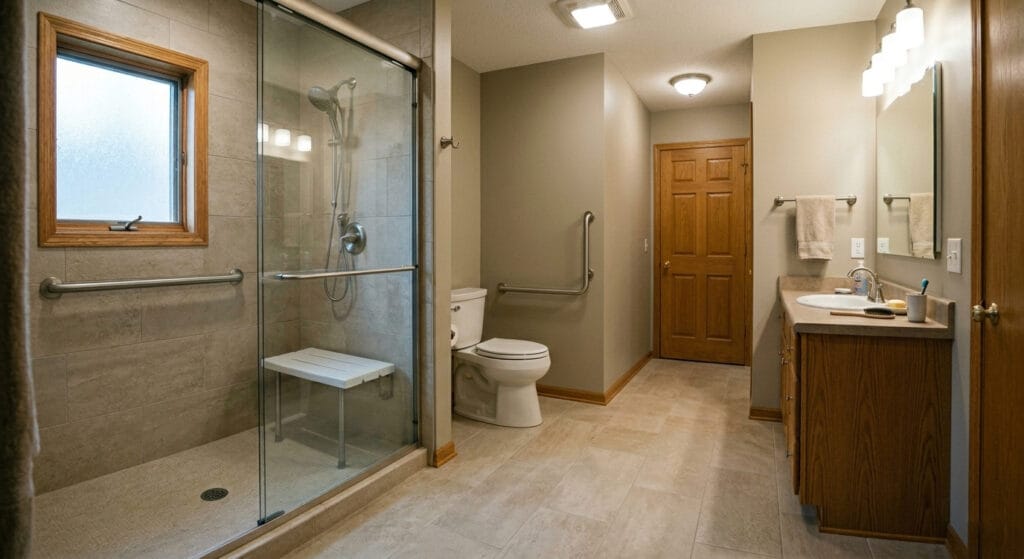
What Bathroom Safety Upgrades Can $5,000 Cover ?
Executive Summary
$5,000 can fund a focused package of bathroom improvements, or potentially a basic tub-to-shower conversion. It should not be assumed to cover a complete accessibility remodel.
Choose the main outcome before selecting finishes. Compare written scopes and separate published price benchmarks from illustrative budget allocations.
A $5,000 bathroom safety budget needs to account for both the equipment you choose and the work required to make it usable. This guide compares installed cost ranges, shows two sample allocations, and explains what to check before accepting a quote.
1What $5,000 Can Realistically Cover
Begin by listing the daily tasks the bathroom needs to support: entering the bathing area, washing while seated, standing up from the toilet, and reaching controls or supplies. Rank the difficulties you want the project to address. This gives each proposed purchase a clear purpose and helps you assess whether the finished bathroom will meet your needs.
The main choice is whether to spread the money across the room or concentrate it on the bathing area. If the current shower works well and the main difficulties involve standing up, reaching controls, or using the sink, several smaller changes may offer better value. If entering the bathtub is the central problem, spending on a new vanity before pricing a bathing solution can leave the most important requirement unresolved.
Treat $5,000 as the total amount available, including installation, applicable taxes, disposal, permits where required, and any reserve you choose to retain. A $5,000 construction proposal is already over budget if those other charges sit outside it. Ask providers to work toward an all-in ceiling, with exclusions clearly identified.
Define a functional requirement
Describe what needs to work better, such as reaching the shower controls from a seated position. Ask the provider to explain how the proposed equipment and its placement address that requirement.
Check shared use
Consider everyone who uses the room. Confirm that seating, support equipment, and storage leave usable space for other household members and for assistance where needed.
For a broader comparison of project types, see our bathroom modifications for aging in place guide. This article focuses on deciding how to use a fixed $5,000 allowance.
2Published Costs: Which Options Fit the Budget?
The benchmarks below are U.S. dollar figures from HomeGuide cost guides reviewed on October 14, 2026. Their underlying articles were published in 2025. These are published planning ranges, not newly collected local quotes or promises that a contractor will accept a particular budget.
| Modification | Published pricing basis | Budget implication |
|---|---|---|
| Grab bars | $100 to $350 per bar, including the bar and installation | Often compatible with a package of smaller changes. Confirm wall support and repair exclusions. |
| Toilet replacement | $350 to $800 for the unit and installation labor | A useful reference for an ordinary replacement, not a guaranteed price for a particular height or specialized model. |
| Tub cut-out | $800 to $1,800 for a tub cut conversion | Can leave money for other changes, subject to tub compatibility and the provider’s complete scope. |
| Tub to prefabricated shower | $1,000 to $8,000, including installation | $5,000 falls inside the range. An actual proposal must establish whether your configuration fits. |
| Tub to custom tiled shower | $3,500 to $15,000 | The lower end overlaps the budget, but allows little room for additions or unexpected work. |
| Standard walk-in tub | $4,000 to $18,000 installed | The lower end overlaps $5,000. Do not assume that equipment pricing covers the finished project. |
On smaller screens, swipe across the table to see all columns.
Sources: grab bar installation, toilet installation, tub-to-shower and cut-out conversions, and walk-in tubs. Each range describes its own scope; adding their lowest figures does not establish a realistic bundled quote.
Use these references to decide what to investigate first. A shower conversion deserves a quotation when the bathing area is the priority. A walk-in tub deserves a complete installed proposal before you commit funds elsewhere. Small equipment purchases should be priced separately from any structural, plumbing, or electrical work they require.
3Targeted Modifications That Preserve Your Bathroom
Grab bars with an appropriate installation scope
Grab bars are a relatively contained purchase when the intended locations can accept the specified mounting arrangement. The important decision is where support is needed and whether the existing wall can provide it. A decorative finish, folding design, difficult surface, or wall repair can change the proposal.
Ask the installer to quote the number of bars, their models, intended positions, attachment requirements, and any surface repairs together. This makes the finished scope visible. A price for attaching one standard bar should not be assumed to include opening and restoring a wall or supplying a specialized support system.
A toilet selected for the intended user
A replacement toilet can be worth considering when the current fixture’s height or shape makes everyday use awkward. Choose by the finished seated height, usable surrounding space, and compatibility with any support equipment. A higher toilet is not automatically a better fit for everyone sharing the room.
Keeping the toilet in its current location can help contain scope. Still, ask the plumber to confirm the existing connection, floor condition, shutoff, removal, and disposal. A new fixture does not create extra transfer space if a nearby cabinet remains in the way. Where individual transfer needs determine the configuration, an occupational therapist can help clarify that specific requirement.
Seating and reachable shower equipment
A suitable shower chair or transfer bench, handheld shower, and reachable supply storage may improve a bathroom without replacing the enclosure. Check the equipment’s dimensions, rated capacity, intended use, and fit within the actual bathing area. A seat that fits the floor plan can still conflict with a door or leave the shower control out of reach.
Distinguish freestanding equipment from wall-mounted seating. A folding seat requires an appropriate supporting structure and qualified installation. Similarly, replacing a showerhead is a different purchasing decision from relocating a concealed valve. Ask for product and installation figures separately so the scope remains clear.
Lighting, controls, and storage
Lighting changes can focus on the tasks that are difficult now, such as seeing at the sink or reaching a switch. Ask an electrician whether the proposed work is a fixture replacement in an existing position or requires new wiring and controls. Do not assume the two scopes have the same labor cost.
Storage improvements should make regularly used items easier to reach without narrowing the route through the room. Keeping a sound vanity and reorganizing nearby storage may preserve funds for bathing changes. Replacing cabinetry makes more sense when the current cabinet itself prevents the access you need.
4Can You Convert a Tub to a Shower for $5,000?
Possibly. HomeGuide’s installed prefabricated conversion range includes $5,000, but that supports investigating the option rather than assuming it will fit your home. A standard-size system using the existing bathing location is a different proposal from a custom shower with a revised floor structure and relocated plumbing.
Request a complete wet-area quotation identifying removal, disposal, base, wall system, waterproofing responsibilities, plumbing, controls, enclosure, and surrounding finish work. Ask which seating and support features are included. If a provider offers an allowance instead of a named component, find out whether your required choice exceeds that allowance.
The actual entry configuration matters more than the label “walk-in.” Ask for the finished threshold, clear opening, and usable internal space. A low-threshold shower and a curbless shower are different configurations. A standard replacement package should not be assumed to provide wheelchair entry or assistance space.
Budget test: If the proposed conversion uses nearly the entire $5,000, determine what remains outside the price before accepting it. Taxes, required permits, repairs, or a separate enclosure can turn an apparently affordable package into an over-budget project.
Where a conversion exceeds the ceiling, ask for a revised scope using different finishes or a simpler enclosure while preserving the required function. If the budget cannot fund the necessary access, keep that requirement visible and reconsider the timing. An inexpensive conversion that leaves the main entry problem unresolved is a poor use of the available money.
A tub cut-out is another option to investigate when retaining the existing tub is acceptable. It reduces part of the tub wall but does not create a flush-floor shower or change the room’s circulation space. Ask the provider about compatibility, the resulting entry, whether soaking can be retained with the selected system, and warranty responsibility.
Request a Bathroom Quote in Your Area
Answer a few quick questions to request a quote. A bathroom provider serving your area may contact you to discuss your project.
Thank you!
Your bathroom quote request has been received.
If a provider is available for your project and area, they may contact you using the details you supplied.

5Two Illustrative Ways to Allocate $5,000
These examples are editorial budget allocations, not contractor quotes, market averages, or verified prices for your area. They show how a household could assign a fixed ceiling before requesting estimates. Replace every allowance with written pricing, and account for taxes and fees within the relevant lines.
| Budget item | Existing-room improvements | Shower-first project |
|---|---|---|
| Main installed work | $800 for grab bars and related mounting work | $3,600 for a complete basic conversion allowance |
| Toilet or shower equipment | $650 for toilet replacement | $300 for separate seating or handheld equipment |
| Additional bathing equipment | $400 for seating and handheld equipment | $400 for separately quoted support features |
| Other selected work | $1,550 for prioritized flooring, lighting, controls, or storage | $0: retain the existing toilet, vanity, and room finishes |
| Unallocated planning reserve | $1,600 | $700 |
| Total ceiling | $5,000 | $5,000 |
In the first example, the homeowner keeps the main fixtures and leaves substantial flexibility because the secondary work has not been priced. The $1,550 line is a combined allowance for selected priorities, not a claim that all listed changes can be completed for that amount. There is no obligation to spend the unused balance.
The second example gives the bathing area priority. It is viable only if an actual complete conversion quote fits the assigned allowance. The equipment and support lines must be removed or reassigned if those items are already included. If the conversion quote arrives at $4,600 before those extras, the example no longer fits the ceiling.
Keep a reserve separate from the contractor's agreed scope. Its size should reflect the work and the uncertainties identified during assessment; the examples do not establish a universal percentage. Unused reserve remains your money. If repairs exceed it, pause discretionary additions and agree on a revised plan before authorizing more work.
6Changes That Can Consume the Budget Quickly
Moving fixtures, widening openings, rebuilding a shower floor, or changing the bathroom layout can make a $5,000 allowance harder to maintain. These changes involve the surrounding construction, not just the visible product. Ask the contractor to explain which parts of the proposal are required by the chosen configuration and which are optional design preferences.
A curbless shower may involve drainage, floor height, waterproofing, and adjacent surfaces. It cannot be priced reliably by subtracting a curb from a standard shower package. A qualified contractor should determine the site requirements; the local permitting authority can answer questions about applicable approvals.
Flooring deserves similar attention. Replacing a finish over a sound substrate differs from correcting damaged flooring or rebuilding transitions. Request a breakdown of removal, preparation, materials, installation, and thresholds. Ask whether the chosen surface is intended for the bathroom conditions and cleaning routine, rather than relying on an unsupported “non-slip” label.
Walk-in tubs can place most or all of the allowance into one purchase. The published installed benchmark begins below $5,000 but extends far above it. Confirm the chosen model, removal, delivery access, plumbing, electrical requirements where applicable, finish work, and service terms in a complete proposal. A unit-only sale price does not resolve those costs.
If several of these major changes are essential, the useful outcome may be a defined first phase. Avoid using the budget on finishes that will be removed during the planned second phase. Discuss the eventual configuration before selecting equipment that might obstruct it.
7How to Keep the Scope Within Your Ceiling
Write a short project brief before contacting providers. State the $5,000 all-in maximum, the task you need to improve, the fixtures you hope to retain, and any features that are essential. Attach clear room photographs and approximate dimensions for initial discussion, while recognizing that a site visit may be needed to establish feasibility.
Ask for a base proposal plus separately priced alternatives. For example, compare two wall finishes within the same shower configuration rather than comparing a basic enclosure with a complete-room remodel. Separating options shows what you can omit without undermining the main purpose.
Preserve functional requirements when reducing cost. A simpler finish may be a reasonable tradeoff. An opening that cannot accommodate the intended user is not an equivalent alternative. The provider should explain how the revised design still supports the required task.
Coordinate work that affects the same surface. If shower walls are being replaced, discuss support locations and seating requirements before the wall system is finalized. If flooring replacement is planned later, confirm how today's fixture choices and transitions relate to it. This is about preventing duplicated work, not performing the installation yourself.
Also ask whether the contractor accepts owner-purchased products. A discounted fixture may shift responsibility for compatibility, delivery, missing parts, or warranty handling to you. Compare the complete arrangement before treating a lower retail price as a project saving.
8Questions to Ask Before Accepting a Quote
- Does this proposal stay within $5,000 after all listed charges? Identify taxes, permits, delivery, disposal, and other separate amounts.
- Which exact products and configurations are included? Request models, dimensions, finishes, and allowances rather than a general “accessible bathroom” description.
- What does the installation price cover? Clarify removal, plumbing, wall support, waterproofing, electrical work where relevant, and surrounding repairs.
- What conditions could change the price? Ask how additional work is documented, priced, and approved before it proceeds.
- Which features are essential, and which can be deferred? Have the provider distinguish functional requirements from optional upgrades.
- Who is responsible for permits and specialist work? Verify the appropriate licensing and insurance for the actual scope in your location.
- How long will the room be unavailable? Discuss the intended schedule and how your household will manage during the work.
- What do the product and workmanship warranties cover? Confirm labor, exclusions, service contacts, and any maintenance conditions in writing.
When comparing proposals, copy the same scope headings into a simple checklist. A lower total can reflect a missing enclosure or excluded repair work rather than a cheaper equivalent project. Ask for clarification before ranking providers by price.
The professional you need depends on the unresolved question. A plumber can assess a fixture replacement or plumbing requirement; an electrician can price wiring and controls; a remodeling contractor can coordinate the overall scope. Individual seating or transfer needs may require functional input beyond an ordinary construction quote.
9Frequently Asked Questions
Do I have to spend the entire $5,000?
No. If smaller modifications address the intended tasks and the room otherwise works well, keep the remaining funds. A budget ceiling is permission to spend up to that amount, not a target that every proposal must reach.
Is financing a way to keep the project under $5,000?
Financing changes payment timing, not the project price. Compare the total amount payable, fees, interest terms, and any conditions attached to promotional offers. Keep the construction price and financing cost separate when deciding whether a proposal fits your limit.
Can a small bathroom cost less to modify?
Less floor area can reduce some material quantities, but limited access or tight fixture spacing can complicate the intended modification. Compare the specific installed scope. The size of the room alone does not establish whether a conversion, toilet change, or access improvement fits $5,000.
What if every suitable quote exceeds the budget?
Request a revised proposal showing the essential first phase and the deferred work. If the essential configuration still exceeds the ceiling, use the quotes to set a realistic funding goal. Avoid accepting an incomplete scope simply because its headline price matches the available money.
10Your Next Step: Price One Clear Bathroom Plan
Send your project brief to providers and request written proposals using the same scope. Record the complete installed total, any exclusions, and the funds left within your $5,000 ceiling. Resolve missing items before choosing a proposal.
Before authorizing work, make sure the agreed products, responsibilities, payment schedule, and process for approving changes are documented. Keep that final scope alongside your budget so you can track what has been agreed throughout the project.
Sources and Pricing Scope
Reviewed October 14, 2026. These U.S. cost references were published in 2025; reviewing them today does not establish that the underlying data was collected in 2026. HomeGuide describes tracking homeowner contractor estimates; its conversion guide specifies 81 reported project costs for its overall conversion summary. Published figures do not replace a local written proposal.
- HomeGuide: Grab Bar Installation CostSeptember 2, 2025. Per-bar equipment and installation benchmark; scope factors.
- HomeGuide: Toilet Installation CostSeptember 22, 2025. Unit and labor benchmark; fixture and site differences.
- HomeGuide: Tub-to-Shower Conversion CostJuly 30, 2025. Prefabricated, custom tiled, and tub cut-out comparisons.
- HomeGuide: Walk-In Tub CostAugust 27, 2025. Equipment-only versus installed pricing.
This article provides general project-planning information. Prices, specifications, and warranty terms can change. Confirm the scope, suitability, and final cost with the relevant provider or qualified professional before committing.