
For a complete overview of safer stairs, explore our Complete Stair Safety Guide for Aging in Place .
Executive Summary
Stair-related risk often develops gradually before any fall occurs. Families may notice slower movement, heavier handrail use, hesitation, fewer trips, or greater need for lighting. These changes can reflect shifts in strength, balance, vision, confidence, or endurance. Recognizing patterns early helps families evaluate stair safety thoughtfully before a near-fall or serious incident forces urgent decisions at home later on unexpectedly.
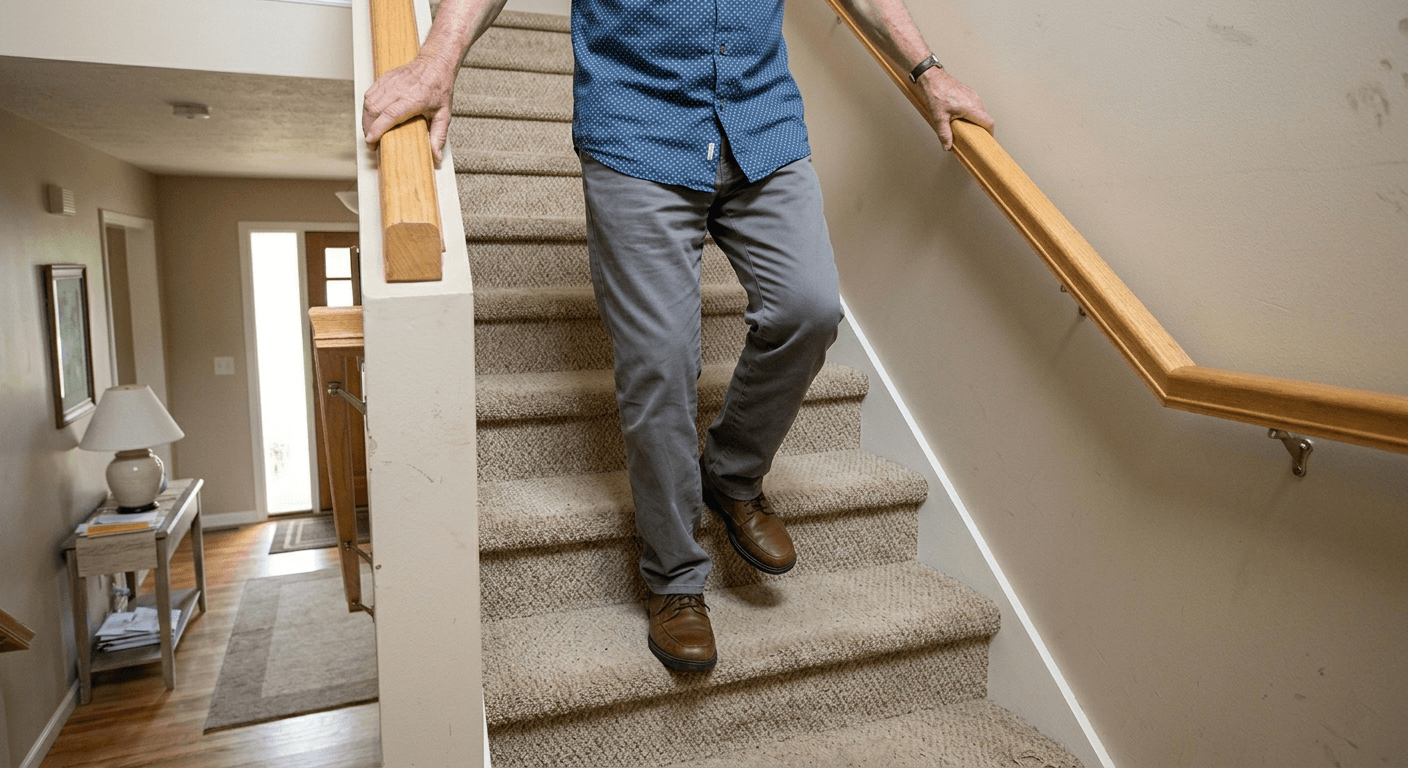
Table of Contents
Use this guide to understand how stair risk can build gradually before a visible fall occurs.
- 01 Why families often miss stair risk
- 02 Why stairs challenge the aging body differently
- 03 Why risk can grow before a fall
- 04 Physical changes that affect stair safety
- 05 Environmental conditions that magnify risk
- 06 Why descending stairs often becomes harder first
- 07 What these changes usually mean
- 08 Practical adjustments that can help reduce stair risk
- 09 When to consider professional evaluation
- 10 Frequently asked questions
1. Introduction
In many homes, the staircase looks exactly the same as it did ten years ago.
The handrails are still attached. The steps have not changed shape. The carpet remains in place. Nothing appears obviously dangerous.
Yet the person using those stairs may have changed significantly.
A homeowner who once walked up and down several times a day without thinking may now move more slowly, use the railing more often, or hesitate before descending. A spouse may notice that laundry stays downstairs longer than it used to. An adult child might observe that basement trips have become less frequent.
These changes rarely happen all at once.
Instead, they tend to appear gradually and blend into everyday life. Because the progression is slow, family members often view each change as normal aging rather than a potential indicator of increasing stair-related risk.
This is usually overlooked.
The reality is that stair safety depends on the interaction between the staircase and the person using it. A staircase that felt easy to navigate at age 55 may place very different demands on the body at age 75.
That does not mean a fall is inevitable.
It does mean that risk can increase long before an accident occurs.
Understanding why this happens is one of the most important parts of aging-in-place planning. For families evaluating a broader home safety plan, the stairway should be considered within the larger context of aging in place and practical home modifications for aging in place, not as an isolated part of the house.
Plan Your Stair Project
Organize stair project priorities and questions before comparing written proposals.
2. Why Stairs Challenge the Aging Body Differently
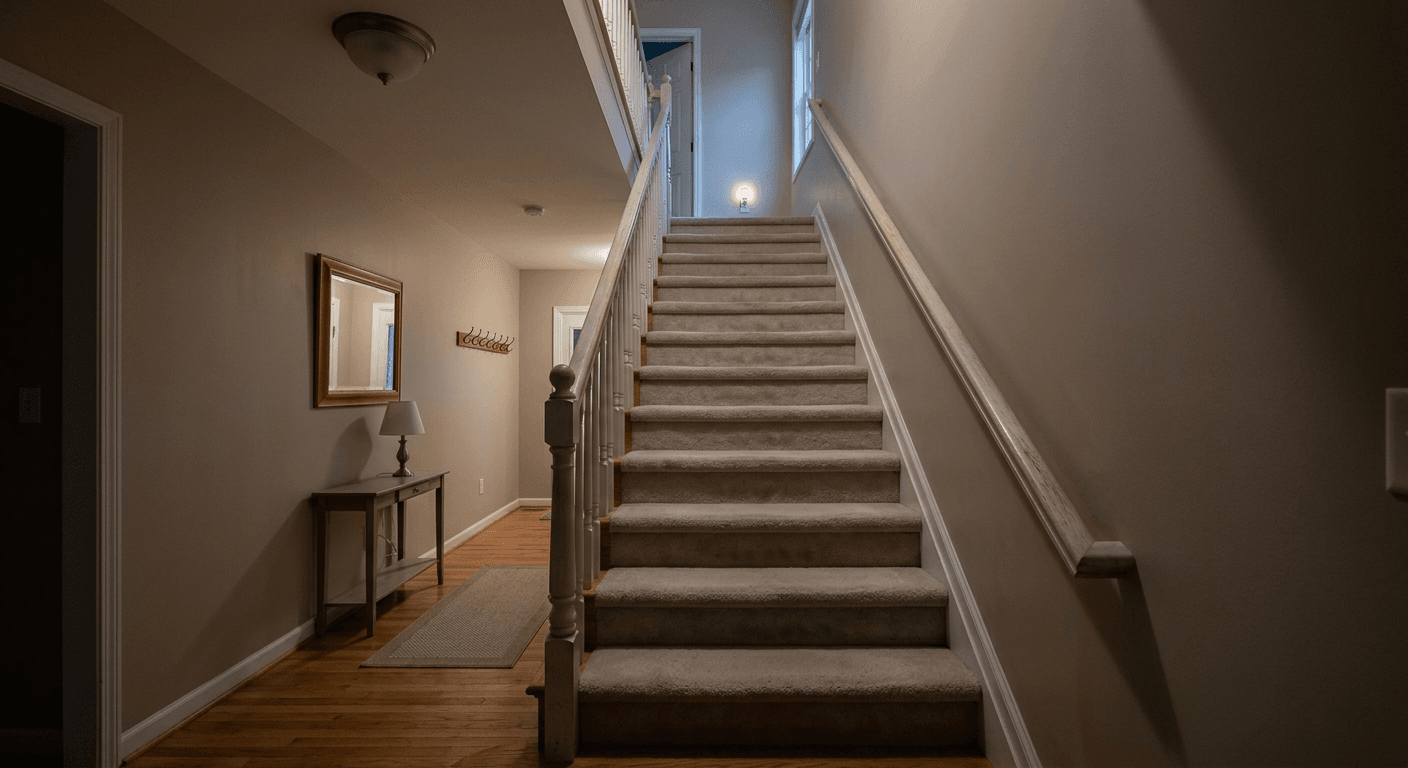
Stairs require a combination of physical and sensory abilities that many people take for granted until changes begin to appear.
Walking across a flat floor is relatively predictable. Stairs are different.
Every step requires lifting the body upward, controlling momentum, judging distance accurately, maintaining balance, and reacting quickly if something unexpected happens.
As people age, several systems involved in stair navigation can change simultaneously.
Balance Becomes Less Automatic
Balance is not a single ability. It depends on communication between vision, muscles, joints, nerves, and the inner ear.
Small declines in any of these systems can affect stability.
On a flat surface, a person may compensate without difficulty. On stairs, those same changes can become much more noticeable.
This is not a minor detail.
A slight loss of balance control can increase the amount of attention required to use stairs safely.
Muscle Strength Gradually Declines
Leg strength plays a major role in stair use.
Climbing stairs requires force generation from the hips, thighs, and calves. Descending requires controlled braking by many of the same muscle groups.
Even modest reductions in strength can make stair navigation more demanding.
People often compensate by moving more slowly or relying more heavily on handrails.
Joint Mobility Changes
Aging can affect flexibility in the ankles, knees, and hips.
Reduced joint mobility may limit how comfortably someone lifts a foot onto the next step or controls movement while descending.
The staircase itself has not changed.
The movement demands have simply become more difficult to meet.
Vision Plays a Larger Role Than Many Realize
Vision helps users identify step edges, judge depth, detect obstacles, and adapt to changing lighting conditions.
Age-related visual changes can make these tasks harder.
In dim lighting, the difference can become even more pronounced.
In poorly lit areas, stair navigation often becomes far more demanding than families realize.
Reaction Time Slows
If a foot slips, catches on a step, or lands unexpectedly, recovery depends on rapid reactions.
Reaction times naturally tend to slow with age.
The change may be small, but stairs provide very little margin for error.
Even if nothing has happened yet, the risk is already increasing.
3. Why Falls Often Happen After Risk Has Been Growing for Months or Years
Many families imagine falls as sudden, unpredictable events.
In reality, a fall is often the final outcome of a long progression.
Long before a fall occurs, people frequently begin adapting their behavior.
They may:
- Hold handrails continuously
- Avoid carrying large objects
- Pause midway on long staircases
- Turn on lights during daytime use
- Use walls for additional support
- Choose routes that avoid stairs entirely
These adjustments can be surprisingly effective.
For a period of time, they may reduce exposure to risk and help maintain independence.
The challenge is that successful compensation can hide growing problems.
Because the person continues using the staircase, family members may assume everything is fine.
At this point, the setup is no longer fully safe.
The adaptations themselves are often evidence that stair navigation has become more difficult.
This is often where warning signs first appear.
Important distinction: A staircase does not need to look broken to become more difficult to use. Risk often increases when the person’s strength, balance, vision, confidence, or endurance no longer matches the demands of the stairway.
4. Reduced Leg Strength and Push-Off Power
One of the earliest physical changes many people experience involves reduced power during stair climbing.
Walking upstairs requires the body to lift its weight repeatedly against gravity.
When strength declines, the movement may begin to look different.
Common observations include:
- Pulling heavily on handrails
- Taking one step at a time
- Moving more slowly
- Pausing during ascent
- Avoiding unnecessary trips
These changes do not automatically indicate a serious problem.
However, they often suggest that stairs are demanding more effort than they once did.
In many homes, family members notice these changes months before recognizing them as safety concerns.
This is usually underestimated.
5. Changes in Balance and Stability
Balance-related changes are often subtle.
A person may not appear unstable while standing still.
The challenge becomes more noticeable during movement.
Stairs introduce constant shifts in body position. Each step requires transferring weight from one leg to the other while moving vertically.
Small balance changes can produce behaviors such as:
- Reaching for walls
- Holding railings continuously
- Taking extra time during turns
- Avoiding conversations while using stairs
These behaviors often reflect an increased need for concentration.
When stair use requires more mental attention, overall risk may increase.
This should be taken seriously.
6. Slower Reaction Time
Most stair users occasionally misjudge a step.
The difference lies in how quickly they recover.
A younger individual may correct the mistake almost instantly.
An older adult may require slightly more time to react.
That small delay can matter.
A staircase provides fewer opportunities to regain control compared with a flat floor.
This is one reason stair-related incidents can occur even when mobility appears generally good.
The issue is not always strength.
Sometimes it is recovery ability.
7. Vision Changes and Depth Perception
Stairs depend heavily on visual information.
Users constantly evaluate:
- Step height
- Step depth
- Edge location
- Surface condition
- Lighting quality
Age-related visual changes can affect all of these tasks.
Contrast sensitivity often declines with age. Shadows may become more difficult to interpret. Step edges may blend into surrounding surfaces.
In older houses, visual challenges can become even more significant.
Dark carpeting, patterned flooring, and inconsistent lighting may make step boundaries harder to identify.
This is often the most overlooked fix.
Simple visual improvements can sometimes make stair use feel more predictable.
8. Fatigue During Stair Use
Endurance is another factor that receives less attention than it deserves.
A staircase that once felt routine may gradually become exhausting.
People often respond by reducing the number of trips they take each day.
Laundry may accumulate.
Storage areas may be used less frequently.
Certain rooms may become less accessible.
This is not simply a lifestyle preference.
It may indicate that stairs are becoming physically demanding.
Fatigue can affect judgment, balance, coordination, and reaction time simultaneously.
This is often where performance begins to decline.
9. Reduced Confidence and Fear of Falling
Confidence influences movement more than many people realize.
When someone becomes concerned about falling, behavior often changes.
They may:
- Look down constantly
- Grip railings tightly
- Move with excessive caution
- Avoid carrying objects
- Delay using stairs
These changes can be protective in some situations.
However, they can also indicate that the individual no longer feels fully comfortable using the staircase.
Confidence changes should not be dismissed.
They frequently appear before physical limitations become obvious.
This is a meaningful warning sign.
10. Environmental Conditions That Magnify Age-Related Changes
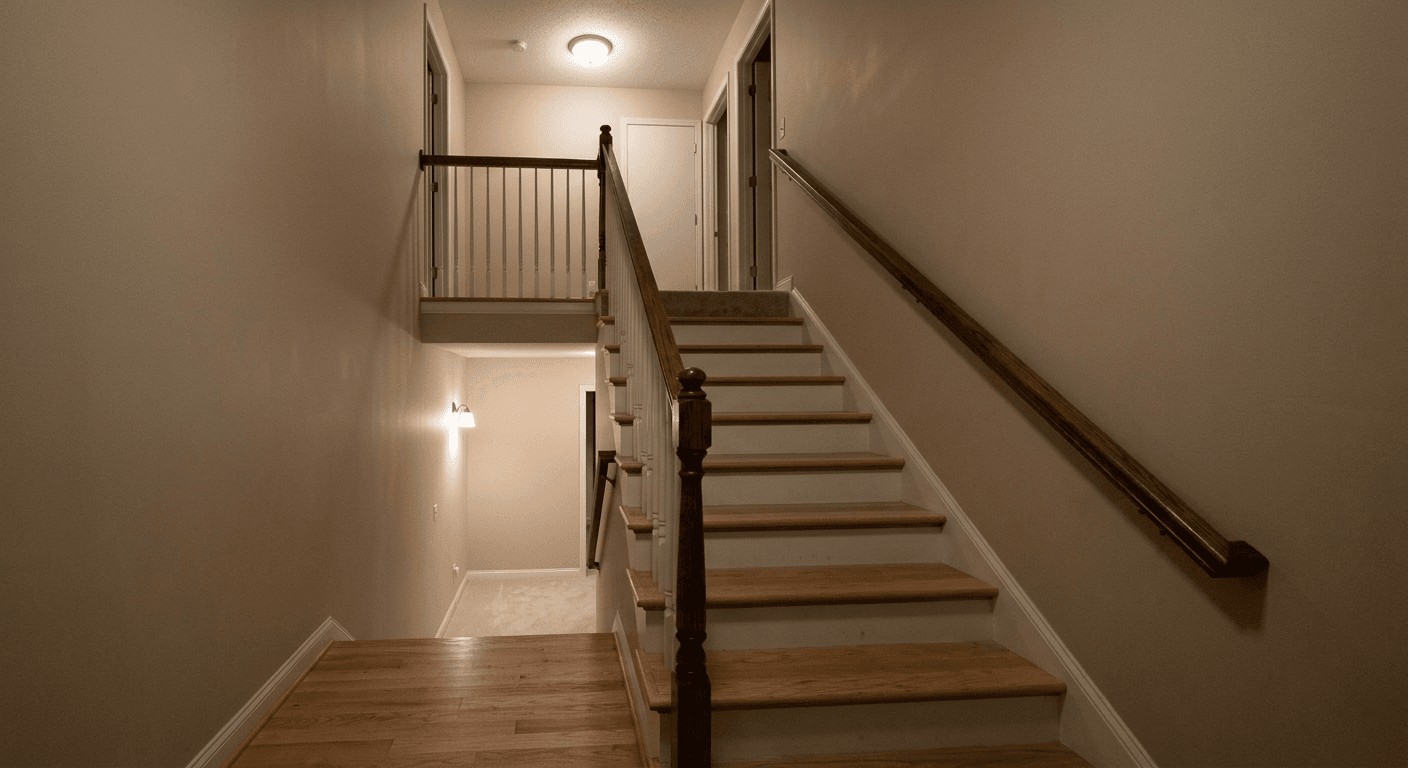
Aging-related changes do not occur in isolation.
The staircase environment can either reduce or magnify their effects.
Common environmental issues include:
Poor Lighting
Lighting affects depth perception, edge detection, and obstacle recognition.
In dim conditions, even healthy individuals may struggle to identify step boundaries.
For older adults, the impact can be much greater.
This should be addressed first.
Inadequate Handrails
Handrails provide support during balance corrections and transitions.
Missing, loose, or poorly positioned handrails reduce available support exactly when it may be needed most.
This has a high impact.
Clutter and Obstacles
Items left on stairs create additional hazards.
Even small objects can become problematic when balance, vision, or reaction time changes are present.
This is not a minor detail.
Footwear and Clothing Choices
Stair safety is not influenced only by the staircase itself. Clothing and footwear can also affect how securely a person moves between floors.
In many homes, older adults use stairs while wearing socks only, particularly on hardwood staircases or smooth finished wood surfaces. While this may feel comfortable and familiar, it can reduce traction compared with properly fitted indoor footwear.
Long robes, loose-fitting garments, and clothing that extends near the feet can also create additional challenges during stair navigation. Fabric that brushes against the feet or hangs near step edges may increase the chance of a misstep, particularly while descending.
This is often overlooked.
These factors may seem minor on their own, but they can become more significant when combined with age-related changes in balance, vision, reaction time, or lower-body strength.
In narrow staircases and multi-level homes, small clothing and footwear issues can magnify existing mobility challenges.
Inconsistent Step Design
In some older homes, stair dimensions may vary slightly.
Even small inconsistencies can increase the likelihood of missteps.
The effect may become more noticeable as physical abilities change.
11. Why Descending Stairs Often Becomes Harder First
Many people assume climbing stairs is the more difficult task.
Surprisingly, descending often becomes challenging sooner.
Going downstairs requires controlled braking.
The body must slow itself during every step.
This places significant demands on the knees, hips, muscles, and balance systems.
Visual judgment also becomes more important.
The user must accurately assess the position of each step while controlling downward movement.
Common observations include:
- Slowing dramatically while descending
- Looking directly at every step
- Holding railings tightly
- Turning sideways occasionally
- Pausing before beginning descent
These behaviors are common because descending offers less room for error.
A misstep while going down can create greater momentum than a similar mistake while climbing.
This is often where families first notice meaningful changes.
12. What These Changes Usually Mean
No single behavior proves that a staircase has become unsafe.
The larger concern is the pattern.
When several changes appear together, they often indicate that stair navigation is requiring more effort, more concentration, or more physical capability than before.
A person who:
- Uses handrails more heavily
- Avoids carrying objects
- Moves more slowly
- Requires brighter lighting
- Avoids unnecessary stair trips
is often adapting to increasing demands.
This is usually not random.
The adaptations themselves provide valuable information.
Even if no fall has occurred, the underlying risk profile may be changing.
This is often where proactive planning becomes important.
Waiting for an accident before evaluating stair safety can mean missing months or years of earlier warning signs.
The goal is not to assume danger exists everywhere.
The goal is to recognize meaningful changes while options remain available. For a wider overview of stair-related risk factors and safety planning, families can also review the main stair safety for seniors guide.

13. Practical Adjustments That Can Help Reduce Stair Risk
Not every situation requires major renovations.
In many homes, practical improvements can help support safer stair use.
Improve Lighting
This should be addressed first.
Adequate lighting improves visibility, depth perception, and obstacle detection.
Pay particular attention to stair landings, top steps, and nighttime pathways.
Consider Motion-Sensor Lighting
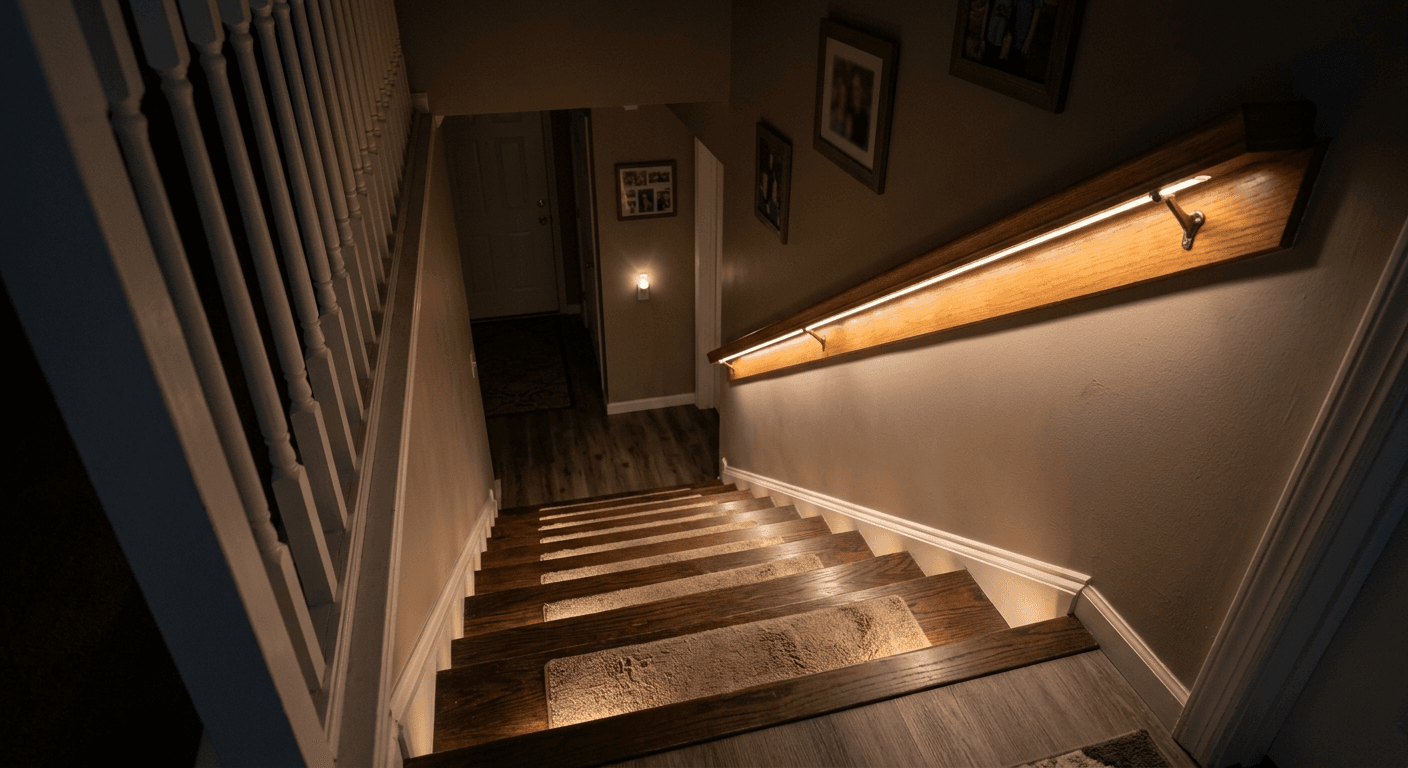
Motion-sensor lights are one of the simplest modern upgrades that can improve stair visibility, particularly during nighttime use.
These systems automatically illuminate the stairway when movement is detected, reducing the need to search for light switches in dark conditions.
In many homes, nighttime trips to bathrooms, bedrooms, or lower levels occur when visibility is at its lowest. Automatic lighting can help make step edges easier to identify and may reduce the likelihood of unexpected visual surprises.
This is often one of the most practical low-cost improvements available.
The effectiveness of motion-sensor lighting depends on placement, brightness levels, and the overall layout of the home, but it can be a useful addition to a broader stair safety strategy.
Ensure Secure Handrails
This has the highest impact.
Handrails should feel sturdy and accessible throughout the staircase.
Continuous support is generally more useful than partial support.
Increase Step Visibility
Contrast markings can help define step edges more clearly.
This may be particularly useful where carpeting or flooring patterns reduce visual distinction.
Remove Clutter
This is often the most overlooked fix.
Clear pathways reduce unnecessary obstacles and allow more predictable movement.
Choose Safer Footwear and Manage Clothing Length
Footwear and clothing choices should be evaluated alongside lighting and handrails, especially when stair use has become slower or more cautious.
Non-slip indoor footwear that fits securely may support better traction than socks on smooth wood stairs. Long robes, loose hems, or wide garments should be considered carefully if they hang near the feet during stair use.
This is a small change, but it can matter in real homes.
Reduce Carrying Demands
Transporting heavy items changes balance and visibility.
Whenever possible, minimizing carrying loads can help reduce demands on the body.
Monitor Behavioral Changes
Pay attention to new habits.
Behavior often reveals emerging challenges before accidents occur.
This is frequently the most valuable source of information.
| Change Observed | What It May Indicate | Why It Matters |
|---|---|---|
| Increased handrail use | Reduced balance or confidence | May indicate growing reliance on support |
| Slower stair use | Reduced strength, endurance, or caution | Suggests stairs require greater effort |
| Avoiding certain trips | Fatigue or fear of falling | Can signal reduced functional comfort |
| Turning on more lights | Visual challenges | May indicate greater dependence on visibility |
| Carrying fewer items | Balance concerns | Reduces stability demands during movement |
| Looking down continuously | Depth perception or confidence changes | May indicate increased concentration needs |
| Pausing before descent | Concern about stair navigation | Often appears before visible mobility issues |
| Using walls for support | Balance changes | Suggests handrails alone may not feel sufficient |
| Prefers socks on stairs or frequently wears loose clothing while using stairs | Reduced traction awareness or increased trip hazards | May increase risk when combined with balance, vision, or mobility changes |
Plan Your Stair Project
Organize stair project priorities and questions before comparing written proposals.
14. When to Consider Professional Evaluation
Professional evaluation may be appropriate when stair-related concerns become persistent or difficult to interpret.
Situations that often justify further assessment include:
- Repeated near-falls
- Significant changes in stair use behavior
- Persistent avoidance of stairs
- Major mobility changes
- New balance difficulties
- Uncertainty about appropriate home modifications
- Ongoing concerns from family members
Depending on the situation, useful professionals may include:
- Home modification contractors
- Occupational therapists
- Accessibility specialists
- Home safety assessors
A professional evaluation can help identify environmental factors, mobility challenges, and modification opportunities that may not be obvious during everyday observation.
The most appropriate approach depends on the individual, the staircase design, and the overall home layout.
15. Future Planning for Multi-Level Homes
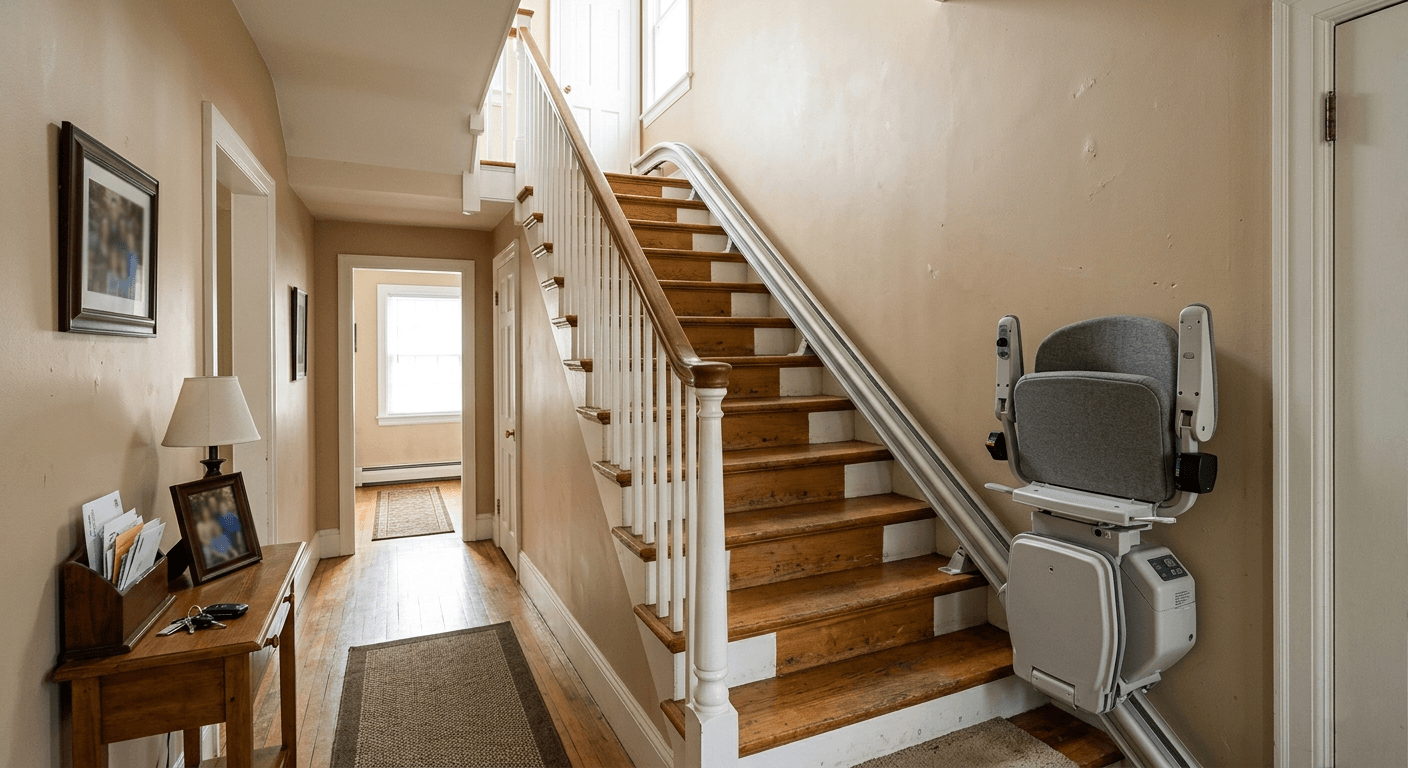
For many families, stair safety eventually becomes part of a broader aging-in-place discussion.
The question is not always whether stairs are currently manageable.
Sometimes the more important question is whether the home will remain practical as needs evolve.
This does not necessarily mean relocating or making major changes immediately.
It simply means evaluating how frequently stairs are used, which activities require access to different floors, and what options may exist if mobility changes continue.
Planning early often provides more flexibility than waiting until a crisis develops.
This is usually easier when decisions are made proactively rather than reactively.
Get a Realistic Stairlift Cost Range Before Comparing Quotes
If the home may eventually need a stairlift, estimate the likely cost based on the staircase type, features, installation needs, and timeline before making a decision.
16. Conclusion
Stairs rarely become dangerous overnight.
In most cases, risk develops gradually as strength, balance, vision, endurance, confidence, reaction time, and environmental conditions change over time.
Long before a fall occurs, many older adults begin adapting their behavior. They move differently, rely more heavily on support, avoid certain activities, or alter how they use the staircase altogether.
These changes deserve attention.
The absence of an accident does not necessarily mean the absence of risk.
Observing gradual behavioral changes can provide valuable insight into how stair use is evolving and whether additional evaluation or practical adjustments may be appropriate.
Recognizing these warning signs early can support better decision-making and help families address concerns before a serious incident occurs.
17. Frequently Asked Questions
Why can stairs become more dangerous with age even before a fall happens?
Stairs can become more difficult before a visible accident occurs because strength, balance, vision, endurance, confidence, and reaction time may change gradually. Many older adults compensate by moving more slowly, using handrails more heavily, or avoiding unnecessary stair trips.
Is heavier handrail use a warning sign?
It can be. Using a handrail is a normal and helpful safety behavior, but a noticeable increase in reliance may indicate that stair use requires more support than before. The pattern matters more than one isolated behavior.
Why is going down stairs often harder for older adults?
Descending stairs requires controlled braking, accurate visual judgment, balance control, and confidence. Because the body is moving downward, a misstep can be harder to recover from than during climbing.
Can motion-sensor lights help with stair safety?
Motion-sensor lights may improve visibility during nighttime stair use by automatically illuminating the stairway. Their usefulness depends on placement, brightness, and the layout of the home.
When should a family consider a professional stair safety evaluation?
A professional evaluation may be appropriate when there are repeated near-falls, persistent stair avoidance, major mobility changes, uncertainty about modifications, or growing family concern about stair use.
Reviewed by AgingAuthority Editorial Team
This article was reviewed by the AgingAuthority Editorial Team using research-informed residential safety analysis and practical aging-in-place editorial standards. Our content is designed to help families understand home safety risks, compare realistic options, and make better-informed decisions.
Learn more about our review standards on the AgingAuthority Editorial Team page.
Executive Summary
Stair-related risk often develops gradually before any fall occurs. Families may notice slower movement, heavier handrail use, hesitation, fewer trips, or greater need for lighting. These changes can reflect shifts in strength, balance, vision, confidence, or endurance. Recognizing patterns early helps families evaluate stair safety thoughtfully before a near-fall or serious incident forces urgent decisions at home later on unexpectedly.
Table of Contents
Use this guide to understand how stair risk can build gradually before a visible fall occurs.
- 01 Why families often miss stair risk
- 02 Why stairs challenge the aging body differently
- 03 Why risk can grow before a fall
- 04 Physical changes that affect stair safety
- 05 Environmental conditions that magnify risk
- 06 Why descending stairs often becomes harder first
- 07 What these changes usually mean
- 08 Practical adjustments that can help reduce stair risk
- 09 When to consider professional evaluation
- 10 Frequently asked questions
1. Introduction
In many homes, the staircase looks exactly the same as it did ten years ago.
The handrails are still attached. The steps have not changed shape. The carpet remains in place. Nothing appears obviously dangerous.
Yet the person using those stairs may have changed significantly.
A homeowner who once walked up and down several times a day without thinking may now move more slowly, use the railing more often, or hesitate before descending. A spouse may notice that laundry stays downstairs longer than it used to. An adult child might observe that basement trips have become less frequent.
These changes rarely happen all at once.
Instead, they tend to appear gradually and blend into everyday life. Because the progression is slow, family members often view each change as normal aging rather than a potential indicator of increasing stair-related risk.
This is usually overlooked.
The reality is that stair safety depends on the interaction between the staircase and the person using it. A staircase that felt easy to navigate at age 55 may place very different demands on the body at age 75.
That does not mean a fall is inevitable.
It does mean that risk can increase long before an accident occurs.
Understanding why this happens is one of the most important parts of aging-in-place planning. For families evaluating a broader home safety plan, the stairway should be considered within the larger context of aging in place and practical home modifications for aging in place, not as an isolated part of the house.
Plan Your Stair Project
Organize stair project priorities and questions before comparing written proposals.
2. Why Stairs Challenge the Aging Body Differently
Stairs require a combination of physical and sensory abilities that many people take for granted until changes begin to appear.
Walking across a flat floor is relatively predictable. Stairs are different.
Every step requires lifting the body upward, controlling momentum, judging distance accurately, maintaining balance, and reacting quickly if something unexpected happens.
As people age, several systems involved in stair navigation can change simultaneously.
Balance Becomes Less Automatic
Balance is not a single ability. It depends on communication between vision, muscles, joints, nerves, and the inner ear.
Small declines in any of these systems can affect stability.
On a flat surface, a person may compensate without difficulty. On stairs, those same changes can become much more noticeable.
This is not a minor detail.
A slight loss of balance control can increase the amount of attention required to use stairs safely.
Muscle Strength Gradually Declines
Leg strength plays a major role in stair use.
Climbing stairs requires force generation from the hips, thighs, and calves. Descending requires controlled braking by many of the same muscle groups.
Even modest reductions in strength can make stair navigation more demanding.
People often compensate by moving more slowly or relying more heavily on handrails.
Joint Mobility Changes
Aging can affect flexibility in the ankles, knees, and hips.
Reduced joint mobility may limit how comfortably someone lifts a foot onto the next step or controls movement while descending.
The staircase itself has not changed.
The movement demands have simply become more difficult to meet.
Vision Plays a Larger Role Than Many Realize
Vision helps users identify step edges, judge depth, detect obstacles, and adapt to changing lighting conditions.
Age-related visual changes can make these tasks harder.
In dim lighting, the difference can become even more pronounced.
In poorly lit areas, stair navigation often becomes far more demanding than families realize.
Reaction Time Slows
If a foot slips, catches on a step, or lands unexpectedly, recovery depends on rapid reactions.
Reaction times naturally tend to slow with age.
The change may be small, but stairs provide very little margin for error.
Even if nothing has happened yet, the risk is already increasing.
3. Why Falls Often Happen After Risk Has Been Growing for Months or Years
Many families imagine falls as sudden, unpredictable events.
In reality, a fall is often the final outcome of a long progression.
Long before a fall occurs, people frequently begin adapting their behavior.
They may:
- Hold handrails continuously
- Avoid carrying large objects
- Pause midway on long staircases
- Turn on lights during daytime use
- Use walls for additional support
- Choose routes that avoid stairs entirely
These adjustments can be surprisingly effective.
For a period of time, they may reduce exposure to risk and help maintain independence.
The challenge is that successful compensation can hide growing problems.
Because the person continues using the staircase, family members may assume everything is fine.
At this point, the setup is no longer fully safe.
The adaptations themselves are often evidence that stair navigation has become more difficult.
This is often where warning signs first appear.
Important distinction: A staircase does not need to look broken to become more difficult to use. Risk often increases when the person’s strength, balance, vision, confidence, or endurance no longer matches the demands of the stairway.
4. Reduced Leg Strength and Push-Off Power
One of the earliest physical changes many people experience involves reduced power during stair climbing.
Walking upstairs requires the body to lift its weight repeatedly against gravity.
When strength declines, the movement may begin to look different.
Common observations include:
- Pulling heavily on handrails
- Taking one step at a time
- Moving more slowly
- Pausing during ascent
- Avoiding unnecessary trips
These changes do not automatically indicate a serious problem.
However, they often suggest that stairs are demanding more effort than they once did.
In many homes, family members notice these changes months before recognizing them as safety concerns.
This is usually underestimated.
5. Changes in Balance and Stability
Balance-related changes are often subtle.
A person may not appear unstable while standing still.
The challenge becomes more noticeable during movement.
Stairs introduce constant shifts in body position. Each step requires transferring weight from one leg to the other while moving vertically.
Small balance changes can produce behaviors such as:
- Reaching for walls
- Holding railings continuously
- Taking extra time during turns
- Avoiding conversations while using stairs
These behaviors often reflect an increased need for concentration.
When stair use requires more mental attention, overall risk may increase.
This should be taken seriously.
6. Slower Reaction Time
Most stair users occasionally misjudge a step.
The difference lies in how quickly they recover.
A younger individual may correct the mistake almost instantly.
An older adult may require slightly more time to react.
That small delay can matter.
A staircase provides fewer opportunities to regain control compared with a flat floor.
This is one reason stair-related incidents can occur even when mobility appears generally good.
The issue is not always strength.
Sometimes it is recovery ability.
7. Vision Changes and Depth Perception
Stairs depend heavily on visual information.
Users constantly evaluate:
- Step height
- Step depth
- Edge location
- Surface condition
- Lighting quality
Age-related visual changes can affect all of these tasks.
Contrast sensitivity often declines with age. Shadows may become more difficult to interpret. Step edges may blend into surrounding surfaces.
In older houses, visual challenges can become even more significant.
Dark carpeting, patterned flooring, and inconsistent lighting may make step boundaries harder to identify.
This is often the most overlooked fix.
Simple visual improvements can sometimes make stair use feel more predictable.
8. Fatigue During Stair Use
Endurance is another factor that receives less attention than it deserves.
A staircase that once felt routine may gradually become exhausting.
People often respond by reducing the number of trips they take each day.
Laundry may accumulate.
Storage areas may be used less frequently.
Certain rooms may become less accessible.
This is not simply a lifestyle preference.
It may indicate that stairs are becoming physically demanding.
Fatigue can affect judgment, balance, coordination, and reaction time simultaneously.
This is often where performance begins to decline.
9. Reduced Confidence and Fear of Falling
Confidence influences movement more than many people realize.
When someone becomes concerned about falling, behavior often changes.
They may:
- Look down constantly
- Grip railings tightly
- Move with excessive caution
- Avoid carrying objects
- Delay using stairs
These changes can be protective in some situations.
However, they can also indicate that the individual no longer feels fully comfortable using the staircase.
Confidence changes should not be dismissed.
They frequently appear before physical limitations become obvious.
This is a meaningful warning sign.
10. Environmental Conditions That Magnify Age-Related Changes
Aging-related changes do not occur in isolation.
The staircase environment can either reduce or magnify their effects.
Common environmental issues include:
Poor Lighting
Lighting affects depth perception, edge detection, and obstacle recognition.
In dim conditions, even healthy individuals may struggle to identify step boundaries.
For older adults, the impact can be much greater.
This should be addressed first.
Inadequate Handrails
Handrails provide support during balance corrections and transitions.
Missing, loose, or poorly positioned handrails reduce available support exactly when it may be needed most.
This has a high impact.
Clutter and Obstacles
Items left on stairs create additional hazards.
Even small objects can become problematic when balance, vision, or reaction time changes are present.
This is not a minor detail.
Footwear and Clothing Choices
Stair safety is not influenced only by the staircase itself. Clothing and footwear can also affect how securely a person moves between floors.
In many homes, older adults use stairs while wearing socks only, particularly on hardwood staircases or smooth finished wood surfaces. While this may feel comfortable and familiar, it can reduce traction compared with properly fitted indoor footwear.
Long robes, loose-fitting garments, and clothing that extends near the feet can also create additional challenges during stair navigation. Fabric that brushes against the feet or hangs near step edges may increase the chance of a misstep, particularly while descending.
This is often overlooked.
These factors may seem minor on their own, but they can become more significant when combined with age-related changes in balance, vision, reaction time, or lower-body strength.
In narrow staircases and multi-level homes, small clothing and footwear issues can magnify existing mobility challenges.
Inconsistent Step Design
In some older homes, stair dimensions may vary slightly.
Even small inconsistencies can increase the likelihood of missteps.
The effect may become more noticeable as physical abilities change.
11. Why Descending Stairs Often Becomes Harder First
Many people assume climbing stairs is the more difficult task.
Surprisingly, descending often becomes challenging sooner.
Going downstairs requires controlled braking.
The body must slow itself during every step.
This places significant demands on the knees, hips, muscles, and balance systems.
Visual judgment also becomes more important.
The user must accurately assess the position of each step while controlling downward movement.
Common observations include:
- Slowing dramatically while descending
- Looking directly at every step
- Holding railings tightly
- Turning sideways occasionally
- Pausing before beginning descent
These behaviors are common because descending offers less room for error.
A misstep while going down can create greater momentum than a similar mistake while climbing.
This is often where families first notice meaningful changes.
12. What These Changes Usually Mean
No single behavior proves that a staircase has become unsafe.
The larger concern is the pattern.
When several changes appear together, they often indicate that stair navigation is requiring more effort, more concentration, or more physical capability than before.
A person who:
- Uses handrails more heavily
- Avoids carrying objects
- Moves more slowly
- Requires brighter lighting
- Avoids unnecessary stair trips
is often adapting to increasing demands.
This is usually not random.
The adaptations themselves provide valuable information.
Even if no fall has occurred, the underlying risk profile may be changing.
This is often where proactive planning becomes important.
Waiting for an accident before evaluating stair safety can mean missing months or years of earlier warning signs.
The goal is not to assume danger exists everywhere.
The goal is to recognize meaningful changes while options remain available. For a wider overview of stair-related risk factors and safety planning, families can also review the main stair safety for seniors guide.
13. Practical Adjustments That Can Help Reduce Stair Risk
Not every situation requires major renovations.
In many homes, practical improvements can help support safer stair use.
Improve Lighting
This should be addressed first.
Adequate lighting improves visibility, depth perception, and obstacle detection.
Pay particular attention to stair landings, top steps, and nighttime pathways.
Consider Motion-Sensor Lighting
Motion-sensor lights are one of the simplest modern upgrades that can improve stair visibility, particularly during nighttime use.
These systems automatically illuminate the stairway when movement is detected, reducing the need to search for light switches in dark conditions.
In many homes, nighttime trips to bathrooms, bedrooms, or lower levels occur when visibility is at its lowest. Automatic lighting can help make step edges easier to identify and may reduce the likelihood of unexpected visual surprises.
This is often one of the most practical low-cost improvements available.
The effectiveness of motion-sensor lighting depends on placement, brightness levels, and the overall layout of the home, but it can be a useful addition to a broader stair safety strategy.
Ensure Secure Handrails
This has the highest impact.
Handrails should feel sturdy and accessible throughout the staircase.
Continuous support is generally more useful than partial support.
Increase Step Visibility
Contrast markings can help define step edges more clearly.
This may be particularly useful where carpeting or flooring patterns reduce visual distinction.
Remove Clutter
This is often the most overlooked fix.
Clear pathways reduce unnecessary obstacles and allow more predictable movement.
Choose Safer Footwear and Manage Clothing Length
Footwear and clothing choices should be evaluated alongside lighting and handrails, especially when stair use has become slower or more cautious.
Non-slip indoor footwear that fits securely may support better traction than socks on smooth wood stairs. Long robes, loose hems, or wide garments should be considered carefully if they hang near the feet during stair use.
This is a small change, but it can matter in real homes.
Reduce Carrying Demands
Transporting heavy items changes balance and visibility.
Whenever possible, minimizing carrying loads can help reduce demands on the body.
Monitor Behavioral Changes
Pay attention to new habits.
Behavior often reveals emerging challenges before accidents occur.
This is frequently the most valuable source of information.
| Change Observed | What It May Indicate | Why It Matters |
|---|---|---|
| Increased handrail use | Reduced balance or confidence | May indicate growing reliance on support |
| Slower stair use | Reduced strength, endurance, or caution | Suggests stairs require greater effort |
| Avoiding certain trips | Fatigue or fear of falling | Can signal reduced functional comfort |
| Turning on more lights | Visual challenges | May indicate greater dependence on visibility |
| Carrying fewer items | Balance concerns | Reduces stability demands during movement |
| Looking down continuously | Depth perception or confidence changes | May indicate increased concentration needs |
| Pausing before descent | Concern about stair navigation | Often appears before visible mobility issues |
| Using walls for support | Balance changes | Suggests handrails alone may not feel sufficient |
| Prefers socks on stairs or frequently wears loose clothing while using stairs | Reduced traction awareness or increased trip hazards | May increase risk when combined with balance, vision, or mobility changes |
Plan Your Stair Project
Organize stair project priorities and questions before comparing written proposals.
14. When to Consider Professional Evaluation
Professional evaluation may be appropriate when stair-related concerns become persistent or difficult to interpret.
Situations that often justify further assessment include:
- Repeated near-falls
- Significant changes in stair use behavior
- Persistent avoidance of stairs
- Major mobility changes
- New balance difficulties
- Uncertainty about appropriate home modifications
- Ongoing concerns from family members
Depending on the situation, useful professionals may include:
- Home modification contractors
- Occupational therapists
- Accessibility specialists
- Home safety assessors
A professional evaluation can help identify environmental factors, mobility challenges, and modification opportunities that may not be obvious during everyday observation.
The most appropriate approach depends on the individual, the staircase design, and the overall home layout.
15. Future Planning for Multi-Level Homes
For many families, stair safety eventually becomes part of a broader aging-in-place discussion.
The question is not always whether stairs are currently manageable.
Sometimes the more important question is whether the home will remain practical as needs evolve.
This does not necessarily mean relocating or making major changes immediately.
It simply means evaluating how frequently stairs are used, which activities require access to different floors, and what options may exist if mobility changes continue.
Planning early often provides more flexibility than waiting until a crisis develops.
This is usually easier when decisions are made proactively rather than reactively.
Get a Realistic Stairlift Cost Range Before Comparing Quotes
If the home may eventually need a stairlift, estimate the likely cost based on the staircase type, features, installation needs, and timeline before making a decision.
16. Conclusion
Stairs rarely become dangerous overnight.
In most cases, risk develops gradually as strength, balance, vision, endurance, confidence, reaction time, and environmental conditions change over time.
Long before a fall occurs, many older adults begin adapting their behavior. They move differently, rely more heavily on support, avoid certain activities, or alter how they use the staircase altogether.
These changes deserve attention.
The absence of an accident does not necessarily mean the absence of risk.
Observing gradual behavioral changes can provide valuable insight into how stair use is evolving and whether additional evaluation or practical adjustments may be appropriate.
Recognizing these warning signs early can support better decision-making and help families address concerns before a serious incident occurs.
17. Frequently Asked Questions
Why can stairs become more dangerous with age even before a fall happens?
Stairs can become more difficult before a visible accident occurs because strength, balance, vision, endurance, confidence, and reaction time may change gradually. Many older adults compensate by moving more slowly, using handrails more heavily, or avoiding unnecessary stair trips.
Is heavier handrail use a warning sign?
It can be. Using a handrail is a normal and helpful safety behavior, but a noticeable increase in reliance may indicate that stair use requires more support than before. The pattern matters more than one isolated behavior.
Why is going down stairs often harder for older adults?
Descending stairs requires controlled braking, accurate visual judgment, balance control, and confidence. Because the body is moving downward, a misstep can be harder to recover from than during climbing.
Can motion-sensor lights help with stair safety?
Motion-sensor lights may improve visibility during nighttime stair use by automatically illuminating the stairway. Their usefulness depends on placement, brightness, and the layout of the home.
When should a family consider a professional stair safety evaluation?
A professional evaluation may be appropriate when there are repeated near-falls, persistent stair avoidance, major mobility changes, uncertainty about modifications, or growing family concern about stair use.
Reviewed by AgingAuthority Editorial Team
This article was reviewed by the AgingAuthority Editorial Team using research-informed residential safety analysis and practical aging-in-place editorial standards. Our content is designed to help families understand home safety risks, compare realistic options, and make better-informed decisions.
Learn more about our review standards on the AgingAuthority Editorial Team page.