Can a Stairlift Be Installed With a Door at the Bottom of the Stairs?
Yes, a bottom doorway can often be accommodated.
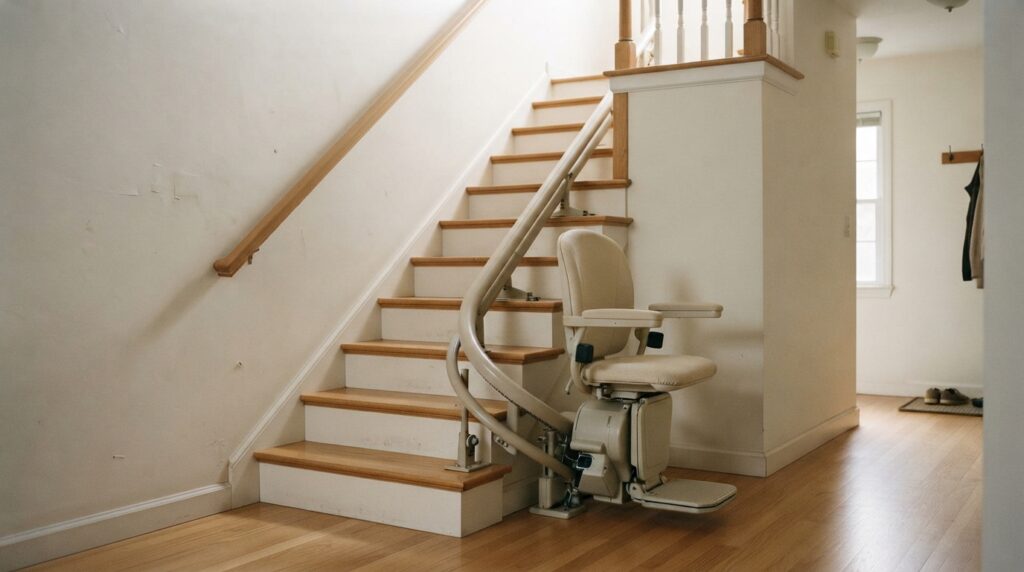
A door at the bottom of the stairs does not automatically rule out a stairlift. The installation needs to account for the door’s opening path, the lower rail, the parked chair, and the space the rider needs to get on and off.
A folding or retractable rail may resolve a track obstruction. It does not, by itself, establish that the chair and doorway will work together. Ask the provider to show the complete proposed layout before you accept a quote.
A doorway beside the lowest step can make an otherwise straightforward stairlift purchase more complicated. You may want to preserve access to a bedroom, bathroom, basement entrance, or hallway while keeping the lift convenient to use.
The useful question is therefore more specific than “Will a stairlift fit?” It is: “Which configuration lets us use the stairlift and this doorway in the way our household needs?”
1. When Can a Stairlift Be Installed With a Bottom Door?
Installation is possible when the proposed system provides enough room for the chair’s travel and boarding position while accommodating the doorway. The answer depends on the relationship between the door and the equipment, rather than the presence of a door alone.
Stannah’s U.S. installation guidance specifically discusses bottom doorways and identifies a retractable rail as an option where the lower track would obstruct access.
Start by separating two situations:
- The door is beside the staircase: the projecting lower rail may cross part of the opening or the door’s swing.
- The door encloses the foot of the staircase: the provider also needs to establish how the rider approaches the chair and moves through the opening.
Those layouts may require different proposals even if the stairs themselves look similar.
The decision to resolve: Can the doorway remain usable with the chair in its intended parking position, and what needs to happen after each trip to restore access?
2. What Does the Doorway Assessment Need to Check?
A photograph of the closed door is a useful starting point, but it does not show the whole configuration. The assessment should consider the space with the door open, the chair ready for boarding, and the lift parked between trips.
The door’s full opening path
A door can clear the track while closed and still contact the equipment as it opens. Ask the provider to account for the door panel and handle throughout the opening movement, rather than measuring only the doorway width.
The rail in both positions
If a moving rail is proposed, the quotation should identify where it sits when extended and where it sits when retracted. “Folding rail included” is less informative than a drawing that shows how the folded section relates to your door.
The chair and boarding space
The folded seat is only one part of the equipment’s footprint. The assessment also needs to consider the carriage, footrest, the rider’s position, and the space needed to approach and leave the chair.
The parking and charging arrangement
Ask where the chair will normally be stored and whether that position supports charging on the quoted model. A proposal should explain how the lift remains available to the rider while the lower doorway is kept clear.
Ask to see more than one position. A parked-chair drawing can look convincing while leaving the boarding arrangement unexplained. Request both views before making a decision.
3. Which Rail Options Are Worth Comparing?
The options below address different types of obstruction. Availability depends on the manufacturer, model, staircase, and local dealer’s offering.
Fixed rail
A fixed rail is worth considering when its lower end and the parked chair remain outside the door’s opening path. A moving section may be unnecessary if the measured layout already provides clearance.
Manual folding rail
A hinged lower section can be moved out of the way manually. The purchase decision should include who will manage it and whether the required movement suits the intended user.
Powered folding rail
A powered mechanism moves the lower rail section. Compare how the specific model coordinates the rail and chair, where the chair must park, and which actions the user still needs to take.
Sliding track
A sliding system moves the track along the staircase instead of lifting a hinged section. It is another option to discuss when a nearby doorway conflicts with a conventional rail end.
Bruno’s stairlift guide lists manual and powered folding rail options for its indoor straight stairlifts. Stannah’s U.S. guide describes an optional retractable rail that raises and lowers automatically as the chair travels.
Savaria’s Handicare 1100 product page identifies a slide-track option for doorways near the top or bottom of the stairs. These are documented examples, rather than a ranking of brands.
| Configuration | What to investigate | Main purchase tradeoff |
|---|---|---|
| Fixed rail | Does the complete equipment footprint clear the door? | No moving rail section, but less flexibility if the lower extension conflicts with access. |
| Manual folding rail | Who folds it, and from what position? | Compare the option price with the physical action it requires. |
| Powered folding rail | How does it clear the doorway, and where does the chair park? | Compare operation, added equipment, and service coverage. |
| Sliding track | What space does the track occupy throughout its movement? | Confirm model availability and the complete moving-track layout. |
| Alternative side or custom rail route | Can another route provide a better boarding or parking position? | Compare the revised equipment scope and price with the original proposal. |
Could installation on the other side solve the problem?
Possibly. Stannah’s installation guidance explains that the staircase layout and obstructions help determine the installation side. Ask the surveyor to compare both sides where feasible, including the upper landing.
A door at the bottom of straight stairs does not automatically mean you need a curved stairlift. If a custom route is proposed, ask what layout constraint makes it preferable to a straight system with a doorway option.
Compare Stairlift Quotes in Your Area
Answer a few quick questions to find stairlift providers serving your area and compare your options.
Thank you!
Your stairlift quote request has been received.
4. Will the Door Need to Be Removed or Changed?
Door removal is not an automatic requirement. First establish whether the equipment configuration can accommodate the existing door.
If it cannot, ask for the proposed door work to be described separately. That could involve reviewing the opening direction, hardware, or a different door arrangement. The stairlift provider should identify the conflict; an appropriate contractor should establish what the building work would involve.
Before agreeing to a change, consider why the door is there. Privacy, room access, and separation between spaces may matter to the household. Where a door has a required building function, ask the relevant contractor or local authority to confirm what changes are permitted.
Keep the scopes visible: Ask for one proposal that preserves the existing door, if feasible, and a separately priced alternative if door work is recommended. That makes the cost and household impact easier to compare.
5. How Does a Bottom Door Affect the Installation Quote?
A doorway can change the quote through an optional rail mechanism, a different rail route, or related door work. It may add no doorway-specific equipment if the standard configuration already fits.
Stannah identifies retractable rails among the nonstandard options that influence the final stairlift price. The manufacturer pages cited here do not establish a universal U.S. installed surcharge for resolving a bottom doorway, so a fixed dollar allowance would be misleading.
Request the doorway solution as a named quote item. If the dealer bundles it into the total, ask for the exact model and feature description in writing.
| Quote item | Why it matters | What to confirm |
|---|---|---|
| Stairlift and base rail | Establishes the equipment being compared. | Model, rail configuration, and installation inclusion. |
| Doorway rail option | May change both the price and everyday operation. | Manual, powered, or sliding system; included or additional. |
| Door modifications | May belong to a separate contractor’s scope. | Exact work, responsible contractor, and separate cost. |
| Parking and charging | The doorway plan must work with equipment storage. | Intended parking location and any electrical work. |
| Warranty and service | The moving rail introduces another component to discuss. | Coverage for the mechanism, labor, and service visits. |
For example, one proposal might include a manual folding rail while another includes a powered system. Those totals represent different equipment and routines. Compare the configuration first, then decide whether the price difference is worthwhile for the intended user.
6. What Should You Ask Before Accepting a Quote?
Use these questions to turn a general assurance into a proposal you can review:
- What exactly conflicts with the door? Ask whether the issue is the rail end, chair, footrest, door swing, or boarding space.
- Can you show the door fully open? Request a measured layout with the relevant equipment positions.
- Why are you recommending this rail option? Ask whether a fixed rail or the opposite installation side was considered.
- What happens after the rider gets off downstairs? Have the provider explain how access through the doorway is restored.
- Does the user need to lift, bend, reach, or operate a separate control? Compare those actions with the intended user’s abilities.
- Where will the chair park and charge? Confirm that the proposed parking arrangement is appropriate for the quoted model.
- Is any door or electrical work excluded? Identify who completes it and whether it must happen before installation.
- How is the moving rail covered? Request written warranty terms and information about service charges.
- Will the handover demonstrate the doorway arrangement? Include the door, parking position, and rail feature in the demonstration.
An authorized dealer can resolve model compatibility and rail layout. A contractor or electrician can clarify related building work. If approaching or leaving the chair is the unresolved issue, an occupational therapist can help define the rider’s functional requirements.
7. Frequently Asked Questions
Will folding the seat keep the doorway clear?
Not necessarily. Folding the seat reduces part of the chair’s footprint, but the carriage and lower rail remain. Ask the provider to show the full folded equipment position beside your door.
Can the door stay open while someone uses the stairlift?
That depends on its opening path and the proposed equipment layout. Have the surveyor assess the door in the position your household intends to use, including during boarding and arrival downstairs.
Can a folding rail be added to an existing stairlift?
Ask the authorized dealer for the existing model. Compatibility, available parts, the current rail, and installation requirements determine whether an upgrade is possible. Do not assume a feature offered on a new system can be added to yours.
Is a manual folding rail suitable for someone who lives alone?
It depends on the required movement and the person’s ability to perform it. Ask for a demonstration of the exact arrangement. A powered option may deserve comparison if managing a manual section would make routine use difficult.
Is there one minimum distance between the door and the bottom step?
No single measurement establishes suitability across all models and layouts. The door’s swing, rail extension, chair position, and boarding space must be assessed together. Request the dimensions for the specific proposal.
Will a folding rail clear the door during a power outage?
Ask the dealer to explain the quoted model’s behavior during an outage, including its moving rail and parking arrangement. Battery-powered chair operation alone does not answer every question about doorway access.
8. What to Do Next
A bottom doorway is a configuration question, not an automatic reason to abandon a stairlift project. The next step is to ask for a proposal that shows the rail, chair, door swing, and boarding area together.
Before the visit, take photos of the lower staircase with the door open and closed. Note which rooms it serves, whether you want it to close between uses, and who will use the lift.
Compare proposals on how the doorway works during ordinary use, the equipment included, and any separate home modifications. That gives you a stronger basis for choosing than a headline stairlift price alone.
9. Sources
The manufacturer resources below support the product features and installation considerations discussed in this guide. Configuration comparisons and quote questions are AgingAuthority’s project-planning interpretation.
- Stannah U.S.: Requirements for Installing a Stairlift Bottom doorways, landing clearance, installation side, and power supply considerations.
- Bruno: Stair Lift Guide Manual and powered folding rail options for indoor straight stairlifts.
- Stannah U.S.: Stairlift Types, Features, and Installation Guide Automatic retractable rail operation and optional features that influence price.
- Savaria: Handicare 1100 Straight Stairlift Published slide-track option for doorways near the staircase.
Scope: This article provides general project-planning information. Prices, specifications, and warranty terms can change. Confirm the scope, suitability, and final cost with the relevant provider or qualified professional before committing.